

215
9
fall resulted in African critique of the EU and USA for subsidizing their own cotton
farmers, and thereby contributing to keep prices as an artificially low level, with serious consequences for a country like Mali.
In addition to reflecting international prices, the annual cotton price in Mali is
set before the agricultural season in negotiations between the CMDT and the cotton
farmers’ union. During the season 2000–2001, the farmers demonstrated that if they
are not happy with the price received from the CMDT, they will rather grow food
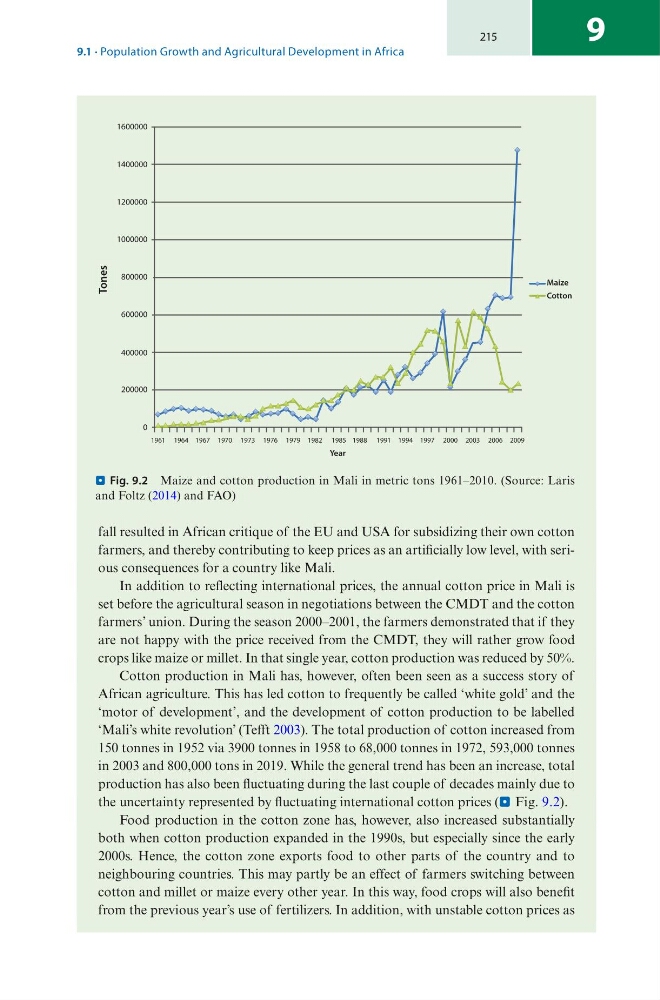
crops like maize or millet. In that single year, cotton production was reduced by 50%.
Cotton production in Mali has, however, often been seen as a success story of
African agriculture. This has led cotton to frequently be called ‘white gold’ and the
‘motor of development’, and the development of cotton production to be labelled
‘Mali’s white revolution’ (Tefft 2003). The total production of cotton increased from
150 tonnes in 1952 via 3900 tonnes in 1958 to 68,000 tonnes in 1972, 593,000 tonnes
in 2003 and 800,000 tons in 2019. While the general trend has been an increase, total
production has also been fluctuating during the last couple of decades mainly due to
the uncertainty represented by fluctuating international cotton prices (. Fig. 9.2).
Food production in the cotton zone has, however, also increased substantially
both when cotton production expanded in the 1990s, but especially since the early
2000s. Hence, the cotton zone exports food to other parts of the country and to
neighbouring countries. This may partly be an effect of farmers switching between
cotton and millet or maize every other year. In this way, food crops will also benefit
from the previous year’s use of fertilizers. In addition, with unstable cotton prices as
1600000
1400000
1200000
1000000
800000
600000
400000
200000
0
1961 1964 1967 1970 1973 1976 1979 1982 1985
1991 1994 1997 2000 2003
2009
2006
1988
Year
Tones
Maize
Cotton
. Fig. 9.2 Maize and cotton production in Mali in metric tons 1961–2010. (Source: Laris
and Foltz (2014) and FAO)
9.1 · Population Growth and Agricultural Development in Africa
9
fall resulted in African critique of the EU and USA for subsidizing their own cotton
farmers, and thereby contributing to keep prices as an artificially low level, with serious consequences for a country like Mali.
In addition to reflecting international prices, the annual cotton price in Mali is
set before the agricultural season in negotiations between the CMDT and the cotton
farmers’ union. During the season 2000–2001, the farmers demonstrated that if they
are not happy with the price received from the CMDT, they will rather grow food
crops like maize or millet. In that single year, cotton production was reduced by 50%.
Cotton production in Mali has, however, often been seen as a success story of
African agriculture. This has led cotton to frequently be called ‘white gold’ and the
‘motor of development’, and the development of cotton production to be labelled
‘Mali’s white revolution’ (Tefft 2003). The total production of cotton increased from
150 tonnes in 1952 via 3900 tonnes in 1958 to 68,000 tonnes in 1972, 593,000 tonnes
in 2003 and 800,000 tons in 2019. While the general trend has been an increase, total
production has also been fluctuating during the last couple of decades mainly due to
the uncertainty represented by fluctuating international cotton prices (. Fig. 9.2).
Food production in the cotton zone has, however, also increased substantially
both when cotton production expanded in the 1990s, but especially since the early
2000s. Hence, the cotton zone exports food to other parts of the country and to
neighbouring countries. This may partly be an effect of farmers switching between
cotton and millet or maize every other year. In this way, food crops will also benefit
from the previous year’s use of fertilizers. In addition, with unstable cotton prices as
1600000
1400000
1200000
1000000
800000
600000
400000
200000
0
1961 1964 1967 1970 1973 1976 1979 1982 1985
1991 1994 1997 2000 2003
2009
2006
1988
Year
Tones
Maize
Cotton
. Fig. 9.2 Maize and cotton production in Mali in metric tons 1961–2010. (Source: Laris
and Foltz (2014) and FAO)
9.1 · Population Growth and Agricultural Development in Africa