

197
8
young men, and in particular pastoralists, have joined various armed groups, and a
large part of the rural population tends to see jihadist rule as a lesser evil than the
corrupt state.
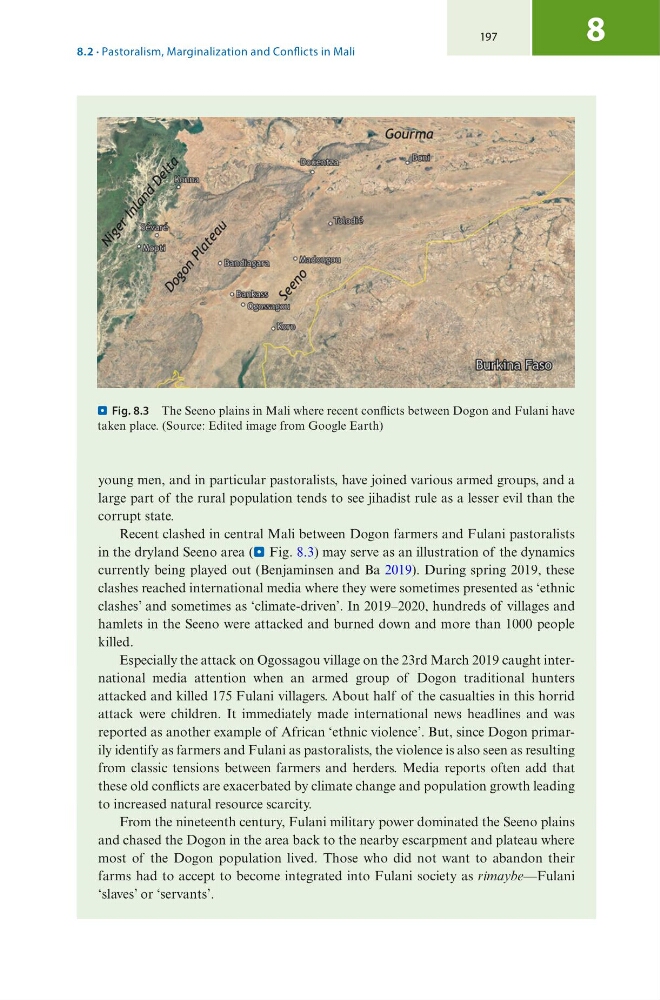
Recent clashed in central Mali between Dogon farmers and Fulani pastoralists
in the dryland Seeno area (. Fig. 8.3) may serve as an illustration of the dynamics
currently being played out (Benjaminsen and Ba 2019). During spring 2019, these
clashes reached international media where they were sometimes presented as ‘ethnic
clashes’ and sometimes as ‘climate-driven’. In 2019–2020, hundreds of villages and
hamlets in the Seeno were attacked and burned down and more than 1000 people
killed.
Especially the attack on Ogossagou village on the 23rd March 2019 caught international media attention when an armed group of Dogon traditional hunters
attacked and killed 175 Fulani villagers. About half of the casualties in this horrid
attack were children. It immediately made international news headlines and was
reported as another example of African ‘ethnic violence’. But, since Dogon primarily identify as farmers and Fulani as pastoralists, the violence is also seen as resulting
from classic tensions between farmers and herders. Media reports often add that
these old conflicts are exacerbated by climate change and population growth leading
to increased natural resource scarcity.
From the nineteenth century, Fulani military power dominated the Seeno plains
and chased the Dogon in the area back to the nearby escarpment and plateau where
most of the Dogon population lived. Those who did not want to abandon their
farms had to accept to become integrated into Fulani society as rimaybe—Fulani
‘slaves’ or ‘servants’.
. Fig. 8.3 The Seeno plains in Mali where recent conflicts between Dogon and Fulani have
taken place. (Source: Edited image from Google Earth)
8.2 · Pastoralism, Marginalization and Conflicts in Mali
8
young men, and in particular pastoralists, have joined various armed groups, and a
large part of the rural population tends to see jihadist rule as a lesser evil than the
corrupt state.
Recent clashed in central Mali between Dogon farmers and Fulani pastoralists
in the dryland Seeno area (. Fig. 8.3) may serve as an illustration of the dynamics
currently being played out (Benjaminsen and Ba 2019). During spring 2019, these
clashes reached international media where they were sometimes presented as ‘ethnic
clashes’ and sometimes as ‘climate-driven’. In 2019–2020, hundreds of villages and
hamlets in the Seeno were attacked and burned down and more than 1000 people
killed.
Especially the attack on Ogossagou village on the 23rd March 2019 caught international media attention when an armed group of Dogon traditional hunters
attacked and killed 175 Fulani villagers. About half of the casualties in this horrid
attack were children. It immediately made international news headlines and was
reported as another example of African ‘ethnic violence’. But, since Dogon primarily identify as farmers and Fulani as pastoralists, the violence is also seen as resulting
from classic tensions between farmers and herders. Media reports often add that
these old conflicts are exacerbated by climate change and population growth leading
to increased natural resource scarcity.
From the nineteenth century, Fulani military power dominated the Seeno plains
and chased the Dogon in the area back to the nearby escarpment and plateau where
most of the Dogon population lived. Those who did not want to abandon their
farms had to accept to become integrated into Fulani society as rimaybe—Fulani
‘slaves’ or ‘servants’.
. Fig. 8.3 The Seeno plains in Mali where recent conflicts between Dogon and Fulani have
taken place. (Source: Edited image from Google Earth)
8.2 · Pastoralism, Marginalization and Conflicts in Mali