

189
8
ghum again were dominant, while maize was almost not planted at all. This shift is
explained by the fact that maize needs more rainfall than millet and sorghum. When
there is enough rainfall, farmers prefer maize because it produces a better crop. But
with less rain, they will with time change to crops that are more drought resistant.
Put differently, it was getting gradually drier in the Sahel from the beginning of the
eighteenth century to around 1850. Thereafter, there was a humid period until about
the turn of the century (Webb 1995).
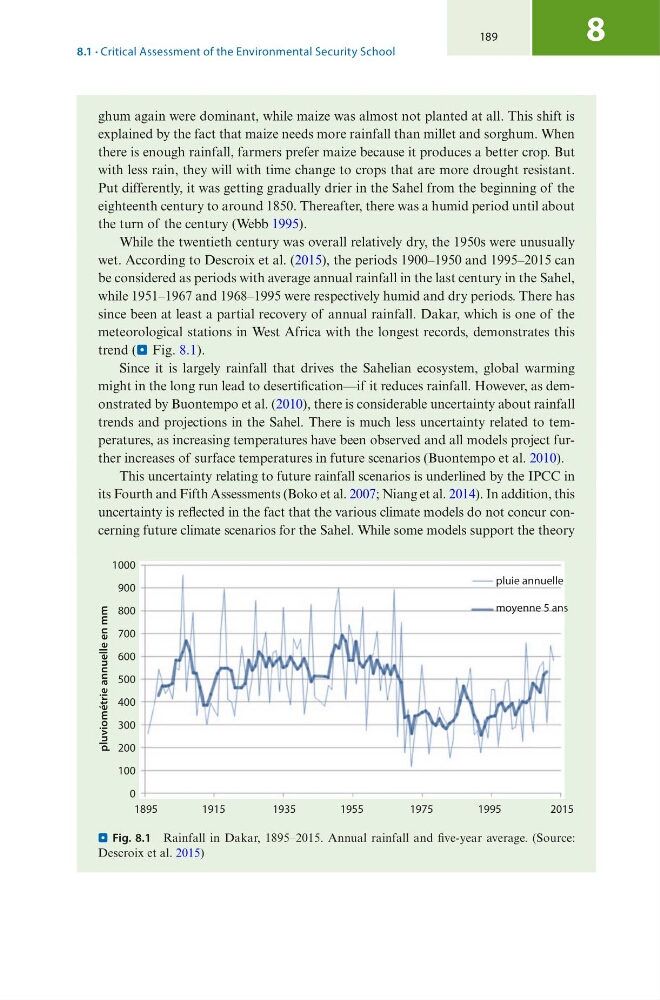
While the twentieth century was overall relatively dry, the 1950s were unusually
wet. According to Descroix et al. (2015), the periods 1900–1950 and 1995–2015 can
be considered as periods with average annual rainfall in the last century in the Sahel,
while 1951–1967 and 1968–1995 were respectively humid and dry periods. There has
since been at least a partial recovery of annual rainfall. Dakar, which is one of the
meteorological stations in West Africa with the longest records, demonstrates this
trend (. Fig. 8.1).
Since it is largely rainfall that drives the Sahelian ecosystem, global warming
might in the long run lead to desertification—if it reduces rainfall. However, as demonstrated by Buontempo et al. (2010), there is considerable uncertainty about rainfall
trends and projections in the Sahel. There is much less uncertainty related to temperatures, as increasing temperatures have been observed and all models project further increases of surface temperatures in future scenarios (Buontempo et al. 2010).
This uncertainty relating to future rainfall scenarios is underlined by the IPCC in
its Fourth and Fifth Assessments (Boko et al. 2007; Niang et al. 2014). In addition, this
uncertainty is reflected in the fact that the various climate models do not concur concerning future climate scenarios for the Sahel. While some models support the theory
1000
900
800
700
600
500
400
300
200
100
0
1895
1915
1935
1955
1975
1995
2015
pluie annuelle
moyenne 5 ans
pluviométrie annuelle en mm
. Fig. 8.1 Rainfall in Dakar, 1895–2015. Annual rainfall and five-year average. (Source:
Descroix et al. 2015)
8.1 · Critical Assessment of the Environmental Security School
8
ghum again were dominant, while maize was almost not planted at all. This shift is
explained by the fact that maize needs more rainfall than millet and sorghum. When
there is enough rainfall, farmers prefer maize because it produces a better crop. But
with less rain, they will with time change to crops that are more drought resistant.
Put differently, it was getting gradually drier in the Sahel from the beginning of the
eighteenth century to around 1850. Thereafter, there was a humid period until about
the turn of the century (Webb 1995).
While the twentieth century was overall relatively dry, the 1950s were unusually
wet. According to Descroix et al. (2015), the periods 1900–1950 and 1995–2015 can
be considered as periods with average annual rainfall in the last century in the Sahel,
while 1951–1967 and 1968–1995 were respectively humid and dry periods. There has
since been at least a partial recovery of annual rainfall. Dakar, which is one of the
meteorological stations in West Africa with the longest records, demonstrates this
trend (. Fig. 8.1).
Since it is largely rainfall that drives the Sahelian ecosystem, global warming
might in the long run lead to desertification—if it reduces rainfall. However, as demonstrated by Buontempo et al. (2010), there is considerable uncertainty about rainfall
trends and projections in the Sahel. There is much less uncertainty related to temperatures, as increasing temperatures have been observed and all models project further increases of surface temperatures in future scenarios (Buontempo et al. 2010).
This uncertainty relating to future rainfall scenarios is underlined by the IPCC in
its Fourth and Fifth Assessments (Boko et al. 2007; Niang et al. 2014). In addition, this
uncertainty is reflected in the fact that the various climate models do not concur concerning future climate scenarios for the Sahel. While some models support the theory
1000
900
800
700
600
500
400
300
200
100
0
1895
1915
1935
1955
1975
1995
2015
pluie annuelle
moyenne 5 ans
pluviométrie annuelle en mm
. Fig. 8.1 Rainfall in Dakar, 1895–2015. Annual rainfall and five-year average. (Source:
Descroix et al. 2015)
8.1 · Critical Assessment of the Environmental Security School