

137
6
ing firewood considered the permit fees too expensive, and they chose instead to
walk longer distances to collect wood elsewhere.
We found that three overlapping groups in particular were adversely affected
by the restrictions on forest use. First, people of the 21 villages living close to the
conserved forests and without alternative forested areas nearby tended to be more
seriously affected than others. Second, villagers with relatively small farms or
without farmland at all were more affected than others. This is because many villagers who lack sufficient farmland depend more on forest resources to sustain a
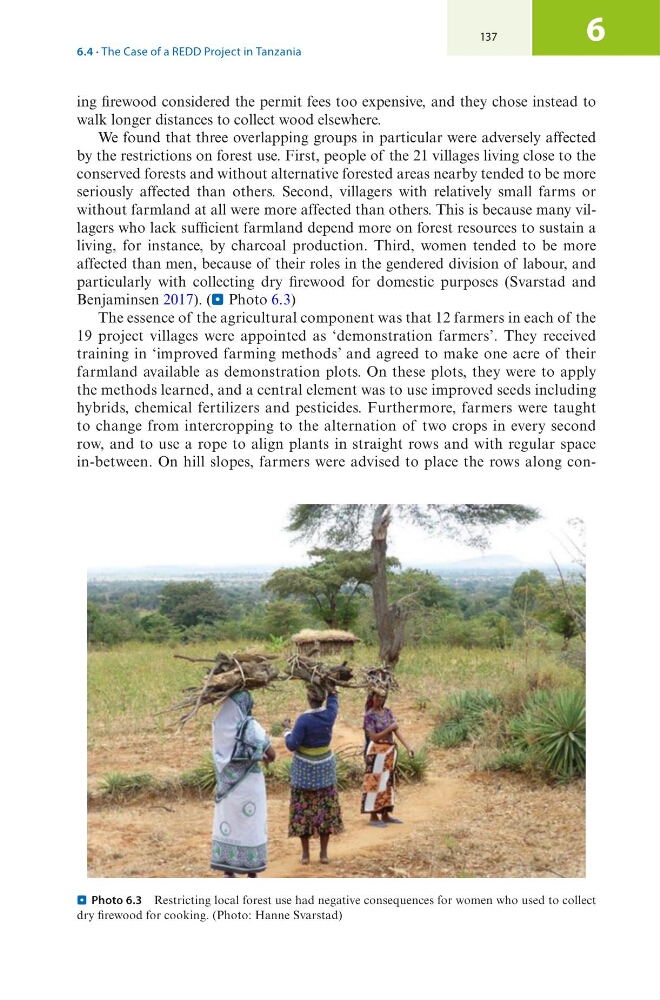
living, for instance, by charcoal production. Third, women tended to be more
affected than men, because of their roles in the gendered division of labour, and
particularly with collecting dry firewood for domestic purposes (Svarstad and
Benjaminsen 2017). (. Photo 6.3)
The essence of the agricultural component was that 12 farmers in each of the
19 project villages were appointed as ‘demonstration farmers’. They received
training in ‘improved farming methods’ and agreed to make one acre of their
farmland available as demonstration plots. On these plots, they were to apply
the methods learned, and a central element was to use improved seeds including
hybrids, chemical fertilizers and pesticides. Furthermore, farmers were taught
to change from intercropping to the alternation of two crops in every second
row, and to use a rope to align plants in straight rows and with regular space
in-between. On hill slopes, farmers were advised to place the rows along con. Photo 6.3 Restricting local forest use had negative consequences for women who used to collect
dry firewood for cooking. (Photo: Hanne Svarstad)
6.4 · The Case of a REDD Project in Tanzania
6
ing firewood considered the permit fees too expensive, and they chose instead to
walk longer distances to collect wood elsewhere.
We found that three overlapping groups in particular were adversely affected
by the restrictions on forest use. First, people of the 21 villages living close to the
conserved forests and without alternative forested areas nearby tended to be more
seriously affected than others. Second, villagers with relatively small farms or
without farmland at all were more affected than others. This is because many villagers who lack sufficient farmland depend more on forest resources to sustain a
living, for instance, by charcoal production. Third, women tended to be more
affected than men, because of their roles in the gendered division of labour, and
particularly with collecting dry firewood for domestic purposes (Svarstad and
Benjaminsen 2017). (. Photo 6.3)
The essence of the agricultural component was that 12 farmers in each of the
19 project villages were appointed as ‘demonstration farmers’. They received
training in ‘improved farming methods’ and agreed to make one acre of their
farmland available as demonstration plots. On these plots, they were to apply
the methods learned, and a central element was to use improved seeds including
hybrids, chemical fertilizers and pesticides. Furthermore, farmers were taught
to change from intercropping to the alternation of two crops in every second
row, and to use a rope to align plants in straight rows and with regular space
in-between. On hill slopes, farmers were advised to place the rows along con. Photo 6.3 Restricting local forest use had negative consequences for women who used to collect
dry firewood for cooking. (Photo: Hanne Svarstad)
6.4 · The Case of a REDD Project in Tanzania