

136
6
told that if their village joined the project, they could expect substantial income in
the future through carbon sales on these markets. For several years, AWF reported
that this element of the project was in progress, but eventually it became clear that
they did not manage to fulfil this promise.
AWF facilitated the establishment of a new organization to manage the forest
with membership from the various villages bordering the two forest reserves. From
each village, four villagers were recruited as forest guards who received uniforms,
some training, and were required to take part in forest patrolling. Villagers caught
for illegal trespassing and activities in the forest were given stiff fines, and some
were jailed. Permits were, however, granted for some resource use such as collection
of dry firewood, but with limitations on when and how often collection could take
place and how much firewood could be collected each time. Many women collect19 REDD villages that border the two forest reserves
Two villages that chose not be part of REDD
Six other REDD villages with village forests
TARANGIRE
NATIONAL
PARK
TANZANIA
0
0
5
5
10Km
ISABE
FOREST
RESERVE
SALANGA
FOREST
RESERVE
10Mi
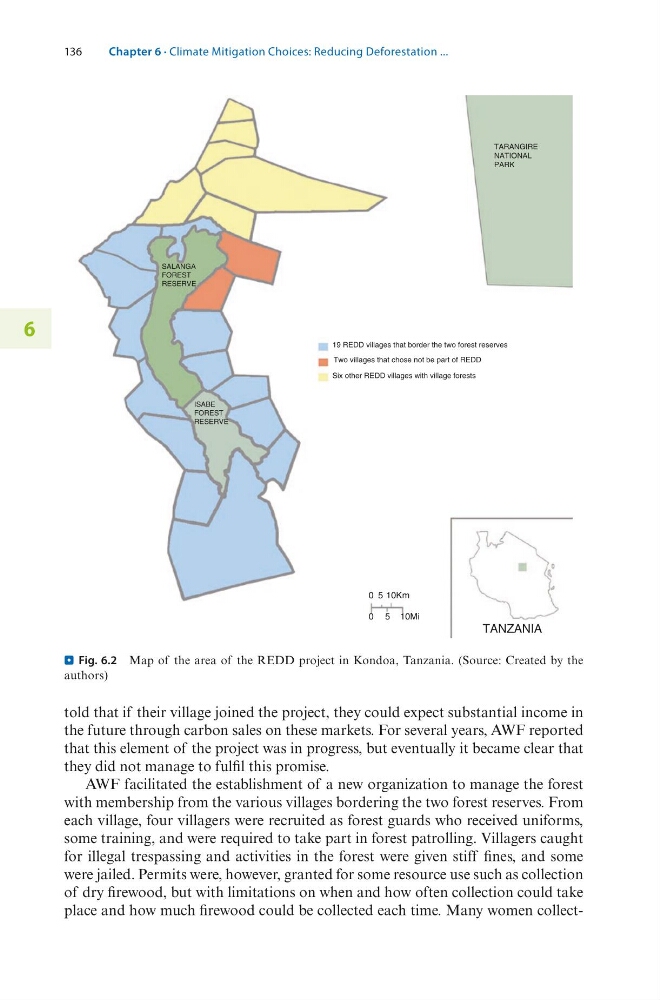
. Fig. 6.2 Map of the area of the REDD project in Kondoa, Tanzania. (Source: Created by the
authors)
Chapter 6 · Climate Mitigation Choices: Reducing Deforestation ...
6
told that if their village joined the project, they could expect substantial income in
the future through carbon sales on these markets. For several years, AWF reported
that this element of the project was in progress, but eventually it became clear that
they did not manage to fulfil this promise.
AWF facilitated the establishment of a new organization to manage the forest
with membership from the various villages bordering the two forest reserves. From
each village, four villagers were recruited as forest guards who received uniforms,
some training, and were required to take part in forest patrolling. Villagers caught
for illegal trespassing and activities in the forest were given stiff fines, and some
were jailed. Permits were, however, granted for some resource use such as collection
of dry firewood, but with limitations on when and how often collection could take
place and how much firewood could be collected each time. Many women collect19 REDD villages that border the two forest reserves
Two villages that chose not be part of REDD
Six other REDD villages with village forests
TARANGIRE
NATIONAL
PARK
TANZANIA
0
0
5
5
10Km
ISABE
FOREST
RESERVE
SALANGA
FOREST
RESERVE
10Mi
. Fig. 6.2 Map of the area of the REDD project in Kondoa, Tanzania. (Source: Created by the
authors)
Chapter 6 · Climate Mitigation Choices: Reducing Deforestation ...