

103
4
Within the tiger reserve, there are several coffee estates that depend on Adivasi
labour. Over 30% of the Adivasi households are employed regularly or seasonally by
these estates. Historically, Adivasi hunted small game and assisted in the hunting of
larger animals such as elephants and tigers by the local maharajas (kings) and also
the British during colonization. The history of the area shows that the landscape has
been used and managed by a number of different actors ranging from the colonial
state, maharajas, commercial coffee planters, temple authorities and Adivasis. This
demonstrates that the area was far from a wilderness landscape that current management strategies strive to recreate.
The Adivasi were shifting cultivators until the area was declared a wildlife sanctuary when they were sedentarized. Prior to the establishment of the sanctuary,
Adivasi used to burn the forest to maintain it as savanna woodland with a grassy
understory. They cleared areas of forest for the cultivation of millet, beans and a
variety of subsistence crops, and they burnt the landscape regularly to maintain an
open forest as this ensured visibility, ease of movement and access to a range of
products such as tubers and grasses.
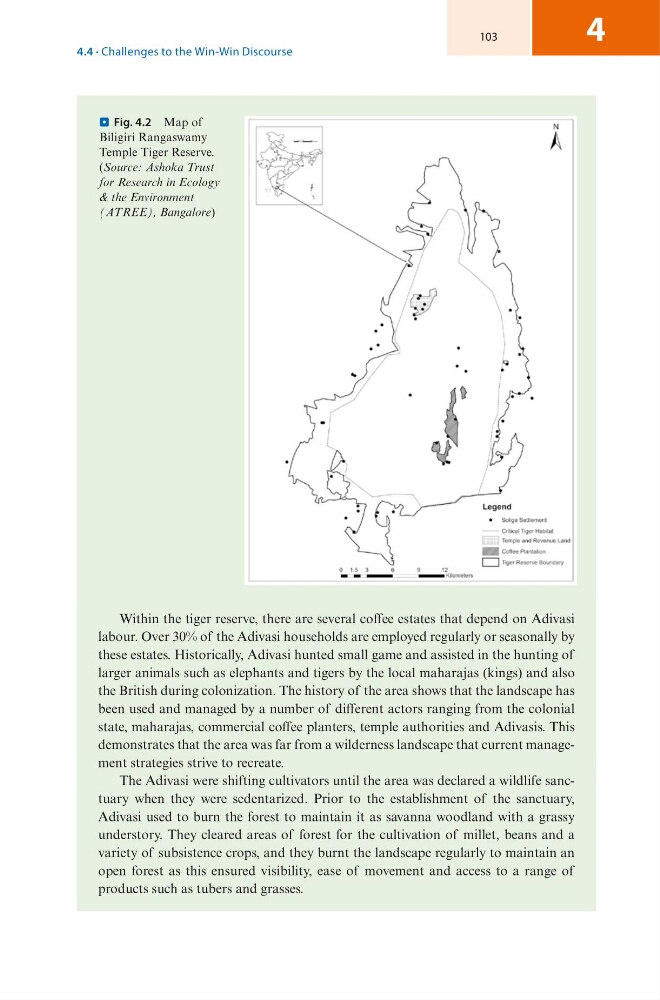
. Fig. 4.2 Map of
Biligiri Rangaswamy
Temple Tiger Reserve.
(Source: Ashoka Trust
for Research in Ecology
& the Environment
(ATREE), Bangalore)
4.4 · Challenges to the Win-Win Discourse
4
Within the tiger reserve, there are several coffee estates that depend on Adivasi
labour. Over 30% of the Adivasi households are employed regularly or seasonally by
these estates. Historically, Adivasi hunted small game and assisted in the hunting of
larger animals such as elephants and tigers by the local maharajas (kings) and also
the British during colonization. The history of the area shows that the landscape has
been used and managed by a number of different actors ranging from the colonial
state, maharajas, commercial coffee planters, temple authorities and Adivasis. This
demonstrates that the area was far from a wilderness landscape that current management strategies strive to recreate.
The Adivasi were shifting cultivators until the area was declared a wildlife sanctuary when they were sedentarized. Prior to the establishment of the sanctuary,
Adivasi used to burn the forest to maintain it as savanna woodland with a grassy
understory. They cleared areas of forest for the cultivation of millet, beans and a
variety of subsistence crops, and they burnt the landscape regularly to maintain an
open forest as this ensured visibility, ease of movement and access to a range of
products such as tubers and grasses.
. Fig. 4.2 Map of
Biligiri Rangaswamy
Temple Tiger Reserve.
(Source: Ashoka Trust
for Research in Ecology
& the Environment
(ATREE), Bangalore)
4.4 · Challenges to the Win-Win Discourse