

63
processing. Leaf and/or image spectra for the pixel containing the plots or sample
locations are then linked with these functional trait measurements to develop the
PLSR algorithm. Typically, for models utilizing imaging spectroscopy data, plotscale estimates of traits are derived using measurements of basal area, leaf area by
species, or other means to produce a weighted average of each trait by dominant
species within given ground area (e.g., McNeil et al. 2008; Singh et al. 2015). The
algorithm is evaluated using internal validation during model development (e.g.,
cross- validation) and/or using a set of training and validation data to build and test
the model predictive capacity across a range of similar samples and optical properties. Some approaches utilize additional steps to characterize the uncertainties associated with the sample collection, measurements, and other issues (e.g., instrument
noise) in the PLSR modeling step. For example, Serbin et al. (2014) and Singh et al.
(2015) introduced a novel PLSR approach that can account for uncertainty in the
prediction of trait values, which has later been used by other groups (Asner et al.
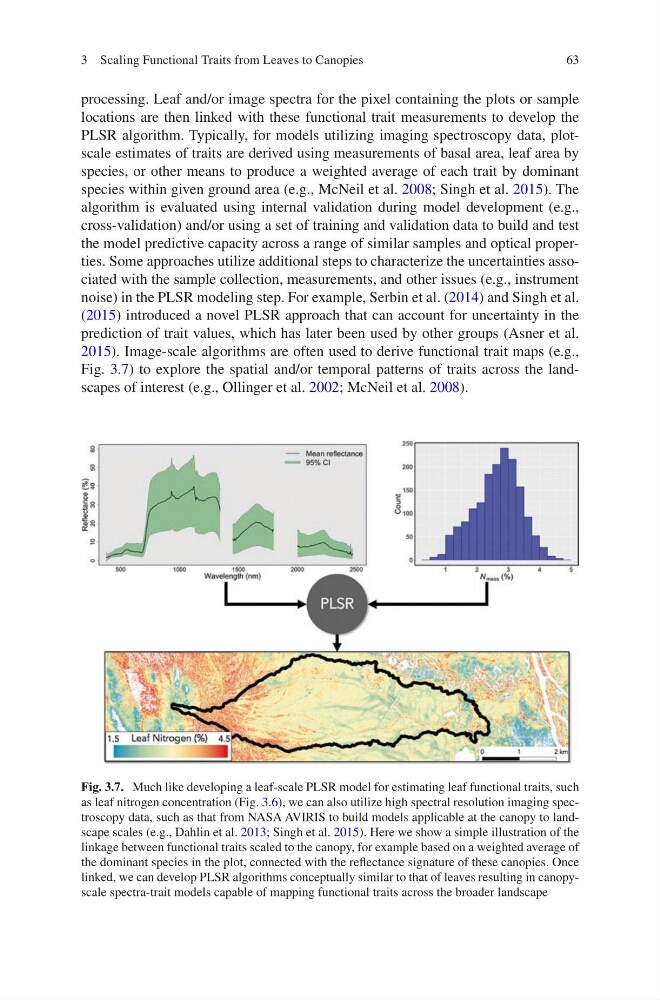
2015). Image- scale algorithms are often used to derive functional trait maps (e.g.,
Fig. 3.7) to explore the spatial and/or temporal patterns of traits across the landscapes of interest (e.g., Ollinger et al. 2002; McNeil et al. 2008).
Fig. 3.7. Much like developing a leaf-scale PLSR model for estimating leaf functional traits, such
as leaf nitrogen concentration (Fig. 3.6), we can also utilize high spectral resolution imaging spectroscopy data, such as that from NASA AVIRIS to build models applicable at the canopy to landscape scales (e.g., Dahlin et al. 2013; Singh et al. 2015). Here we show a simple illustration of the
linkage between functional traits scaled to the canopy, for example based on a weighted average of
the dominant species in the plot, connected with the reflectance signature of these canopies. Once
linked, we can develop PLSR algorithms conceptually similar to that of leaves resulting in canopyscale spectra-trait models capable of mapping functional traits across the broader landscape
3 Scaling Functional Traits from Leaves to Canopies
processing. Leaf and/or image spectra for the pixel containing the plots or sample
locations are then linked with these functional trait measurements to develop the
PLSR algorithm. Typically, for models utilizing imaging spectroscopy data, plotscale estimates of traits are derived using measurements of basal area, leaf area by
species, or other means to produce a weighted average of each trait by dominant
species within given ground area (e.g., McNeil et al. 2008; Singh et al. 2015). The
algorithm is evaluated using internal validation during model development (e.g.,
cross- validation) and/or using a set of training and validation data to build and test
the model predictive capacity across a range of similar samples and optical properties. Some approaches utilize additional steps to characterize the uncertainties associated with the sample collection, measurements, and other issues (e.g., instrument
noise) in the PLSR modeling step. For example, Serbin et al. (2014) and Singh et al.
(2015) introduced a novel PLSR approach that can account for uncertainty in the
prediction of trait values, which has later been used by other groups (Asner et al.
2015). Image- scale algorithms are often used to derive functional trait maps (e.g.,
Fig. 3.7) to explore the spatial and/or temporal patterns of traits across the landscapes of interest (e.g., Ollinger et al. 2002; McNeil et al. 2008).
Fig. 3.7. Much like developing a leaf-scale PLSR model for estimating leaf functional traits, such
as leaf nitrogen concentration (Fig. 3.6), we can also utilize high spectral resolution imaging spectroscopy data, such as that from NASA AVIRIS to build models applicable at the canopy to landscape scales (e.g., Dahlin et al. 2013; Singh et al. 2015). Here we show a simple illustration of the
linkage between functional traits scaled to the canopy, for example based on a weighted average of
the dominant species in the plot, connected with the reflectance signature of these canopies. Once
linked, we can develop PLSR algorithms conceptually similar to that of leaves resulting in canopyscale spectra-trait models capable of mapping functional traits across the broader landscape
3 Scaling Functional Traits from Leaves to Canopies