

62
the number of observations (Geladi and Kowalski 1986; Wold et al. 2001; Carrascal
et al. 2009). This is done through singular value decomposition (SVD), which
reduces the X matrix down to relatively few non-correlated latent components.
While PLSR was originally used in chemometrics, the features and benefits of
PLSR also fit well within the goals of connecting spectral signatures to leaf functional traits. PLSR leverages the fact that different portions of the EM spectrum
change in concert with various nutritional, structural, and morphological properties
of leaves and canopies—in other words, leveraging the known covariance between
variations in leaf optical properties and leaf traits (Ollinger 2011). Importantly,
PLSR also allows for univariate or multivariate modeling where multiple predictands (i.e., Y matrix) can be modeled simultaneously with the same spectral matrix
to account for the covariance between X and Y but also among the various Y
(response) variables (Wold et al. 1984; Geladi and Kowalski 1986; Wold et al.
2001). Wolter et al. (2008) review of the use of PLSR in RS research, and Carrascal
et al. (2009) summarize its use in ecology, as well as key features of PLSR.
Several approaches and implementations of PLSR have been used within the
overarching “plant trait mapping” paradigm, including various spectral transformations and the use of prescreening of wavelengths or down-selection of suitable of
pixels (e.g., Townsend et al. 2003; Feilhauer et al. 2010; Schweiger, Chap. 15; Asner
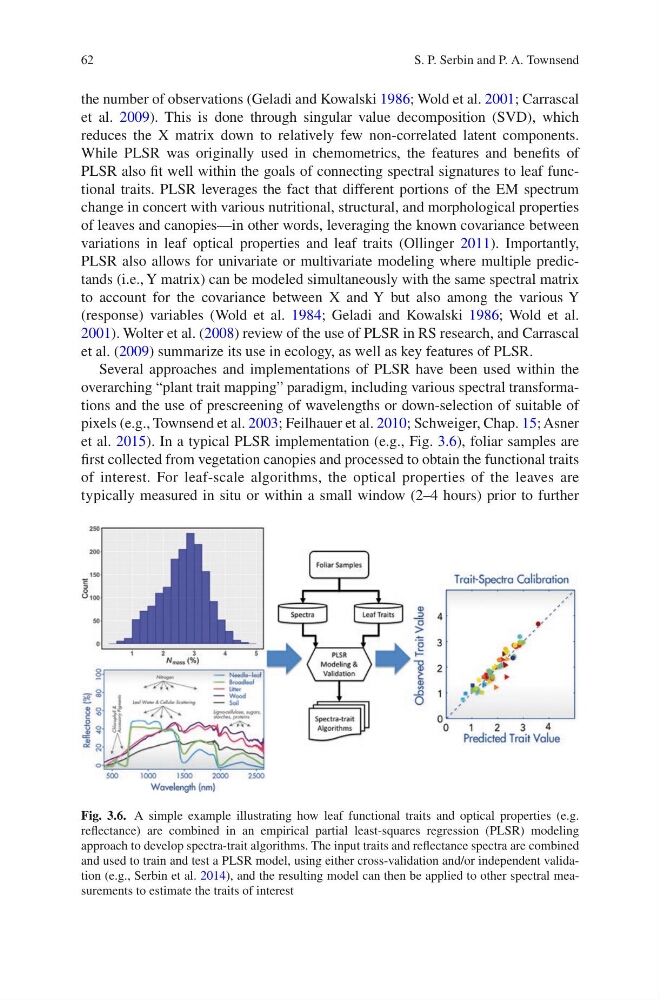
et al. 2015). In a typical PLSR implementation (e.g., Fig. 3.6), foliar samples are
first collected from vegetation canopies and processed to obtain the functional traits
of interest. For leaf-scale algorithms, the optical properties of the leaves are
typically measured in situ or within a small window (2–4 hours) prior to further
Fig. 3.6. A simple example illustrating how leaf functional traits and optical properties (e.g.
reflectance) are combined in an empirical partial least-squares regression (PLSR) modeling
approach to develop spectra-trait algorithms. The input traits and reflectance spectra are combined
and used to train and test a PLSR model, using either cross-validation and/or independent validation (e.g., Serbin et al. 2014), and the resulting model can then be applied to other spectral measurements to estimate the traits of interest
S. P. Serbin and P. A. Townsend
the number of observations (Geladi and Kowalski 1986; Wold et al. 2001; Carrascal
et al. 2009). This is done through singular value decomposition (SVD), which
reduces the X matrix down to relatively few non-correlated latent components.
While PLSR was originally used in chemometrics, the features and benefits of
PLSR also fit well within the goals of connecting spectral signatures to leaf functional traits. PLSR leverages the fact that different portions of the EM spectrum
change in concert with various nutritional, structural, and morphological properties
of leaves and canopies—in other words, leveraging the known covariance between
variations in leaf optical properties and leaf traits (Ollinger 2011). Importantly,
PLSR also allows for univariate or multivariate modeling where multiple predictands (i.e., Y matrix) can be modeled simultaneously with the same spectral matrix
to account for the covariance between X and Y but also among the various Y
(response) variables (Wold et al. 1984; Geladi and Kowalski 1986; Wold et al.
2001). Wolter et al. (2008) review of the use of PLSR in RS research, and Carrascal
et al. (2009) summarize its use in ecology, as well as key features of PLSR.
Several approaches and implementations of PLSR have been used within the
overarching “plant trait mapping” paradigm, including various spectral transformations and the use of prescreening of wavelengths or down-selection of suitable of
pixels (e.g., Townsend et al. 2003; Feilhauer et al. 2010; Schweiger, Chap. 15; Asner
et al. 2015). In a typical PLSR implementation (e.g., Fig. 3.6), foliar samples are
first collected from vegetation canopies and processed to obtain the functional traits
of interest. For leaf-scale algorithms, the optical properties of the leaves are
typically measured in situ or within a small window (2–4 hours) prior to further
Fig. 3.6. A simple example illustrating how leaf functional traits and optical properties (e.g.
reflectance) are combined in an empirical partial least-squares regression (PLSR) modeling
approach to develop spectra-trait algorithms. The input traits and reflectance spectra are combined
and used to train and test a PLSR model, using either cross-validation and/or independent validation (e.g., Serbin et al. 2014), and the resulting model can then be applied to other spectral measurements to estimate the traits of interest
S. P. Serbin and P. A. Townsend