

496
18.4 Seamless Integration of Past Trends to Future Scenarios
Using EBVs
Besides providing spatial interpolation of EBVs, biodiversity models can project
changes in EBVs over time based on the relationship between drivers of biodiversity change and state variables of biodiversity. This means that, when historical data
on drivers is available, past trends for an EBV can be backcast. In other words, a
single snapshot of biodiversity and driver data at a given moment in time can be
used to establish the relationship between driver variables and biodiversity variables
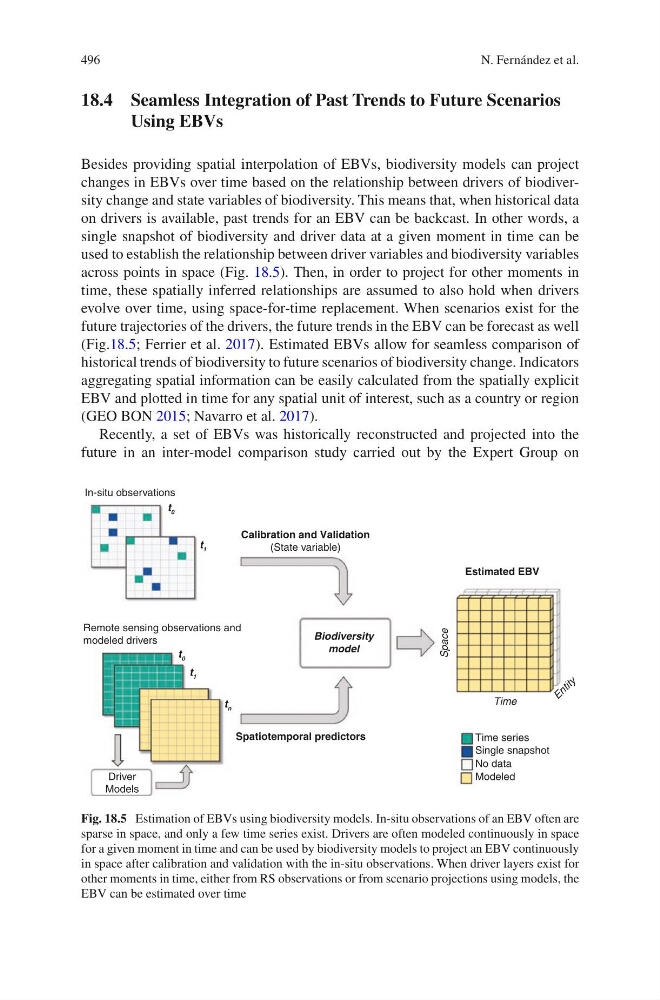
across points in space (Fig. 18.5). Then, in order to project for other moments in
time, these spatially inferred relationships are assumed to also hold when drivers
evolve over time, using space-for-time replacement. When scenarios exist for the
future trajectories of the drivers, the future trends in the EBV can be forecast as well
(Fig.18.5; Ferrier et al. 2017). Estimated EBVs allow for seamless comparison of
historical trends of biodiversity to future scenarios of biodiversity change. Indicators
aggregating spatial information can be easily calculated from the spatially explicit
EBV and plotted in time for any spatial unit of interest, such as a country or region
(GEO BON 2015; Navarro et al. 2017).
Recently, a set of EBVs was historically reconstructed and projected into the
future in an inter-model comparison study carried out by the Expert Group on
In-situ observations
Remote sensing observations and
modeled drivers
Driver
Models
Time series
Time
E n t i t y
Space
Single snapshot
No data
Modeled
Spatiotemporal predictors
Biodiversity
model
t 0
t 0
t 1
t 1
t n
Estimated EBV
Calibration and Validation
(State variable)
Fig. 18.5 Estimation of EBVs using biodiversity models. In-situ observations of an EBV often are
sparse in space, and only a few time series exist. Drivers are often modeled continuously in space
for a given moment in time and can be used by biodiversity models to project an EBV continuously
in space after calibration and validation with the in-situ observations. When driver layers exist for
other moments in time, either from RS observations or from scenario projections using models, the
EBV can be estimated over time
N. Fernández et al.
18.4 Seamless Integration of Past Trends to Future Scenarios
Using EBVs
Besides providing spatial interpolation of EBVs, biodiversity models can project
changes in EBVs over time based on the relationship between drivers of biodiversity change and state variables of biodiversity. This means that, when historical data
on drivers is available, past trends for an EBV can be backcast. In other words, a
single snapshot of biodiversity and driver data at a given moment in time can be
used to establish the relationship between driver variables and biodiversity variables
across points in space (Fig. 18.5). Then, in order to project for other moments in
time, these spatially inferred relationships are assumed to also hold when drivers
evolve over time, using space-for-time replacement. When scenarios exist for the
future trajectories of the drivers, the future trends in the EBV can be forecast as well
(Fig.18.5; Ferrier et al. 2017). Estimated EBVs allow for seamless comparison of
historical trends of biodiversity to future scenarios of biodiversity change. Indicators
aggregating spatial information can be easily calculated from the spatially explicit
EBV and plotted in time for any spatial unit of interest, such as a country or region
(GEO BON 2015; Navarro et al. 2017).
Recently, a set of EBVs was historically reconstructed and projected into the
future in an inter-model comparison study carried out by the Expert Group on
In-situ observations
Remote sensing observations and
modeled drivers
Driver
Models
Time series
Time
E n t i t y
Space
Single snapshot
No data
Modeled
Spatiotemporal predictors
Biodiversity
model
t 0
t 0
t 1
t 1
t n
Estimated EBV
Calibration and Validation
(State variable)
Fig. 18.5 Estimation of EBVs using biodiversity models. In-situ observations of an EBV often are
sparse in space, and only a few time series exist. Drivers are often modeled continuously in space
for a given moment in time and can be used by biodiversity models to project an EBV continuously
in space after calibration and validation with the in-situ observations. When driver layers exist for
other moments in time, either from RS observations or from scenario projections using models, the
EBV can be estimated over time
N. Fernández et al.