

495
18.3.3 Access Principles
The open publication of intermediate and final processed products and the adherence to open data-sharing principles is key to maximize scientific and policy benefits of the EBV framework. The Group on Earth Observations (GEO) has established
a set of Data Management Principles to support publication of information using
open standards and to ensure discoverability and accessibility through GEOSS, the
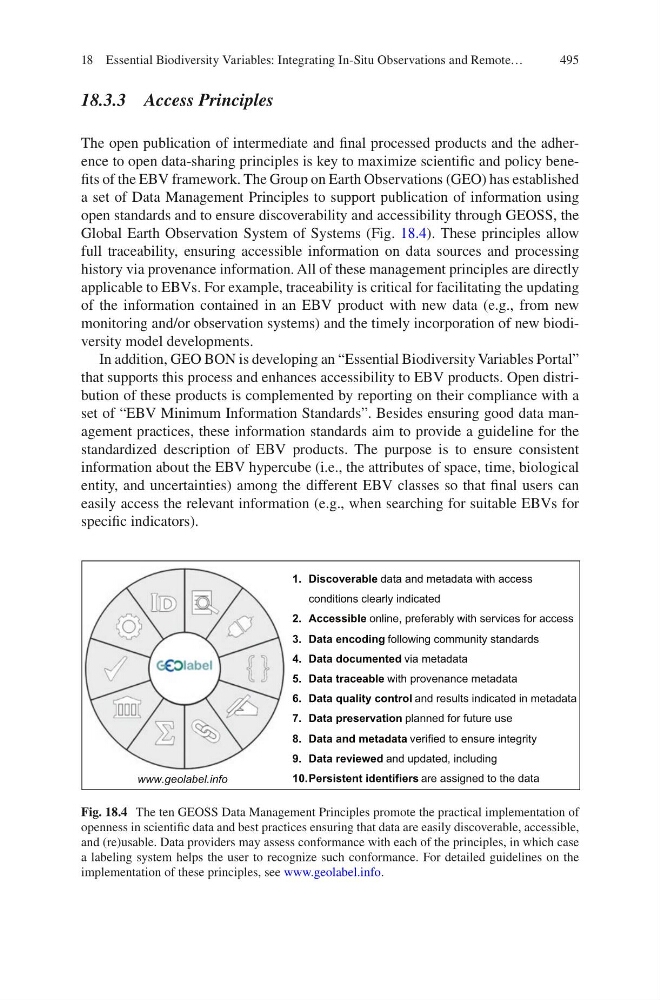
Global Earth Observation System of Systems (Fig. 18.4). These principles allow
full traceability, ensuring accessible information on data sources and processing
history via provenance information. All of these management principles are directly
applicable to EBVs. For example, traceability is critical for facilitating the updating
of the information contained in an EBV product with new data (e.g., from new
monitoring and/or observation systems) and the timely incorporation of new biodiversity model developments.
In addition, GEO BON is developing an “Essential Biodiversity Variables Portal”
that supports this process and enhances accessibility to EBV products. Open distribution of these products is complemented by reporting on their compliance with a
set of “EBV Minimum Information Standards”. Besides ensuring good data management practices, these information standards aim to provide a guideline for the
standardized description of EBV products. The purpose is to ensure consistent
information about the EBV hypercube (i.e., the attributes of space, time, biological
entity, and uncertainties) among the different EBV classes so that final users can
easily access the relevant information (e.g., when searching for suitable EBVs for
specific indicators).
1. Discoverable data and metadata with access
conditions clearly indicated
2. Accessible online, preferably with services for access
3. Data encoding following community standards
4. Data documented via metadata
5. Data traceable with provenance metadata
6. Data quality control and results indicated in metadata
7. Data preservation planned for future use
8. Data and metadata verified to ensure integrity
9. Data reviewed and updated, including
10.Persistent identifiers are assigned to the data
www.geolabel.info
Fig. 18.4 The ten GEOSS Data Management Principles promote the practical implementation of
openness in scientific data and best practices ensuring that data are easily discoverable, accessible,
and (re)usable. Data providers may assess conformance with each of the principles, in which case
a labeling system helps the user to recognize such conformance. For detailed guidelines on the
implementation of these principles, see www.geolabel.info.
18 Essential Biodiversity Variables: Integrating In-Situ Observations and Remote…
18.3.3 Access Principles
The open publication of intermediate and final processed products and the adherence to open data-sharing principles is key to maximize scientific and policy benefits of the EBV framework. The Group on Earth Observations (GEO) has established
a set of Data Management Principles to support publication of information using
open standards and to ensure discoverability and accessibility through GEOSS, the
Global Earth Observation System of Systems (Fig. 18.4). These principles allow
full traceability, ensuring accessible information on data sources and processing
history via provenance information. All of these management principles are directly
applicable to EBVs. For example, traceability is critical for facilitating the updating
of the information contained in an EBV product with new data (e.g., from new
monitoring and/or observation systems) and the timely incorporation of new biodiversity model developments.
In addition, GEO BON is developing an “Essential Biodiversity Variables Portal”
that supports this process and enhances accessibility to EBV products. Open distribution of these products is complemented by reporting on their compliance with a
set of “EBV Minimum Information Standards”. Besides ensuring good data management practices, these information standards aim to provide a guideline for the
standardized description of EBV products. The purpose is to ensure consistent
information about the EBV hypercube (i.e., the attributes of space, time, biological
entity, and uncertainties) among the different EBV classes so that final users can
easily access the relevant information (e.g., when searching for suitable EBVs for
specific indicators).
1. Discoverable data and metadata with access
conditions clearly indicated
2. Accessible online, preferably with services for access
3. Data encoding following community standards
4. Data documented via metadata
5. Data traceable with provenance metadata
6. Data quality control and results indicated in metadata
7. Data preservation planned for future use
8. Data and metadata verified to ensure integrity
9. Data reviewed and updated, including
10.Persistent identifiers are assigned to the data
www.geolabel.info
Fig. 18.4 The ten GEOSS Data Management Principles promote the practical implementation of
openness in scientific data and best practices ensuring that data are easily discoverable, accessible,
and (re)usable. Data providers may assess conformance with each of the principles, in which case
a labeling system helps the user to recognize such conformance. For detailed guidelines on the
implementation of these principles, see www.geolabel.info.
18 Essential Biodiversity Variables: Integrating In-Situ Observations and Remote…