

488
change indicators have evolved in the past and will continue to do so. However, the
EBVs are designed to remain conceptually stable, making them adaptable to different and unforeseen users’ needs. For example, even though the methods used to
acquire and integrate data on species occurrence, and the indicators it can inform
on, are likely to change in the future, the species distribution variable remains
essential.
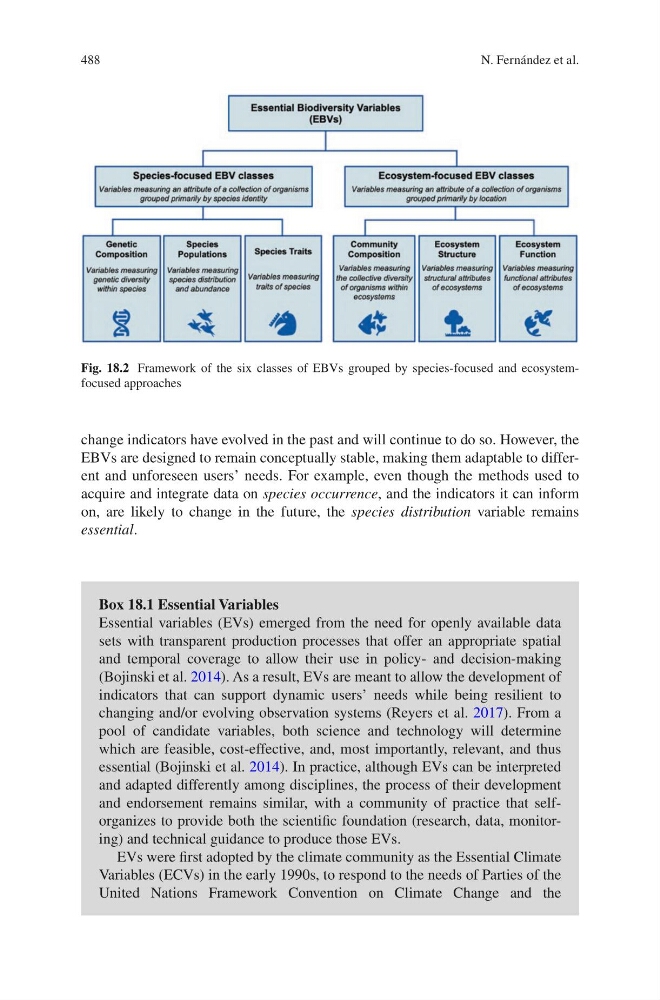
Fig. 18.2 Framework of the six classes of EBVs grouped by species-focused and ecosystemfocused approaches
Box 18.1 Essential Variables
Essential variables (EVs) emerged from the need for openly available data
sets with transparent production processes that offer an appropriate spatial
and temporal coverage to allow their use in policy- and decision-making
(Bojinski et al. 2014). As a result, EVs are meant to allow the development of
indicators that can support dynamic users’ needs while being resilient to
changing and/or evolving observation systems (Reyers et al. 2017). From a
pool of candidate variables, both science and technology will determine
which are feasible, cost-effective, and, most importantly, relevant, and thus
essential (Bojinski et al. 2014). In practice, although EVs can be interpreted
and adapted differently among disciplines, the process of their development
and endorsement remains similar, with a community of practice that selforganizes to provide both the scientific foundation (research, data, monitoring) and technical guidance to produce those EVs.
EVs were first adopted by the climate community as the Essential Climate
Variables (ECVs) in the early 1990s, to respond to the needs of Parties of the
United Nations Framework Convention on Climate Change and the
N. Fernández et al.
change indicators have evolved in the past and will continue to do so. However, the
EBVs are designed to remain conceptually stable, making them adaptable to different and unforeseen users’ needs. For example, even though the methods used to
acquire and integrate data on species occurrence, and the indicators it can inform
on, are likely to change in the future, the species distribution variable remains
essential.
Fig. 18.2 Framework of the six classes of EBVs grouped by species-focused and ecosystemfocused approaches
Box 18.1 Essential Variables
Essential variables (EVs) emerged from the need for openly available data
sets with transparent production processes that offer an appropriate spatial
and temporal coverage to allow their use in policy- and decision-making
(Bojinski et al. 2014). As a result, EVs are meant to allow the development of
indicators that can support dynamic users’ needs while being resilient to
changing and/or evolving observation systems (Reyers et al. 2017). From a
pool of candidate variables, both science and technology will determine
which are feasible, cost-effective, and, most importantly, relevant, and thus
essential (Bojinski et al. 2014). In practice, although EVs can be interpreted
and adapted differently among disciplines, the process of their development
and endorsement remains similar, with a community of practice that selforganizes to provide both the scientific foundation (research, data, monitoring) and technical guidance to produce those EVs.
EVs were first adopted by the climate community as the Essential Climate
Variables (ECVs) in the early 1990s, to respond to the needs of Parties of the
United Nations Framework Convention on Climate Change and the
N. Fernández et al.