

487
variables, such as temperature, fire occurrence, or elevation, may be extremely
important (e.g., as covariates in biodiversity models); however, they do not constitute EBVs themselves. Furthermore, EBVs can be analyzed in relation to other variables to attribute biodiversity change to specific pressures and drivers (Pereira et al.
2012), to predict how different biodiversity metrics might behave with different
scenarios of change (Kim et al. 2018), and to assess the effectiveness of management policies for biodiversity and ecosystem services (Geijzendorffer et al. 2016).
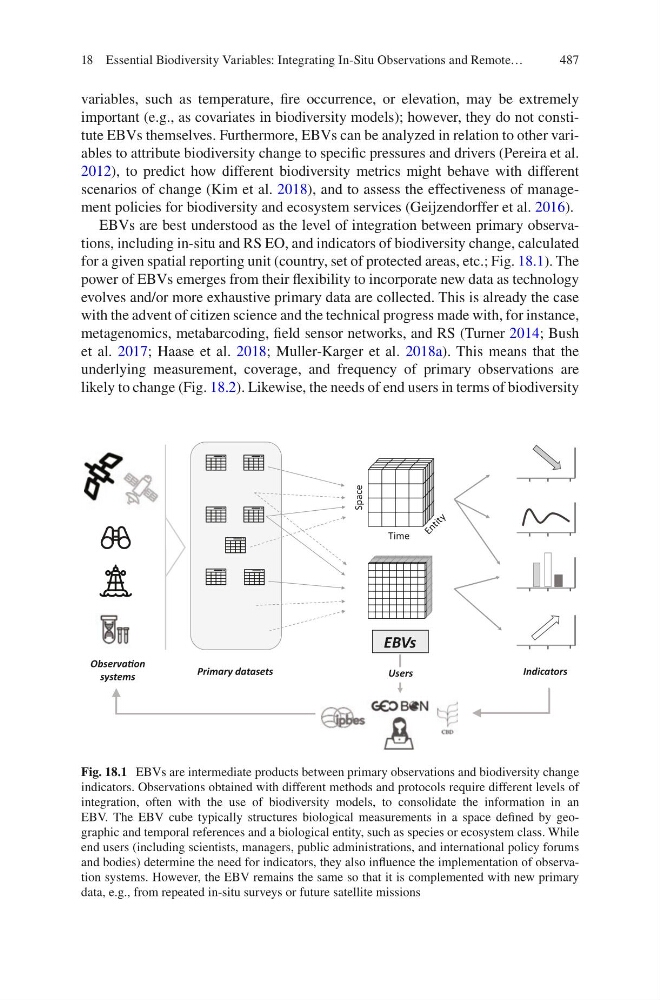
EBVs are best understood as the level of integration between primary observations, including in-situ and RS EO, and indicators of biodiversity change, calculated
for a given spatial reporting unit (country, set of protected areas, etc.; Fig. 18.1). The
power of EBVs emerges from their flexibility to incorporate new data as technology
evolves and/or more exhaustive primary data are collected. This is already the case
with the advent of citizen science and the technical progress made with, for instance,
metagenomics, metabarcoding, field sensor networks, and RS (Turner 2014; Bush
et al. 2017; Haase et al. 2018; Muller-Karger et al. 2018a). This means that the
underlying measurement, coverage, and frequency of primary observations are
likely to change (Fig. 18.2). Likewise, the needs of end users in terms of biodiversity
Time
Space
E n t i t y
EBVs
ObservaƟon
systems
Primary datasets
Indicators
Users
Fig. 18.1 EBVs are intermediate products between primary observations and biodiversity change
indicators. Observations obtained with different methods and protocols require different levels of
integration, often with the use of biodiversity models, to consolidate the information in an
EBV. The EBV cube typically structures biological measurements in a space defined by geographic and temporal references and a biological entity, such as species or ecosystem class. While
end users (including scientists, managers, public administrations, and international policy forums
and bodies) determine the need for indicators, they also influence the implementation of observation systems. However, the EBV remains the same so that it is complemented with new primary
data, e.g., from repeated in-situ surveys or future satellite missions
18 Essential Biodiversity Variables: Integrating In-Situ Observations and Remote…
variables, such as temperature, fire occurrence, or elevation, may be extremely
important (e.g., as covariates in biodiversity models); however, they do not constitute EBVs themselves. Furthermore, EBVs can be analyzed in relation to other variables to attribute biodiversity change to specific pressures and drivers (Pereira et al.
2012), to predict how different biodiversity metrics might behave with different
scenarios of change (Kim et al. 2018), and to assess the effectiveness of management policies for biodiversity and ecosystem services (Geijzendorffer et al. 2016).
EBVs are best understood as the level of integration between primary observations, including in-situ and RS EO, and indicators of biodiversity change, calculated
for a given spatial reporting unit (country, set of protected areas, etc.; Fig. 18.1). The
power of EBVs emerges from their flexibility to incorporate new data as technology
evolves and/or more exhaustive primary data are collected. This is already the case
with the advent of citizen science and the technical progress made with, for instance,
metagenomics, metabarcoding, field sensor networks, and RS (Turner 2014; Bush
et al. 2017; Haase et al. 2018; Muller-Karger et al. 2018a). This means that the
underlying measurement, coverage, and frequency of primary observations are
likely to change (Fig. 18.2). Likewise, the needs of end users in terms of biodiversity
Time
Space
E n t i t y
EBVs
ObservaƟon
systems
Primary datasets
Indicators
Users
Fig. 18.1 EBVs are intermediate products between primary observations and biodiversity change
indicators. Observations obtained with different methods and protocols require different levels of
integration, often with the use of biodiversity models, to consolidate the information in an
EBV. The EBV cube typically structures biological measurements in a space defined by geographic and temporal references and a biological entity, such as species or ecosystem class. While
end users (including scientists, managers, public administrations, and international policy forums
and bodies) determine the need for indicators, they also influence the implementation of observation systems. However, the EBV remains the same so that it is complemented with new primary
data, e.g., from repeated in-situ surveys or future satellite missions
18 Essential Biodiversity Variables: Integrating In-Situ Observations and Remote…