

26
2.7.1 The Spatial Scale of Diversity: Alpha, Beta, and Gamma
Diversity
Diversity metrics are designed to capture biological variation at different spatial
extents. Alpha diversity (α) represents the diversity within local communities, which
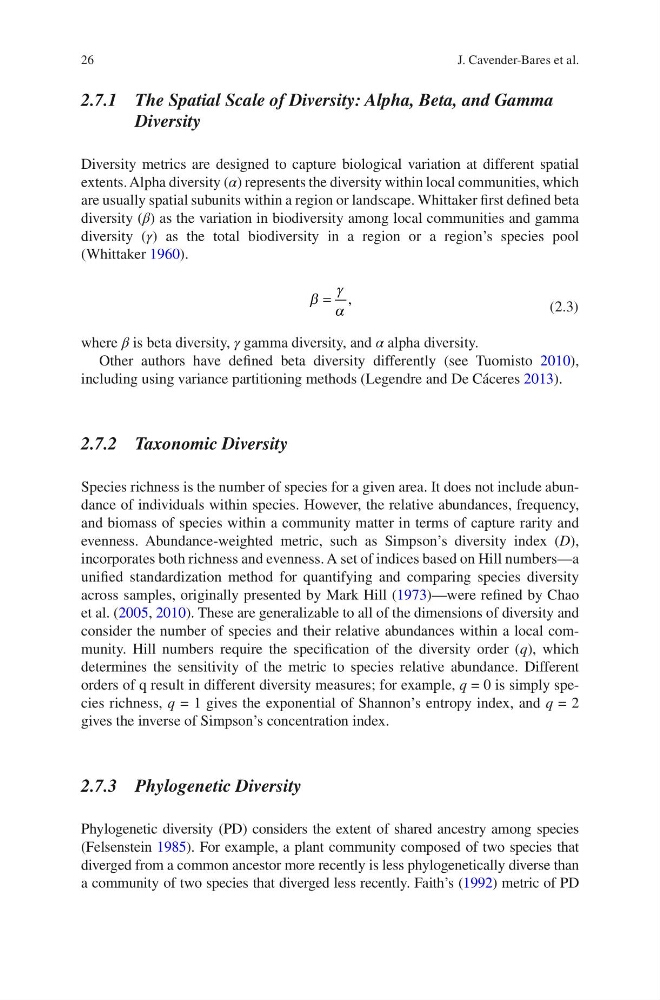
are usually spatial subunits within a region or landscape. Whittaker first defined beta
diversity (β) as the variation in biodiversity among local communities and gamma
diversity (γ) as the total biodiversity in a region or a region’s species pool
(Whittaker 1960).
E
J
D
,
(2.3)
where β is beta diversity, γ gamma diversity, and α alpha diversity.
Other authors have defined beta diversity differently (see Tuomisto 2010),
including using variance partitioning methods (Legendre and De Cáceres 2013).
2.7.2 Taxonomic Diversity
Species richness is the number of species for a given area. It does not include abundance of individuals within species. However, the relative abundances, frequency,
and biomass of species within a community matter in terms of capture rarity and
evenness. Abundance-weighted metric, such as Simpson’s diversity index (D),
incorporates both richness and evenness. A set of indices based on Hill numbers—a
unified standardization method for quantifying and comparing species diversity
across samples, originally presented by Mark Hill (1973)—were refined by Chao
et al. (2005, 2010). These are generalizable to all of the dimensions of diversity and
consider the number of species and their relative abundances within a local community. Hill numbers require the specification of the diversity order (q), which
determines the sensitivity of the metric to species relative abundance. Different
orders of q result in different diversity measures; for example, q = 0 is simply species richness, q = 1 gives the exponential of Shannon’s entropy index, and q = 2
gives the inverse of Simpson’s concentration index.
2.7.3 Phylogenetic Diversity
Phylogenetic diversity (PD) considers the extent of shared ancestry among species
(Felsenstein 1985). For example, a plant community composed of two species that
diverged from a common ancestor more recently is less phylogenetically diverse than
a community of two species that diverged less recently. Faith’s (1992) metric of PD
J. Cavender-Bares et al.
2.7.1 The Spatial Scale of Diversity: Alpha, Beta, and Gamma
Diversity
Diversity metrics are designed to capture biological variation at different spatial
extents. Alpha diversity (α) represents the diversity within local communities, which
are usually spatial subunits within a region or landscape. Whittaker first defined beta
diversity (β) as the variation in biodiversity among local communities and gamma
diversity (γ) as the total biodiversity in a region or a region’s species pool
(Whittaker 1960).
E
J
D
,
(2.3)
where β is beta diversity, γ gamma diversity, and α alpha diversity.
Other authors have defined beta diversity differently (see Tuomisto 2010),
including using variance partitioning methods (Legendre and De Cáceres 2013).
2.7.2 Taxonomic Diversity
Species richness is the number of species for a given area. It does not include abundance of individuals within species. However, the relative abundances, frequency,
and biomass of species within a community matter in terms of capture rarity and
evenness. Abundance-weighted metric, such as Simpson’s diversity index (D),
incorporates both richness and evenness. A set of indices based on Hill numbers—a
unified standardization method for quantifying and comparing species diversity
across samples, originally presented by Mark Hill (1973)—were refined by Chao
et al. (2005, 2010). These are generalizable to all of the dimensions of diversity and
consider the number of species and their relative abundances within a local community. Hill numbers require the specification of the diversity order (q), which
determines the sensitivity of the metric to species relative abundance. Different
orders of q result in different diversity measures; for example, q = 0 is simply species richness, q = 1 gives the exponential of Shannon’s entropy index, and q = 2
gives the inverse of Simpson’s concentration index.
2.7.3 Phylogenetic Diversity
Phylogenetic diversity (PD) considers the extent of shared ancestry among species
(Felsenstein 1985). For example, a plant community composed of two species that
diverged from a common ancestor more recently is less phylogenetically diverse than
a community of two species that diverged less recently. Faith’s (1992) metric of PD
J. Cavender-Bares et al.