

430
purpose. Rather than provide a detailed summary of all the possible methods used,
we present the concept of spectral information content as a viable proxy for multiple
dimensions of biodiversity at the species, functional, or genetic and phylogenetic
levels (Cavender-Bares et al. 2017; Schweiger et al. 2018; Cavender-Bares et al.,
Chap. 2, this volume) and note that recent reviews (e.g., Wang and Gamon 2019)
consider this topic in more detail.
16.2 What Is “Scale” and Why Is It Important?
“Scale” has several definitions and is used as both a noun and a verb. As a noun, it
refers to a level of observation and can have several dimensions, including spatial,
temporal, spectral, and biological. As a verb, it refers to the act of examining a phenomenon at multiple levels, usually referring to transcending spatial scales, as in
“upscaling” (extrapolation from fine-scale data to a coarser scale) or “downscaling”
(interpreting underlying patterns or mechanisms from coarse-scale data).
Discussions of scale have a rich history in both biology and RS. In biology, scale
typically refers to levels of organization (genetic, cellular, organismal, species or
population, community or ecosystem, etc.). Biodiversity can be defined at many of
these levels, requiring different study approaches (Bonar et al. 2011). Biological
systems typically exhibit complex, nonlinear interactions, and feedbacks, resulting
in emergent properties and thus requiring evaluation across multiple levels of organization (Heffernan et al. 2014). Scale can also refer to sampling scale, as in the
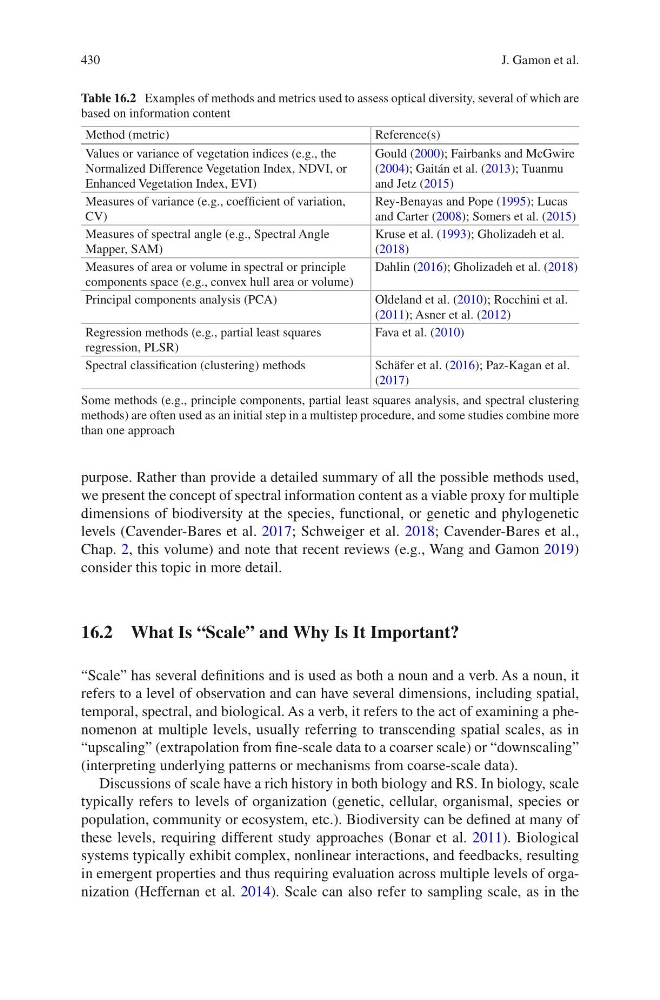
Table 16.2 Examples of methods and metrics used to assess optical diversity, several of which are
based on information content
Method (metric)
Reference(s)
Values or variance of vegetation indices (e.g., the
Normalized Difference Vegetation Index, NDVI, or
Enhanced Vegetation Index, EVI)
Gould (2000); Fairbanks and McGwire
(2004); Gaitán et al. (2013); Tuanmu
and Jetz (2015)
Measures of variance (e.g., coefficient of variation,
CV)
Rey-Benayas and Pope (1995); Lucas
and Carter (2008); Somers et al. (2015)
Measures of spectral angle (e.g., Spectral Angle
Mapper, SAM)
Kruse et al. (1993); Gholizadeh et al.
(2018)
Measures of area or volume in spectral or principle
components space (e.g., convex hull area or volume)
Dahlin (2016); Gholizadeh et al. (2018)
Principal components analysis (PCA)
Oldeland et al. (2010); Rocchini et al.
(2011); Asner et al. (2012)
Regression methods (e.g., partial least squares
regression, PLSR)
Fava et al. (2010)
Spectral classification (clustering) methods
Schäfer et al. (2016); Paz-Kagan et al.
(2017)
Some methods (e.g., principle components, partial least squares analysis, and spectral clustering
methods) are often used as an initial step in a multistep procedure, and some studies combine more
than one approach
J. Gamon et al.
purpose. Rather than provide a detailed summary of all the possible methods used,
we present the concept of spectral information content as a viable proxy for multiple
dimensions of biodiversity at the species, functional, or genetic and phylogenetic
levels (Cavender-Bares et al. 2017; Schweiger et al. 2018; Cavender-Bares et al.,
Chap. 2, this volume) and note that recent reviews (e.g., Wang and Gamon 2019)
consider this topic in more detail.
16.2 What Is “Scale” and Why Is It Important?
“Scale” has several definitions and is used as both a noun and a verb. As a noun, it
refers to a level of observation and can have several dimensions, including spatial,
temporal, spectral, and biological. As a verb, it refers to the act of examining a phenomenon at multiple levels, usually referring to transcending spatial scales, as in
“upscaling” (extrapolation from fine-scale data to a coarser scale) or “downscaling”
(interpreting underlying patterns or mechanisms from coarse-scale data).
Discussions of scale have a rich history in both biology and RS. In biology, scale
typically refers to levels of organization (genetic, cellular, organismal, species or
population, community or ecosystem, etc.). Biodiversity can be defined at many of
these levels, requiring different study approaches (Bonar et al. 2011). Biological
systems typically exhibit complex, nonlinear interactions, and feedbacks, resulting
in emergent properties and thus requiring evaluation across multiple levels of organization (Heffernan et al. 2014). Scale can also refer to sampling scale, as in the
Table 16.2 Examples of methods and metrics used to assess optical diversity, several of which are
based on information content
Method (metric)
Reference(s)
Values or variance of vegetation indices (e.g., the
Normalized Difference Vegetation Index, NDVI, or
Enhanced Vegetation Index, EVI)
Gould (2000); Fairbanks and McGwire
(2004); Gaitán et al. (2013); Tuanmu
and Jetz (2015)
Measures of variance (e.g., coefficient of variation,
CV)
Rey-Benayas and Pope (1995); Lucas
and Carter (2008); Somers et al. (2015)
Measures of spectral angle (e.g., Spectral Angle
Mapper, SAM)
Kruse et al. (1993); Gholizadeh et al.
(2018)
Measures of area or volume in spectral or principle
components space (e.g., convex hull area or volume)
Dahlin (2016); Gholizadeh et al. (2018)
Principal components analysis (PCA)
Oldeland et al. (2010); Rocchini et al.
(2011); Asner et al. (2012)
Regression methods (e.g., partial least squares
regression, PLSR)
Fava et al. (2010)
Spectral classification (clustering) methods
Schäfer et al. (2016); Paz-Kagan et al.
(2017)
Some methods (e.g., principle components, partial least squares analysis, and spectral clustering
methods) are often used as an initial step in a multistep procedure, and some studies combine more
than one approach
J. Gamon et al.