

24
plants or, more commonly, calculated among pixels or among other meaningful
spatial units.
Biodiversity metrics can have different components, including (1) taxonomic
units; (2) abundance, frequency, or biomass of those units and their degree of evenness; and (3) the dispersion or distances between those units in trait, evolutionary,
or spectral space. Myriad metrics quantify the major dimensions and components of
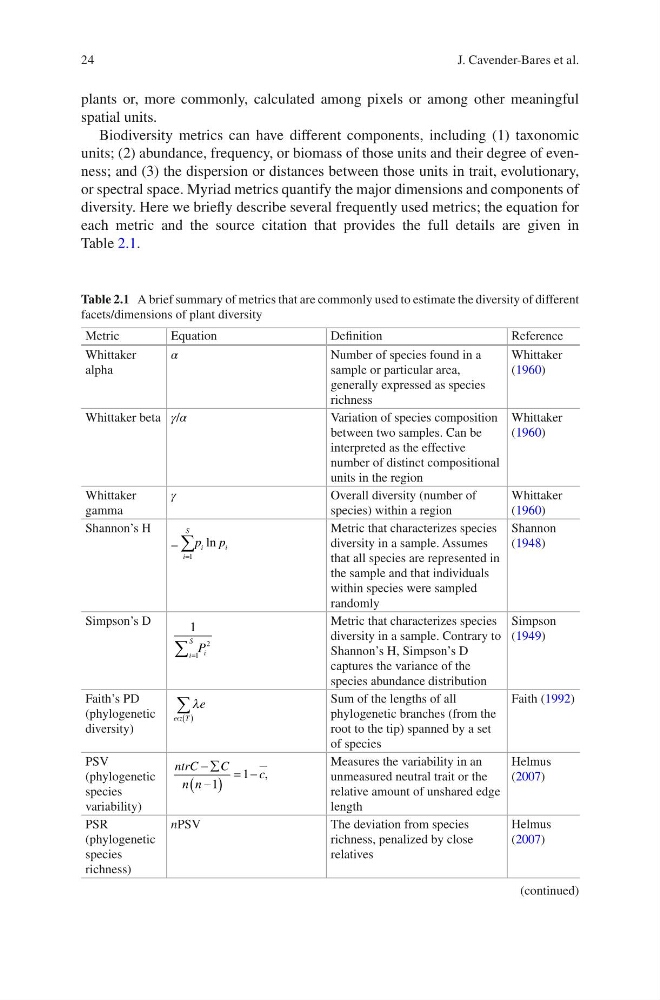
diversity. Here we briefly describe several frequently used metrics; the equation for
each metric and the source citation that provides the full details are given in
Table 2.1.
Table 2.1 A brief summary of metrics that are commonly used to estimate the diversity of different
facets/dimensions of plant diversity
Metric
Equation
Definition
Reference
Whittaker
alpha
α
Number of species found in a
sample or particular area,
generally expressed as species
richness
Whittaker
(1960)
Whittaker beta γ/α
Variation of species composition
between two samples. Can be
interpreted as the effective
number of distinct compositional
units in the region
Whittaker
(1960)
Whittaker
gamma
γ
Overall diversity (number of
species) within a region
Whittaker
(1960)
Shannon’s H
−
i
S
i
i
p p
¦
1
ln
Metric that characterizes species
diversity in a sample. Assumes
that all species are represented in
the sample and that individuals
within species were sampled
randomly
Shannon
(1948)
Simpson’s D
1
1
2
i
S
i
P
¦
Metric that characterizes species
diversity in a sample. Contrary to
Shannon’s H, Simpson’s D
captures the variance of the
species abundance distribution
Simpson
(1949)
Faith’s PD
(phylogenetic
diversity)
e z T
e
¦ O
Sum of the lengths of all
phylogenetic branches (from the
root to the tip) spanned by a set
of species
Faith (1992)
PSV
(phylogenetic
species
variability)
ntrC
C
n n
c
¦
1
1 ,
Measures the variability in an
unmeasured neutral trait or the
relative amount of unshared edge
length
Helmus
(2007)
PSR
(phylogenetic
species
richness)
nPSV
The deviation from species
richness, penalized by close
relatives
Helmus
(2007)
(continued)
J. Cavender-Bares et al.
plants or, more commonly, calculated among pixels or among other meaningful
spatial units.
Biodiversity metrics can have different components, including (1) taxonomic
units; (2) abundance, frequency, or biomass of those units and their degree of evenness; and (3) the dispersion or distances between those units in trait, evolutionary,
or spectral space. Myriad metrics quantify the major dimensions and components of
diversity. Here we briefly describe several frequently used metrics; the equation for
each metric and the source citation that provides the full details are given in
Table 2.1.
Table 2.1 A brief summary of metrics that are commonly used to estimate the diversity of different
facets/dimensions of plant diversity
Metric
Equation
Definition
Reference
Whittaker
alpha
α
Number of species found in a
sample or particular area,
generally expressed as species
richness
Whittaker
(1960)
Whittaker beta γ/α
Variation of species composition
between two samples. Can be
interpreted as the effective
number of distinct compositional
units in the region
Whittaker
(1960)
Whittaker
gamma
γ
Overall diversity (number of
species) within a region
Whittaker
(1960)
Shannon’s H
−
i
S
i
i
p p
¦
1
ln
Metric that characterizes species
diversity in a sample. Assumes
that all species are represented in
the sample and that individuals
within species were sampled
randomly
Shannon
(1948)
Simpson’s D
1
1
2
i
S
i
P
¦
Metric that characterizes species
diversity in a sample. Contrary to
Shannon’s H, Simpson’s D
captures the variance of the
species abundance distribution
Simpson
(1949)
Faith’s PD
(phylogenetic
diversity)
e z T
e
¦ O
Sum of the lengths of all
phylogenetic branches (from the
root to the tip) spanned by a set
of species
Faith (1992)
PSV
(phylogenetic
species
variability)
ntrC
C
n n
c
¦
1
1 ,
Measures the variability in an
unmeasured neutral trait or the
relative amount of unshared edge
length
Helmus
(2007)
PSR
(phylogenetic
species
richness)
nPSV
The deviation from species
richness, penalized by close
relatives
Helmus
(2007)
(continued)
J. Cavender-Bares et al.