

22
partitioning resources. Approaches that use spectral detection of patterns that
might be interpreted within this framework will need to pay close attention to the
pixel-to-plant size ratio—or the grain size at which biological diversity varies
(Gamon et al., Chap. 16; Serbin and Townsend, Chap. 3; Schimel et al., Chap. 19)—
as well as to the spatial extent at which density-dependent processes and environmental sorting pressures are strongest. Often these processes are expected to
dominate at different spatial scales, such that competition and Janzen-Connell-type
mechanisms operate at very local scales, while environmental sorting may be more
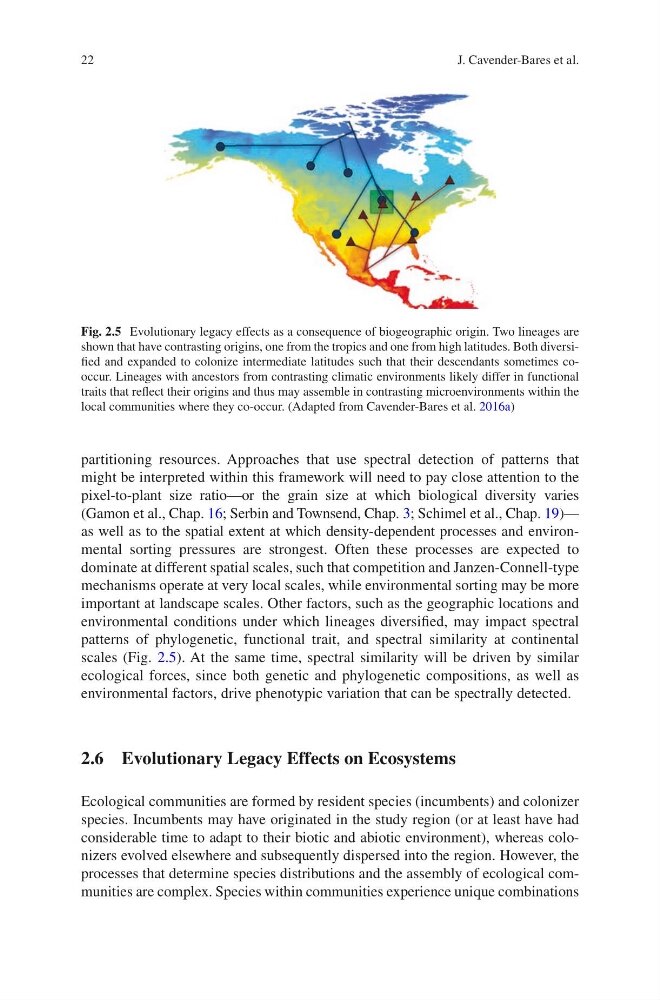
important at landscape scales. Other factors, such as the geographic locations and
environmental conditions under which lineages diversified, may impact spectral
patterns of phylogenetic, functional trait, and spectral similarity at continental
scales (Fig. 2.5). At the same time, spectral similarity will be driven by similar
ecological forces, since both genetic and phylogenetic compositions, as well as
environmental factors, drive phenotypic variation that can be spectrally detected.
2.6 Evolutionary Legacy Effects on Ecosystems
Ecological communities are formed by resident species (incumbents) and colonizer
species. Incumbents may have originated in the study region (or at least have had
considerable time to adapt to their biotic and abiotic environment), whereas colonizers evolved elsewhere and subsequently dispersed into the region. However, the
processes that determine species distributions and the assembly of ecological communities are complex. Species within communities experience unique combinations
Fig. 2.5 Evolutionary legacy effects as a consequence of biogeographic origin. Two lineages are
shown that have contrasting origins, one from the tropics and one from high latitudes. Both diversified and expanded to colonize intermediate latitudes such that their descendants sometimes cooccur. Lineages with ancestors from contrasting climatic environments likely differ in functional
traits that reflect their origins and thus may assemble in contrasting microenvironments within the
local communities where they co-occur. (Adapted from Cavender-Bares et al. 2016a)
J. Cavender-Bares et al.
partitioning resources. Approaches that use spectral detection of patterns that
might be interpreted within this framework will need to pay close attention to the
pixel-to-plant size ratio—or the grain size at which biological diversity varies
(Gamon et al., Chap. 16; Serbin and Townsend, Chap. 3; Schimel et al., Chap. 19)—
as well as to the spatial extent at which density-dependent processes and environmental sorting pressures are strongest. Often these processes are expected to
dominate at different spatial scales, such that competition and Janzen-Connell-type
mechanisms operate at very local scales, while environmental sorting may be more
important at landscape scales. Other factors, such as the geographic locations and
environmental conditions under which lineages diversified, may impact spectral
patterns of phylogenetic, functional trait, and spectral similarity at continental
scales (Fig. 2.5). At the same time, spectral similarity will be driven by similar
ecological forces, since both genetic and phylogenetic compositions, as well as
environmental factors, drive phenotypic variation that can be spectrally detected.
2.6 Evolutionary Legacy Effects on Ecosystems
Ecological communities are formed by resident species (incumbents) and colonizer
species. Incumbents may have originated in the study region (or at least have had
considerable time to adapt to their biotic and abiotic environment), whereas colonizers evolved elsewhere and subsequently dispersed into the region. However, the
processes that determine species distributions and the assembly of ecological communities are complex. Species within communities experience unique combinations
Fig. 2.5 Evolutionary legacy effects as a consequence of biogeographic origin. Two lineages are
shown that have contrasting origins, one from the tropics and one from high latitudes. Both diversified and expanded to colonize intermediate latitudes such that their descendants sometimes cooccur. Lineages with ancestors from contrasting climatic environments likely differ in functional
traits that reflect their origins and thus may assemble in contrasting microenvironments within the
local communities where they co-occur. (Adapted from Cavender-Bares et al. 2016a)
J. Cavender-Bares et al.