

372
the imaginary part. Buiteveld et al. (1994) conducted detailed measurements of pure
water over temperatures from 25 to 40.5 °C and improved absorption coefficients
over the range of 300–800 nm. Féret et al. (2017) combined these in developing the
PROSPECT-D model and tested the inversion on leaf data from six data sets with a
total of 521 leaves. From this, they derived the absorption coefficients for pure
water, shown in Fig. 14.12 covering the 400–2500 nm region.
The atmosphere is nearly always saturated with water vapor at 1450 nm and
1940 nm (Fig. 14.13). Published imaging spectrometer data are typically shown
with these wavelengths deleted since only in the driest deserts is there a possibility
of observing the ground surface from airborne or satellite sensors (see also
Segelstein’s (1981) absorption coefficients, Fig. 14.6). A series of increasingly
strong water vapor absorptions are observed from the visible region, around 512 nm
to the SWIR at–2500 nm. Because the absorption maximum of each phase of water
at 940–1020 nm is offset by 30–40 nm, it is possible to identify and quantify whether
water is present in vapor, liquid, or solid phases in imaging spectroscopy data having bandwidths of 5–10 nm. The second absorption region for detecting the three
phases of water is located at 1100–1300 nm. Absorptions are too strong beyond
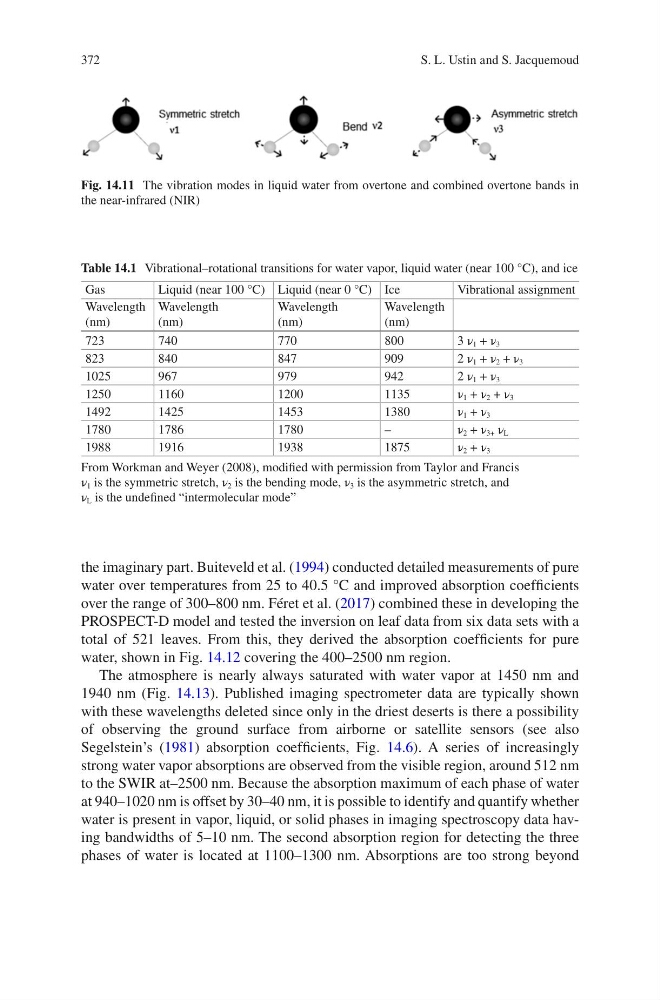
Fig. 14.11 The vibration modes in liquid water from overtone and combined overtone bands in
the near-infrared (NIR)
Table 14.1 Vibrational–rotational transitions for water vapor, liquid water (near 100 °C), and ice
Gas
Liquid (near 100 °C) Liquid (near 0 °C) Ice
Vibrational assignment
Wavelength
(nm)
Wavelength
(nm)
Wavelength
(nm)
Wavelength
(nm)
723
740
770
800
3 ν 1 + ν 3
823
840
847
909
2 ν 1 + ν 2 + ν 3
1025
967
979
942
2 ν 1 + ν 3
1250
1160
1200
1135
ν 1 + ν 2 + ν 3
1492
1425
1453
1380
ν 1 + ν 3
1780
1786
1780
–
ν 2 + ν 3+ ν L
1988
1916
1938
1875
ν 2 + ν 3
From Workman and Weyer (2008), modified with permission from Taylor and Francis
ν 1 is the symmetric stretch, ν 2 is the bending mode, ν 3 is the asymmetric stretch, and
ν L is the undefined “intermolecular mode”
S. L. Ustin and S. Jacquemoud
the imaginary part. Buiteveld et al. (1994) conducted detailed measurements of pure
water over temperatures from 25 to 40.5 °C and improved absorption coefficients
over the range of 300–800 nm. Féret et al. (2017) combined these in developing the
PROSPECT-D model and tested the inversion on leaf data from six data sets with a
total of 521 leaves. From this, they derived the absorption coefficients for pure
water, shown in Fig. 14.12 covering the 400–2500 nm region.
The atmosphere is nearly always saturated with water vapor at 1450 nm and
1940 nm (Fig. 14.13). Published imaging spectrometer data are typically shown
with these wavelengths deleted since only in the driest deserts is there a possibility
of observing the ground surface from airborne or satellite sensors (see also
Segelstein’s (1981) absorption coefficients, Fig. 14.6). A series of increasingly
strong water vapor absorptions are observed from the visible region, around 512 nm
to the SWIR at–2500 nm. Because the absorption maximum of each phase of water
at 940–1020 nm is offset by 30–40 nm, it is possible to identify and quantify whether
water is present in vapor, liquid, or solid phases in imaging spectroscopy data having bandwidths of 5–10 nm. The second absorption region for detecting the three
phases of water is located at 1100–1300 nm. Absorptions are too strong beyond
Fig. 14.11 The vibration modes in liquid water from overtone and combined overtone bands in
the near-infrared (NIR)
Table 14.1 Vibrational–rotational transitions for water vapor, liquid water (near 100 °C), and ice
Gas
Liquid (near 100 °C) Liquid (near 0 °C) Ice
Vibrational assignment
Wavelength
(nm)
Wavelength
(nm)
Wavelength
(nm)
Wavelength
(nm)
723
740
770
800
3 ν 1 + ν 3
823
840
847
909
2 ν 1 + ν 2 + ν 3
1025
967
979
942
2 ν 1 + ν 3
1250
1160
1200
1135
ν 1 + ν 2 + ν 3
1492
1425
1453
1380
ν 1 + ν 3
1780
1786
1780
–
ν 2 + ν 3+ ν L
1988
1916
1938
1875
ν 2 + ν 3
From Workman and Weyer (2008), modified with permission from Taylor and Francis
ν 1 is the symmetric stretch, ν 2 is the bending mode, ν 3 is the asymmetric stretch, and
ν L is the undefined “intermolecular mode”
S. L. Ustin and S. Jacquemoud