

18
log
l og
S z
A c
u ,
(2.1)
or simply,
S cA
Z
=
,
(2.2)
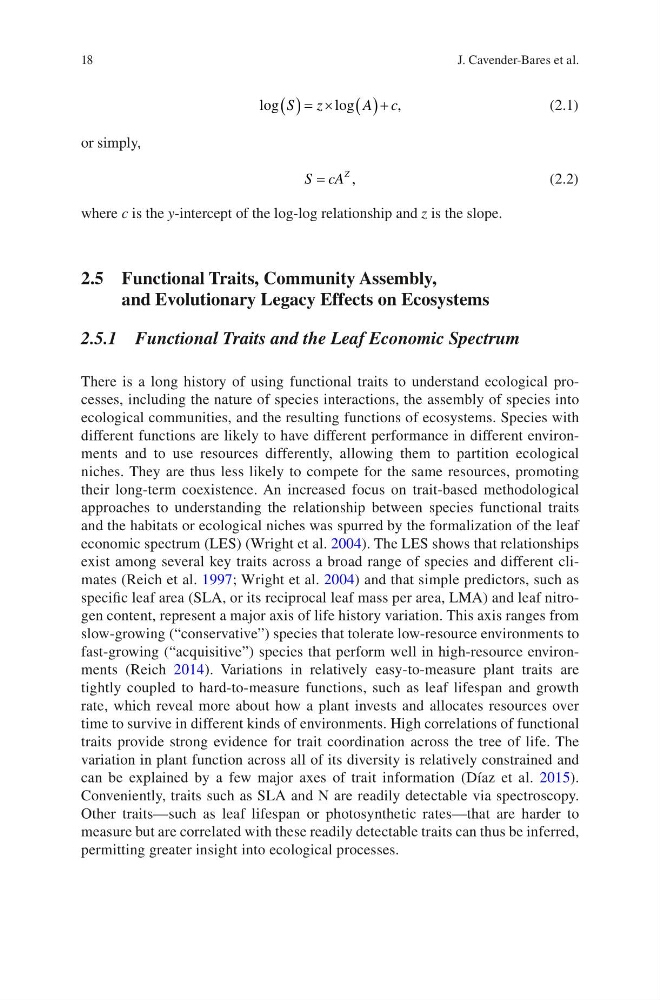
where c is the y-intercept of the log-log relationship and z is the slope.
2.5 Functional Traits, Community Assembly,
and Evolutionary Legacy Effects on Ecosystems
2.5.1 Functional Traits and the Leaf Economic Spectrum
There is a long history of using functional traits to understand ecological processes, including the nature of species interactions, the assembly of species into
ecological communities, and the resulting functions of ecosystems. Species with
different functions are likely to have different performance in different environments and to use resources differently, allowing them to partition ecological
niches. They are thus less likely to compete for the same resources, promoting
their long-term coexistence. An increased focus on trait-based methodological
approaches to understanding the relationship between species functional traits
and the habitats or ecological niches was spurred by the formalization of the leaf
economic spectrum (LES) (Wright et al. 2004). The LES shows that relationships
exist among several key traits across a broad range of species and different climates (Reich et al. 1997; Wright et al. 2004) and that simple predictors, such as
specific leaf area (SLA, or its reciprocal leaf mass per area, LMA) and leaf nitrogen content, represent a major axis of life history variation. This axis ranges from
slow-growing (“conservative”) species that tolerate low-resource environments to
fast-growing (“acquisitive”) species that perform well in high-resource environments (Reich 2014). Variations in relatively easy-to-measure plant traits are
tightly coupled to hard-to-measure functions, such as leaf lifespan and growth
rate, which reveal more about how a plant invests and allocates resources over
time to survive in different kinds of environments. High correlations of functional
traits provide strong evidence for trait coordination across the tree of life. The
variation in plant function across all of its diversity is relatively constrained and
can be explained by a few major axes of trait information (Díaz et al. 2015).
Conveniently, traits such as SLA and N are readily detectable via spectroscopy.
Other traits—such as leaf lifespan or photosynthetic rates—that are harder to
measure but are correlated with these readily detectable traits can thus be inferred,
permitting greater insight into ecological processes.
J. Cavender-Bares et al.
log
l og
S z
A c
u ,
(2.1)
or simply,
S cA
Z
=
,
(2.2)
where c is the y-intercept of the log-log relationship and z is the slope.
2.5 Functional Traits, Community Assembly,
and Evolutionary Legacy Effects on Ecosystems
2.5.1 Functional Traits and the Leaf Economic Spectrum
There is a long history of using functional traits to understand ecological processes, including the nature of species interactions, the assembly of species into
ecological communities, and the resulting functions of ecosystems. Species with
different functions are likely to have different performance in different environments and to use resources differently, allowing them to partition ecological
niches. They are thus less likely to compete for the same resources, promoting
their long-term coexistence. An increased focus on trait-based methodological
approaches to understanding the relationship between species functional traits
and the habitats or ecological niches was spurred by the formalization of the leaf
economic spectrum (LES) (Wright et al. 2004). The LES shows that relationships
exist among several key traits across a broad range of species and different climates (Reich et al. 1997; Wright et al. 2004) and that simple predictors, such as
specific leaf area (SLA, or its reciprocal leaf mass per area, LMA) and leaf nitrogen content, represent a major axis of life history variation. This axis ranges from
slow-growing (“conservative”) species that tolerate low-resource environments to
fast-growing (“acquisitive”) species that perform well in high-resource environments (Reich 2014). Variations in relatively easy-to-measure plant traits are
tightly coupled to hard-to-measure functions, such as leaf lifespan and growth
rate, which reveal more about how a plant invests and allocates resources over
time to survive in different kinds of environments. High correlations of functional
traits provide strong evidence for trait coordination across the tree of life. The
variation in plant function across all of its diversity is relatively constrained and
can be explained by a few major axes of trait information (Díaz et al. 2015).
Conveniently, traits such as SLA and N are readily detectable via spectroscopy.
Other traits—such as leaf lifespan or photosynthetic rates—that are harder to
measure but are correlated with these readily detectable traits can thus be inferred,
permitting greater insight into ecological processes.
J. Cavender-Bares et al.