

334
(i) Coupling of the different monitoring approaches (in-situ and RS) for plant
diversity.
(ii) The integration and linking of multisource data and RS platforms. MUSOVDH- MN should integrate the following data and site survey platforms:
Species/habitats: Data from site surveys for species, species lists, metabarcoding, microgenomics (Bush et al. 2017), and phenotyping (Deans et al. 2015)
and data from museums, lysimeters, plant phenomic facilities (Furbank
2009), controlled environmental facilities (ecotrons, Lawton et al. 1993),
long-term ecological research (Mueller et al. 2010), spectral laboratory
experiments, and biodiversity ecosystem functioning experiments
(Bruelheide et al. 2014)
Status, Processes, Stress, Disturbances & Resource Limitations
In-situ
approaches
Remote Sensing
approaches
Characteristics of processes,
stress, disturbances and
resource limitations
Scope, length, intensity
consistency, dominance,
overlay
Characteristics of remote
sensing sensors
Spatial resolution
Spectral resolution
Radiometric resolution
Temporal resolution
Angular resolution
Characteristics of
composition & configuration
of
Spectral Traits (ST) / Spectral
Trait Variation (STV)
Compostion
Configuration
Abundance
2D/3D structure
Patterns
Heterogeneity
Characteristics of
classification approaches
Pixel-based
Spectral-based
Geographic objects based
- GEOBIA
Characteristics of
diversity
Phylogenetic Diversity
Taxonomic Diversity
Trait Diversity
Structural diversity
Functional Diversity
Constraints of RS
for monitoring plant diversity
Physical-based by techniques
Plant species, populations, communities, habitats
biomes, ecosystems, landscapes
Species Concepts
Phylogenetic
Species Concept
(PSC)
Morpho-Species
Concept
(MSC)
Biological
Species Concept
(BSC)
Close-range
RS
Air-/Spaceborne
RS
PhyloDiversity
Taxonomic
Diversity
Trait
Diversity
species distribution
population abundance
population structure
by
age/ size class
co-ancestry
allelic diversity
population genetic
differentiation
breed and variety
diversity
chemical/ biochemical
traits
phenotypical/
morphological traits
physiological/ functional
traits etc.
chemical/ biochemical traits
phenotypical/ morphological traits physiological/
functional traits etc.
Close-Range-Remote-Sensing -
Spectral Trait/Spectral Trait
Variation Concept
(CR-RS-ST/STV-C)
Air- and Spaceborne RemoteSensing - Spectral Trait/Spectral
Trait Variation Concept
(AS-RS-ST/STV-C)
Phylo
Diversity
Taxonomic
Diversity
Knowledge-based by taxonomist
Remote-Sensing - spectral Trait/Spectral Trait Variation Concept
(RS-ST/STV-C)
Functional Diversity
Discrimination of
plant species, populations,
communities, habitats
biomes, ecosystems, landscapes
Trait Diversity
Structural Diversity
Phylogeny
Taxonomy
Spectral Traits (ST)
Spectral Trait Variations (STV)
Traits
Status, Processes, Stress, Disturbances & Resource Limitations
Plant Diversity
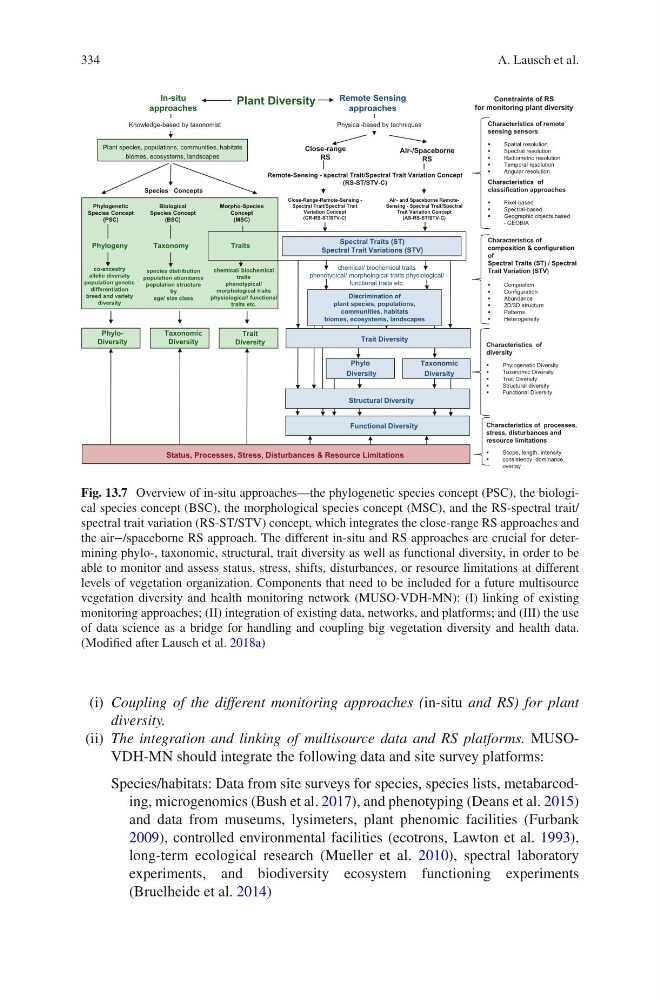
Fig. 13.7 Overview of in-situ approaches—the phylogenetic species concept (PSC), the biological species concept (BSC), the morphological species concept (MSC), and the RS-spectral trait/
spectral trait variation (RS-ST/STV) concept, which integrates the close-range RS approaches and
the air−/spaceborne RS approach. The different in-situ and RS approaches are crucial for determining phylo-, taxonomic, structural, trait diversity as well as functional diversity, in order to be
able to monitor and assess status, stress, shifts, disturbances, or resource limitations at different
levels of vegetation organization. Components that need to be included for a future multisource
vegetation diversity and health monitoring network (MUSO-VDH-MN): (I) linking of existing
monitoring approaches; (II) integration of existing data, networks, and platforms; and (III) the use
of data science as a bridge for handling and coupling big vegetation diversity and health data.
(Modified after Lausch et al. 2018a)
A. Lausch et al.
(i) Coupling of the different monitoring approaches (in-situ and RS) for plant
diversity.
(ii) The integration and linking of multisource data and RS platforms. MUSOVDH- MN should integrate the following data and site survey platforms:
Species/habitats: Data from site surveys for species, species lists, metabarcoding, microgenomics (Bush et al. 2017), and phenotyping (Deans et al. 2015)
and data from museums, lysimeters, plant phenomic facilities (Furbank
2009), controlled environmental facilities (ecotrons, Lawton et al. 1993),
long-term ecological research (Mueller et al. 2010), spectral laboratory
experiments, and biodiversity ecosystem functioning experiments
(Bruelheide et al. 2014)
Status, Processes, Stress, Disturbances & Resource Limitations
In-situ
approaches
Remote Sensing
approaches
Characteristics of processes,
stress, disturbances and
resource limitations
Scope, length, intensity
consistency, dominance,
overlay
Characteristics of remote
sensing sensors
Spatial resolution
Spectral resolution
Radiometric resolution
Temporal resolution
Angular resolution
Characteristics of
composition & configuration
of
Spectral Traits (ST) / Spectral
Trait Variation (STV)
Compostion
Configuration
Abundance
2D/3D structure
Patterns
Heterogeneity
Characteristics of
classification approaches
Pixel-based
Spectral-based
Geographic objects based
- GEOBIA
Characteristics of
diversity
Phylogenetic Diversity
Taxonomic Diversity
Trait Diversity
Structural diversity
Functional Diversity
Constraints of RS
for monitoring plant diversity
Physical-based by techniques
Plant species, populations, communities, habitats
biomes, ecosystems, landscapes
Species Concepts
Phylogenetic
Species Concept
(PSC)
Morpho-Species
Concept
(MSC)
Biological
Species Concept
(BSC)
Close-range
RS
Air-/Spaceborne
RS
PhyloDiversity
Taxonomic
Diversity
Trait
Diversity
species distribution
population abundance
population structure
by
age/ size class
co-ancestry
allelic diversity
population genetic
differentiation
breed and variety
diversity
chemical/ biochemical
traits
phenotypical/
morphological traits
physiological/ functional
traits etc.
chemical/ biochemical traits
phenotypical/ morphological traits physiological/
functional traits etc.
Close-Range-Remote-Sensing -
Spectral Trait/Spectral Trait
Variation Concept
(CR-RS-ST/STV-C)
Air- and Spaceborne RemoteSensing - Spectral Trait/Spectral
Trait Variation Concept
(AS-RS-ST/STV-C)
Phylo
Diversity
Taxonomic
Diversity
Knowledge-based by taxonomist
Remote-Sensing - spectral Trait/Spectral Trait Variation Concept
(RS-ST/STV-C)
Functional Diversity
Discrimination of
plant species, populations,
communities, habitats
biomes, ecosystems, landscapes
Trait Diversity
Structural Diversity
Phylogeny
Taxonomy
Spectral Traits (ST)
Spectral Trait Variations (STV)
Traits
Status, Processes, Stress, Disturbances & Resource Limitations
Plant Diversity
Fig. 13.7 Overview of in-situ approaches—the phylogenetic species concept (PSC), the biological species concept (BSC), the morphological species concept (MSC), and the RS-spectral trait/
spectral trait variation (RS-ST/STV) concept, which integrates the close-range RS approaches and
the air−/spaceborne RS approach. The different in-situ and RS approaches are crucial for determining phylo-, taxonomic, structural, trait diversity as well as functional diversity, in order to be
able to monitor and assess status, stress, shifts, disturbances, or resource limitations at different
levels of vegetation organization. Components that need to be included for a future multisource
vegetation diversity and health monitoring network (MUSO-VDH-MN): (I) linking of existing
monitoring approaches; (II) integration of existing data, networks, and platforms; and (III) the use
of data science as a bridge for handling and coupling big vegetation diversity and health data.
(Modified after Lausch et al. 2018a)
A. Lausch et al.