

318
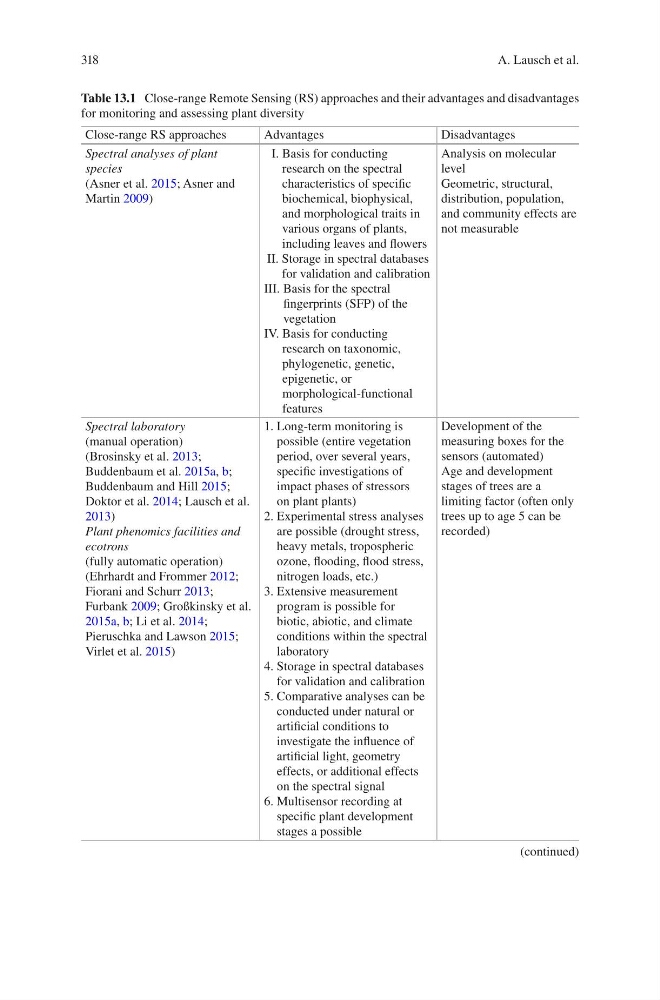
Table 13.1 Close-range Remote Sensing (RS) approaches and their advantages and disadvantages
for monitoring and assessing plant diversity
Close-range RS approaches
Advantages
Disadvantages
Spectral analyses of plant
species
(Asner et al. 2015; Asner and
Martin 2009)
I. Basis for conducting
research on the spectral
characteristics of specific
biochemical, biophysical,
and morphological traits in
various organs of plants,
including leaves and flowers
II. Storage in spectral databases
for validation and calibration
III. Basis for the spectral
fingerprints (SFP) of the
vegetation
IV. Basis for conducting
research on taxonomic,
phylogenetic, genetic,
epigenetic, or
morphological- functional
features
Analysis on molecular
level
Geometric, structural,
distribution, population,
and community effects are
not measurable
Spectral laboratory
(manual operation)
(Brosinsky et al. 2013;
Buddenbaum et al. 2015a, b;
Buddenbaum and Hill 2015;
Doktor et al. 2014; Lausch et al.
2013)
Plant phenomics facilities and
ecotrons
(fully automatic operation)
(Ehrhardt and Frommer 2012;
Fiorani and Schurr 2013;
Furbank 2009; Großkinsky et al.
2015a, b; Li et al. 2014;
Pieruschka and Lawson 2015;
Virlet et al. 2015)
1. Long-term monitoring is
possible (entire vegetation
period, over several years,
specific investigations of
impact phases of stressors
on plant plants)
2. Experimental stress analyses
are possible (drought stress,
heavy metals, tropospheric
ozone, flooding, flood stress,
nitrogen loads, etc.)
3. Extensive measurement
program is possible for
biotic, abiotic, and climate
conditions within the spectral
laboratory
4. Storage in spectral databases
for validation and calibration
5. Comparative analyses can be
conducted under natural or
artificial conditions to
investigate the influence of
artificial light, geometry
effects, or additional effects
on the spectral signal
6. Multisensor recording at
specific plant development
stages a possible
Development of the
measuring boxes for the
sensors (automated)
Age and development
stages of trees are a
limiting factor (often only
trees up to age 5 can be
recorded)
(continued)
A. Lausch et al.
Table 13.1 Close-range Remote Sensing (RS) approaches and their advantages and disadvantages
for monitoring and assessing plant diversity
Close-range RS approaches
Advantages
Disadvantages
Spectral analyses of plant
species
(Asner et al. 2015; Asner and
Martin 2009)
I. Basis for conducting
research on the spectral
characteristics of specific
biochemical, biophysical,
and morphological traits in
various organs of plants,
including leaves and flowers
II. Storage in spectral databases
for validation and calibration
III. Basis for the spectral
fingerprints (SFP) of the
vegetation
IV. Basis for conducting
research on taxonomic,
phylogenetic, genetic,
epigenetic, or
morphological- functional
features
Analysis on molecular
level
Geometric, structural,
distribution, population,
and community effects are
not measurable
Spectral laboratory
(manual operation)
(Brosinsky et al. 2013;
Buddenbaum et al. 2015a, b;
Buddenbaum and Hill 2015;
Doktor et al. 2014; Lausch et al.
2013)
Plant phenomics facilities and
ecotrons
(fully automatic operation)
(Ehrhardt and Frommer 2012;
Fiorani and Schurr 2013;
Furbank 2009; Großkinsky et al.
2015a, b; Li et al. 2014;
Pieruschka and Lawson 2015;
Virlet et al. 2015)
1. Long-term monitoring is
possible (entire vegetation
period, over several years,
specific investigations of
impact phases of stressors
on plant plants)
2. Experimental stress analyses
are possible (drought stress,
heavy metals, tropospheric
ozone, flooding, flood stress,
nitrogen loads, etc.)
3. Extensive measurement
program is possible for
biotic, abiotic, and climate
conditions within the spectral
laboratory
4. Storage in spectral databases
for validation and calibration
5. Comparative analyses can be
conducted under natural or
artificial conditions to
investigate the influence of
artificial light, geometry
effects, or additional effects
on the spectral signal
6. Multisensor recording at
specific plant development
stages a possible
Development of the
measuring boxes for the
sensors (automated)
Age and development
stages of trees are a
limiting factor (often only
trees up to age 5 can be
recorded)
(continued)
A. Lausch et al.