

312
used in field-based studies, depending on the spatial scale of the study (Gamon
et al., Chap. 16). In laboratories, cameras and sensors may be mounted in plant
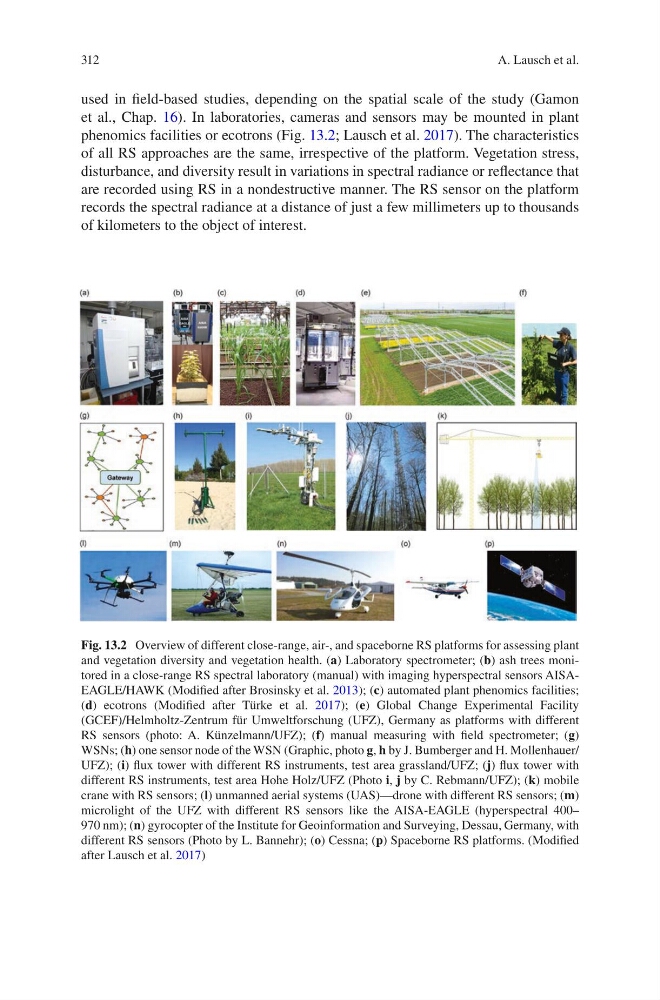
phenomics facilities or ecotrons (Fig. 13.2; Lausch et al. 2017). The characteristics
of all RS approaches are the same, irrespective of the platform. Vegetation stress,
disturbance, and diversity result in variations in spectral radiance or reflectance that
are recorded using RS in a nondestructive manner. The RS sensor on the platform
records the spectral radiance at a distance of just a few millimeters up to thousands
of kilometers to the object of interest.
Fig. 13.2 Overview of different close-range, air-, and spaceborne RS platforms for assessing plant
and vegetation diversity and vegetation health. (a) Laboratory spectrometer; (b) ash trees monitored in a close-range RS spectral laboratory (manual) with imaging hyperspectral sensors AISAEAGLE/HAWK (Modified after Brosinsky et al. 2013); (c) automated plant phenomics facilities;
(d) ecotrons (Modified after Türke et al. 2017); (e) Global Change Experimental Facility
(GCEF)/Helmholtz-Zentrum für Umweltforschung (UFZ), Germany as platforms with different
RS sensors (photo: A. Künzelmann/UFZ); (f) manual measuring with field spectrometer; (g)
WSNs; (h) one sensor node of the WSN (Graphic, photo g, h by J. Bumberger and H. Mollenhauer/
UFZ); (i) flux tower with different RS instruments, test area grassland/UFZ; (j) flux tower with
different RS instruments, test area Hohe Holz/UFZ (Photo i, j by C. Rebmann/UFZ); (k) mobile
crane with RS sensors; (l) unmanned aerial systems (UAS)—drone with different RS sensors; (m)
microlight of the UFZ with different RS sensors like the AISA-EAGLE (hyperspectral 400–
970 nm); (n) gyrocopter of the Institute for Geoinformation and Surveying, Dessau, Germany, with
different RS sensors (Photo by L. Bannehr); (o) Cessna; (p) Spaceborne RS platforms. (Modified
after Lausch et al. 2017)
A. Lausch et al.
used in field-based studies, depending on the spatial scale of the study (Gamon
et al., Chap. 16). In laboratories, cameras and sensors may be mounted in plant
phenomics facilities or ecotrons (Fig. 13.2; Lausch et al. 2017). The characteristics
of all RS approaches are the same, irrespective of the platform. Vegetation stress,
disturbance, and diversity result in variations in spectral radiance or reflectance that
are recorded using RS in a nondestructive manner. The RS sensor on the platform
records the spectral radiance at a distance of just a few millimeters up to thousands
of kilometers to the object of interest.
Fig. 13.2 Overview of different close-range, air-, and spaceborne RS platforms for assessing plant
and vegetation diversity and vegetation health. (a) Laboratory spectrometer; (b) ash trees monitored in a close-range RS spectral laboratory (manual) with imaging hyperspectral sensors AISAEAGLE/HAWK (Modified after Brosinsky et al. 2013); (c) automated plant phenomics facilities;
(d) ecotrons (Modified after Türke et al. 2017); (e) Global Change Experimental Facility
(GCEF)/Helmholtz-Zentrum für Umweltforschung (UFZ), Germany as platforms with different
RS sensors (photo: A. Künzelmann/UFZ); (f) manual measuring with field spectrometer; (g)
WSNs; (h) one sensor node of the WSN (Graphic, photo g, h by J. Bumberger and H. Mollenhauer/
UFZ); (i) flux tower with different RS instruments, test area grassland/UFZ; (j) flux tower with
different RS instruments, test area Hohe Holz/UFZ (Photo i, j by C. Rebmann/UFZ); (k) mobile
crane with RS sensors; (l) unmanned aerial systems (UAS)—drone with different RS sensors; (m)
microlight of the UFZ with different RS sensors like the AISA-EAGLE (hyperspectral 400–
970 nm); (n) gyrocopter of the Institute for Geoinformation and Surveying, Dessau, Germany, with
different RS sensors (Photo by L. Bannehr); (o) Cessna; (p) Spaceborne RS platforms. (Modified
after Lausch et al. 2017)
A. Lausch et al.