

295
decade) to characterize phenology for widespread IAS detection, particularly for
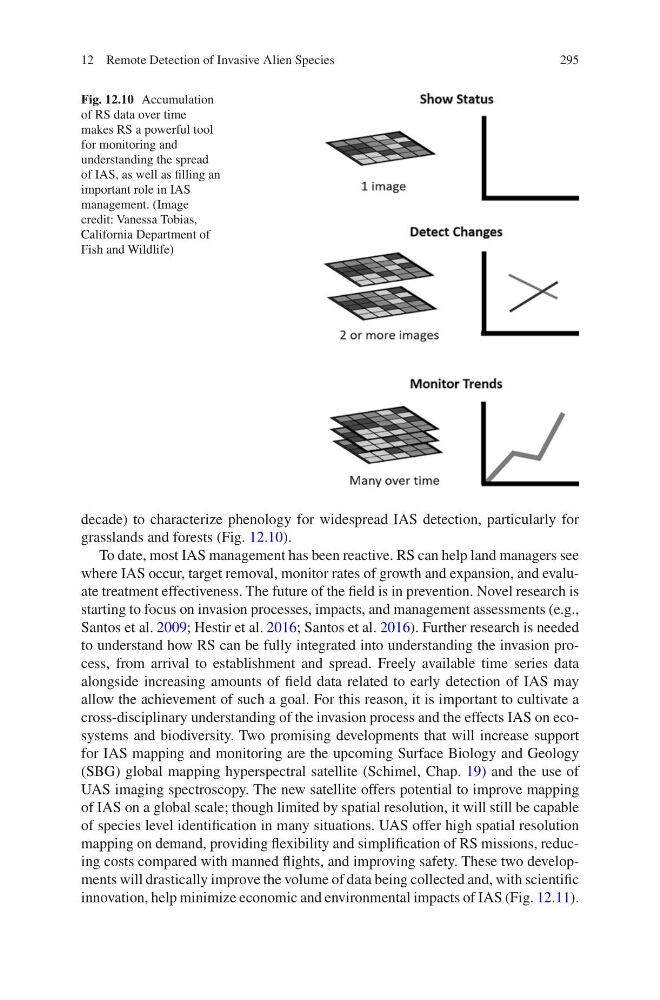
grasslands and forests (Fig. 12.10).
To date, most IAS management has been reactive. RS can help land managers see
where IAS occur, target removal, monitor rates of growth and expansion, and evaluate treatment effectiveness. The future of the field is in prevention. Novel research is
starting to focus on invasion processes, impacts, and management assessments (e.g.,
Santos et al. 2009; Hestir et al. 2016; Santos et al. 2016). Further research is needed
to understand how RS can be fully integrated into understanding the invasion process, from arrival to establishment and spread. Freely available time series data
alongside increasing amounts of field data related to early detection of IAS may
allow the achievement of such a goal. For this reason, it is important to cultivate a
cross-disciplinary understanding of the invasion process and the effects IAS on ecosystems and biodiversity. Two promising developments that will increase support
for IAS mapping and monitoring are the upcoming Surface Biology and Geology
(SBG) global mapping hyperspectral satellite (Schimel, Chap. 19) and the use of
UAS imaging spectroscopy. The new satellite offers potential to improve mapping
of IAS on a global scale; though limited by spatial resolution, it will still be capable
of species level identification in many situations. UAS offer high spatial resolution
mapping on demand, providing flexibility and simplification of RS missions, reducing costs compared with manned flights, and improving safety. These two developments will drastically improve the volume of data being collected and, with scientific
innovation, help minimize economic and environmental impacts of IAS (Fig. 12.11).
Fig. 12.10 Accumulation
of RS data over time
makes RS a powerful tool
for monitoring and
understanding the spread
of IAS, as well as filling an
important role in IAS
management. (Image
credit: Vanessa Tobias,
California Department of
Fish and Wildlife)
12 Remote Detection of Invasive Alien Species
decade) to characterize phenology for widespread IAS detection, particularly for
grasslands and forests (Fig. 12.10).
To date, most IAS management has been reactive. RS can help land managers see
where IAS occur, target removal, monitor rates of growth and expansion, and evaluate treatment effectiveness. The future of the field is in prevention. Novel research is
starting to focus on invasion processes, impacts, and management assessments (e.g.,
Santos et al. 2009; Hestir et al. 2016; Santos et al. 2016). Further research is needed
to understand how RS can be fully integrated into understanding the invasion process, from arrival to establishment and spread. Freely available time series data
alongside increasing amounts of field data related to early detection of IAS may
allow the achievement of such a goal. For this reason, it is important to cultivate a
cross-disciplinary understanding of the invasion process and the effects IAS on ecosystems and biodiversity. Two promising developments that will increase support
for IAS mapping and monitoring are the upcoming Surface Biology and Geology
(SBG) global mapping hyperspectral satellite (Schimel, Chap. 19) and the use of
UAS imaging spectroscopy. The new satellite offers potential to improve mapping
of IAS on a global scale; though limited by spatial resolution, it will still be capable
of species level identification in many situations. UAS offer high spatial resolution
mapping on demand, providing flexibility and simplification of RS missions, reducing costs compared with manned flights, and improving safety. These two developments will drastically improve the volume of data being collected and, with scientific
innovation, help minimize economic and environmental impacts of IAS (Fig. 12.11).
Fig. 12.10 Accumulation
of RS data over time
makes RS a powerful tool
for monitoring and
understanding the spread
of IAS, as well as filling an
important role in IAS
management. (Image
credit: Vanessa Tobias,
California Department of
Fish and Wildlife)
12 Remote Detection of Invasive Alien Species