

95
4.4.4 Computation of Functional Richness
To showcase how the RTM-validated EO traits can be used for spatially explicit
diversity assessments, we compute the functional richness within the 3-D trait space
using a spatial subset of pixels (e.g., in a 60 m × 60 m box containing 100 pixels). In
the case of the morphological traits, the 3-D trait space is spanned by the axes CH,
PAI, and FHD, whereas for the physiological traits the trait space is spanned by the
axes CHL, CAR, and EWT. The richness within the trait space is based on volume
of a 3-D convex hull of all pixels’ trait values (i.e., the larger the variation of the
respective traits, the larger the volume of the convex hull). As an example, if all trait
values were the same, the richness would be zero because no volume would be
spanned in the 3-D trait space. Computing the richness using a pixel-based approach
has the advantage of resolving both inter- and intraspecific variation of the traits,
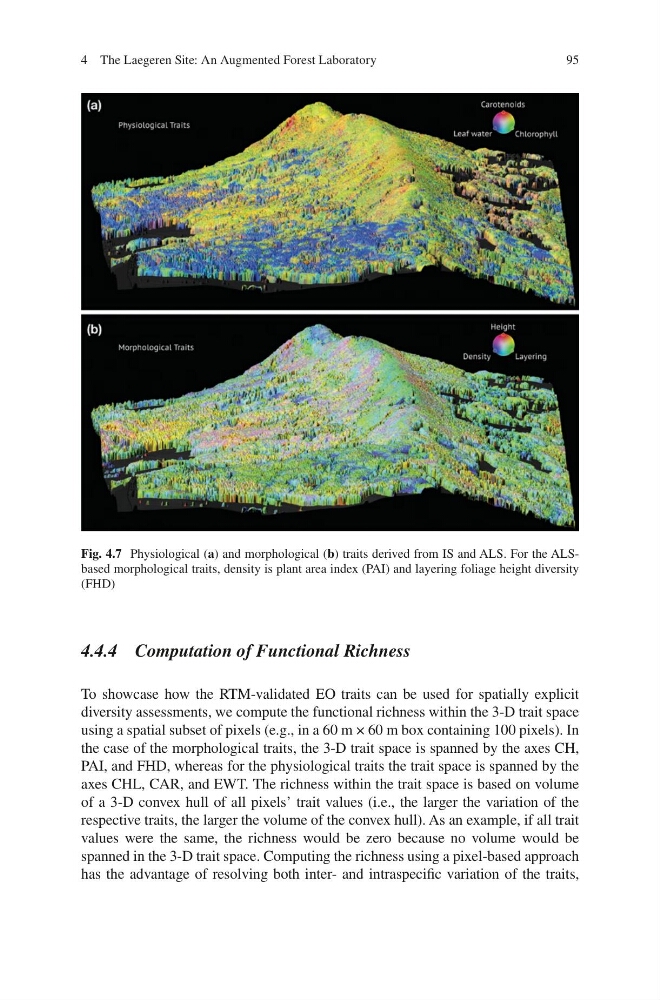
Fig. 4.7 Physiological (a) and morphological (b) traits derived from IS and ALS. For the ALSbased morphological traits, density is plant area index (PAI) and layering foliage height diversity
(FHD)
4 The Laegeren Site: An Augmented Forest Laboratory
4.4.4 Computation of Functional Richness
To showcase how the RTM-validated EO traits can be used for spatially explicit
diversity assessments, we compute the functional richness within the 3-D trait space
using a spatial subset of pixels (e.g., in a 60 m × 60 m box containing 100 pixels). In
the case of the morphological traits, the 3-D trait space is spanned by the axes CH,
PAI, and FHD, whereas for the physiological traits the trait space is spanned by the
axes CHL, CAR, and EWT. The richness within the trait space is based on volume
of a 3-D convex hull of all pixels’ trait values (i.e., the larger the variation of the
respective traits, the larger the volume of the convex hull). As an example, if all trait
values were the same, the richness would be zero because no volume would be
spanned in the 3-D trait space. Computing the richness using a pixel-based approach
has the advantage of resolving both inter- and intraspecific variation of the traits,
Fig. 4.7 Physiological (a) and morphological (b) traits derived from IS and ALS. For the ALSbased morphological traits, density is plant area index (PAI) and layering foliage height diversity
(FHD)
4 The Laegeren Site: An Augmented Forest Laboratory