

separation into the different components is achieved. The reproducibility of multiple fractionations is very good, as can be seen in Fig. 2.48 for the same resin. This
makes CEF a preferred choice for conducting fast and repeated fractionations, for
example, of an unknown material. Sufficiently large fractions can be accumulated
that allow further analyses, e.g. by NMR spectroscopy.
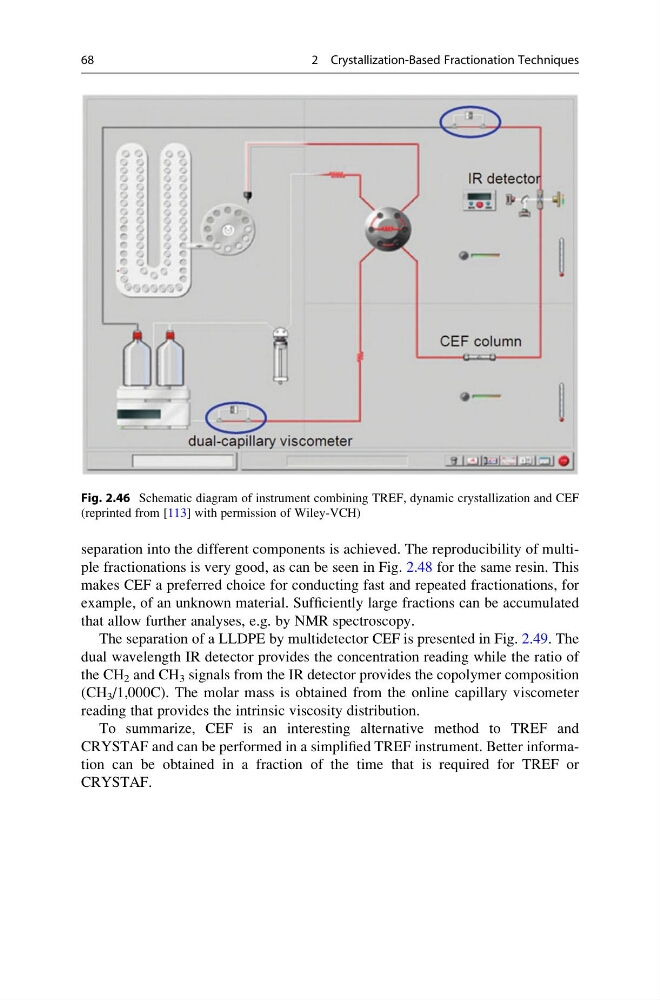
The separation of a LLDPE by multidetector CEF is presented in Fig. 2.49. The
dual wavelength IR detector provides the concentration reading while the ratio of
the CH 2 and CH 3 signals from the IR detector provides the copolymer composition
(CH 3 /1,000C). The molar mass is obtained from the online capillary viscometer
reading that provides the intrinsic viscosity distribution.
To summarize, CEF is an interesting alternative method to TREF and
CRYSTAF and can be performed in a simplified TREF instrument. Better information can be obtained in a fraction of the time that is required for TREF or
CRYSTAF.
Fig. 2.46 Schematic diagram of instrument combining TREF, dynamic crystallization and CEF
(reprinted from [113] with permission of Wiley-VCH)
68
2 Crystallization-Based Fractionation Techniques
makes CEF a preferred choice for conducting fast and repeated fractionations, for
example, of an unknown material. Sufficiently large fractions can be accumulated
that allow further analyses, e.g. by NMR spectroscopy.
The separation of a LLDPE by multidetector CEF is presented in Fig. 2.49. The
dual wavelength IR detector provides the concentration reading while the ratio of
the CH 2 and CH 3 signals from the IR detector provides the copolymer composition
(CH 3 /1,000C). The molar mass is obtained from the online capillary viscometer
reading that provides the intrinsic viscosity distribution.
To summarize, CEF is an interesting alternative method to TREF and
CRYSTAF and can be performed in a simplified TREF instrument. Better information can be obtained in a fraction of the time that is required for TREF or
CRYSTAF.
Fig. 2.46 Schematic diagram of instrument combining TREF, dynamic crystallization and CEF
(reprinted from [113] with permission of Wiley-VCH)
68
2 Crystallization-Based Fractionation Techniques