

propylene-1-butene showed crystalline behaviour over the entire range of
compositions, indicating the co-crystallization of 1-butene with propylene [112].
2.3
Crystallization Elution Fractionation
A further refinement of crystallization-based fractionation techniques was recently
introduced by Monrabal et al. with the development of crystallization elution
fractionation (CEF) [113]. Combining the advantages of TREF and CRYSTAF,
the aim of CEF is to improve the separation and to decrease the fractionation time.
This is achieved by using dynamic crystallization as the first step of the process. In
TREF, crystallization takes place in the column statically and all polymer fractions
crystallize on the solid support at the same location, forming onion-like crystalline
layers; see Fig. 2.1. In CEF, crystallization of the different polymer fractions takes
place at different locations in the column. This is achieved by applying a small flow
of the solvent in the column.
Figure 2.44 demonstrates the differences between normal TREF, dynamic crystallization and CEF. Figure 2.44a depicts the typical TREF process, where the first
step is sample loading at high temperature, followed by stepwise crystallization of
the polymer components by crystallizability. The same sample loading is the first
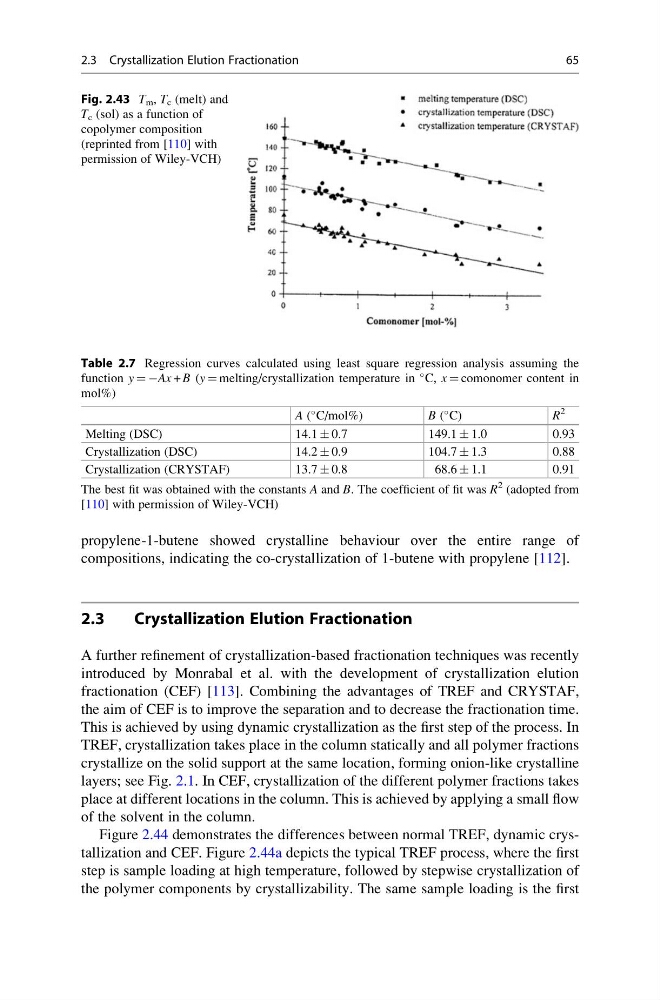
Fig. 2.43 T m , T c (melt) and
T c (sol) as a function of
copolymer composition
(reprinted from [110] with
permission of Wiley-VCH)
Table 2.7 Regression curves calculated using least square regression analysis assuming the
function y ¼ ÀAx + B (y ¼ melting/crystallization temperature in
C, x ¼ comonomer content in
mol%)
A (
C/mol%)
B (
C)
R
2
Melting (DSC)
14.1 Æ 0.7
149.1 Æ 1.0
0.93
Crystallization (DSC)
14.2 Æ 0.9
104.7 Æ 1.3
0.88
Crystallization (CRYSTAF)
13.7 Æ 0.8
68.6 Æ 1.1
0.91
The best fit was obtained with the constants A and B. The coefficient of fit was R
2 (adopted from
[110] with permission of Wiley-VCH)
2.3 Crystallization Elution Fractionation
65
compositions, indicating the co-crystallization of 1-butene with propylene [112].
2.3
Crystallization Elution Fractionation
A further refinement of crystallization-based fractionation techniques was recently
introduced by Monrabal et al. with the development of crystallization elution
fractionation (CEF) [113]. Combining the advantages of TREF and CRYSTAF,
the aim of CEF is to improve the separation and to decrease the fractionation time.
This is achieved by using dynamic crystallization as the first step of the process. In
TREF, crystallization takes place in the column statically and all polymer fractions
crystallize on the solid support at the same location, forming onion-like crystalline
layers; see Fig. 2.1. In CEF, crystallization of the different polymer fractions takes
place at different locations in the column. This is achieved by applying a small flow
of the solvent in the column.
Figure 2.44 demonstrates the differences between normal TREF, dynamic crystallization and CEF. Figure 2.44a depicts the typical TREF process, where the first
step is sample loading at high temperature, followed by stepwise crystallization of
the polymer components by crystallizability. The same sample loading is the first
Fig. 2.43 T m , T c (melt) and
T c (sol) as a function of
copolymer composition
(reprinted from [110] with
permission of Wiley-VCH)
Table 2.7 Regression curves calculated using least square regression analysis assuming the
function y ¼ ÀAx + B (y ¼ melting/crystallization temperature in
C, x ¼ comonomer content in
mol%)
A (
C/mol%)
B (
C)
R
2
Melting (DSC)
14.1 Æ 0.7
149.1 Æ 1.0
0.93
Crystallization (DSC)
14.2 Æ 0.9
104.7 Æ 1.3
0.88
Crystallization (CRYSTAF)
13.7 Æ 0.8
68.6 Æ 1.1
0.91
The best fit was obtained with the constants A and B. The coefficient of fit was R
2 (adopted from
[110] with permission of Wiley-VCH)
2.3 Crystallization Elution Fractionation
65