

copolymers as a function of the comonomer content. It can be clearly seen that
melting point depression is independent of the type of comonomer. The molar mass
of the copolymers was not treated as an independent variable as the molar masses
were sufficiently high not to be an influencing factor.
For the investigation of the crystallization behaviour, a constant cooling rate was
applied to the crystallization from the melt (DSC) and from dilute solution
(CRYSTAF). It is well accepted from TREF studies of polyolefins that above a
molar mass of 15 kg/mol the crystallization behaviour is independent of the chain
length [5]. The molar masses of propylene/higher α-olefin copolymers in the
current study are well above this threshold; therefore crystallization behaviour is
presumed to be independent of molar mass. DSC measurements provided T c (melt),
and are plotted against comonomer content of all copolymers; see Fig. 2.41b. The
decrease of T c (melt) with increasing comonomer content seems to be independent
of the nature of the respective comonomers. The explanation given earlier for
depression in the melting point being independent of the comonomer type is valid
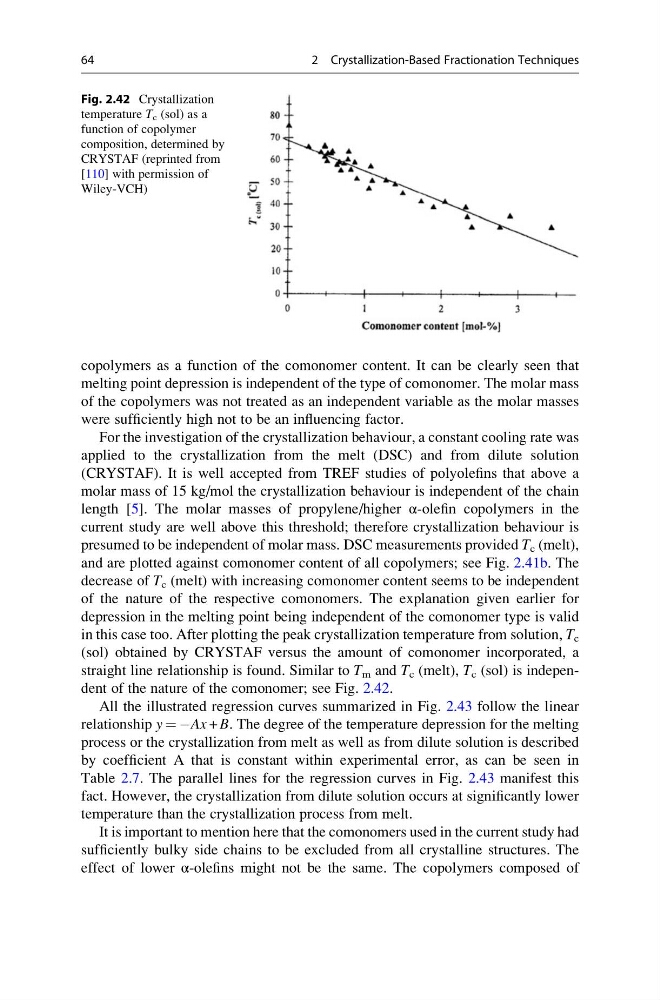
in this case too. After plotting the peak crystallization temperature from solution, T c
(sol) obtained by CRYSTAF versus the amount of comonomer incorporated, a
straight line relationship is found. Similar to T m and T c (melt), T c (sol) is independent of the nature of the comonomer; see Fig. 2.42.
All the illustrated regression curves summarized in Fig. 2.43 follow the linear
relationship y ¼ ÀAx + B. The degree of the temperature depression for the melting
process or the crystallization from melt as well as from dilute solution is described
by coefficient A that is constant within experimental error, as can be seen in
Table 2.7. The parallel lines for the regression curves in Fig. 2.43 manifest this
fact. However, the crystallization from dilute solution occurs at significantly lower
temperature than the crystallization process from melt.
It is important to mention here that the comonomers used in the current study had
sufficiently bulky side chains to be excluded from all crystalline structures. The
effect of lower α-olefins might not be the same. The copolymers composed of
Fig. 2.42 Crystallization
temperature T c (sol) as a
function of copolymer
composition, determined by
CRYSTAF (reprinted from
[110] with permission of
Wiley-VCH)
64
2 Crystallization-Based Fractionation Techniques
melting point depression is independent of the type of comonomer. The molar mass
of the copolymers was not treated as an independent variable as the molar masses
were sufficiently high not to be an influencing factor.
For the investigation of the crystallization behaviour, a constant cooling rate was
applied to the crystallization from the melt (DSC) and from dilute solution
(CRYSTAF). It is well accepted from TREF studies of polyolefins that above a
molar mass of 15 kg/mol the crystallization behaviour is independent of the chain
length [5]. The molar masses of propylene/higher α-olefin copolymers in the
current study are well above this threshold; therefore crystallization behaviour is
presumed to be independent of molar mass. DSC measurements provided T c (melt),
and are plotted against comonomer content of all copolymers; see Fig. 2.41b. The
decrease of T c (melt) with increasing comonomer content seems to be independent
of the nature of the respective comonomers. The explanation given earlier for
depression in the melting point being independent of the comonomer type is valid
in this case too. After plotting the peak crystallization temperature from solution, T c
(sol) obtained by CRYSTAF versus the amount of comonomer incorporated, a
straight line relationship is found. Similar to T m and T c (melt), T c (sol) is independent of the nature of the comonomer; see Fig. 2.42.
All the illustrated regression curves summarized in Fig. 2.43 follow the linear
relationship y ¼ ÀAx + B. The degree of the temperature depression for the melting
process or the crystallization from melt as well as from dilute solution is described
by coefficient A that is constant within experimental error, as can be seen in
Table 2.7. The parallel lines for the regression curves in Fig. 2.43 manifest this
fact. However, the crystallization from dilute solution occurs at significantly lower
temperature than the crystallization process from melt.
It is important to mention here that the comonomers used in the current study had
sufficiently bulky side chains to be excluded from all crystalline structures. The
effect of lower α-olefins might not be the same. The copolymers composed of
Fig. 2.42 Crystallization
temperature T c (sol) as a
function of copolymer
composition, determined by
CRYSTAF (reprinted from
[110] with permission of
Wiley-VCH)
64
2 Crystallization-Based Fractionation Techniques