

2.2.2 Analysis of Blends of Polyethylene and Polypropylene [104]
Polymer blends are very important commercial materials that combine useful
properties of different polymers in a single product without involving any chemical
reaction. The approach provides a good alternative to developing new tailor-made
polymeric structures. The blending is a particularly feasible and commercially
viable approach for polyolefins. Polyolefin blends ranging from blends of
homopolymers to blends of homo- and copolymers are commercially available to
achieve some selected application properties.
There are no universal methods available for the identification and quantitative
determination of blend components and this is a demanding analytical challenge.
The most widely used techniques for this purpose are spectroscopic techniques such
as FTIR and NMR. These are averaging techniques; they are unable to differentiate
between mixtures of two homopolymers and a copolymer with similar chemical
compositions. Therefore, a separation step is often required prior to spectroscopic
analysis for proper characterization of these complex polymers. This is particularly
challenging for polyolefin blends because they dissolve only at high temperatures.
The most widely used method to separate polymer blends is the separation
according to molar mass by SEC. This is only a viable method if the blend
components have sufficiently different molar masses. DSC or TREF provide
other approaches for compositional analysis by determining the melting and crystallization behaviour, respectively. DSC is advantageous in the analysis of blends
due to the required equipment being simple and widely available. Another advantage of using DSC for blend analysis is that very small amounts of components can
be detected. However, quantitative analysis by DSC is problematic. Thermal
history problems that must be considered in DSC are eliminated in TREF as
crystallization takes place from dilute solutions. TREF has been successfully used
for the separation of copolymers and polymer blends [16, 105–109]. The separation
and quantification of different components of the blends of HDPE, LDPE, LLDPE
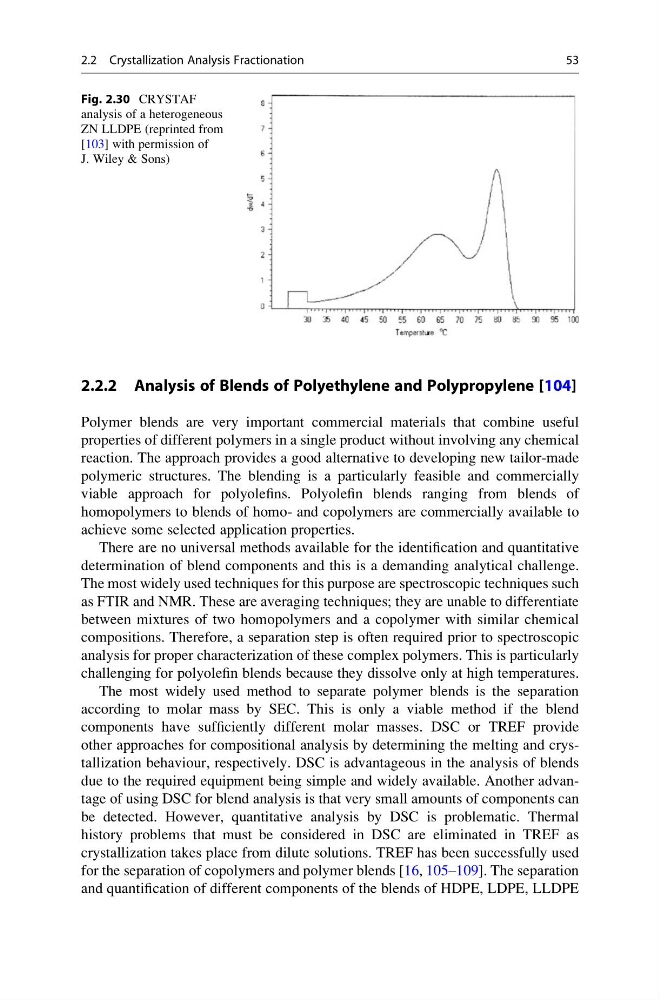
Fig. 2.30 CRYSTAF
analysis of a heterogeneous
ZN LLDPE (reprinted from
[103] with permission of
J. Wiley & Sons)
2.2 Crystallization Analysis Fractionation
53
Polymer blends are very important commercial materials that combine useful
properties of different polymers in a single product without involving any chemical
reaction. The approach provides a good alternative to developing new tailor-made
polymeric structures. The blending is a particularly feasible and commercially
viable approach for polyolefins. Polyolefin blends ranging from blends of
homopolymers to blends of homo- and copolymers are commercially available to
achieve some selected application properties.
There are no universal methods available for the identification and quantitative
determination of blend components and this is a demanding analytical challenge.
The most widely used techniques for this purpose are spectroscopic techniques such
as FTIR and NMR. These are averaging techniques; they are unable to differentiate
between mixtures of two homopolymers and a copolymer with similar chemical
compositions. Therefore, a separation step is often required prior to spectroscopic
analysis for proper characterization of these complex polymers. This is particularly
challenging for polyolefin blends because they dissolve only at high temperatures.
The most widely used method to separate polymer blends is the separation
according to molar mass by SEC. This is only a viable method if the blend
components have sufficiently different molar masses. DSC or TREF provide
other approaches for compositional analysis by determining the melting and crystallization behaviour, respectively. DSC is advantageous in the analysis of blends
due to the required equipment being simple and widely available. Another advantage of using DSC for blend analysis is that very small amounts of components can
be detected. However, quantitative analysis by DSC is problematic. Thermal
history problems that must be considered in DSC are eliminated in TREF as
crystallization takes place from dilute solutions. TREF has been successfully used
for the separation of copolymers and polymer blends [16, 105–109]. The separation
and quantification of different components of the blends of HDPE, LDPE, LLDPE
Fig. 2.30 CRYSTAF
analysis of a heterogeneous
ZN LLDPE (reprinted from
[103] with permission of
J. Wiley & Sons)
2.2 Crystallization Analysis Fractionation
53