

Alternatively, the polymer solution can be mixed with the support in a beaker or
flask. In the next step, the temperature of the column (beaker, flask) is slowly
decreased from high to ambient in order to crystallize polymer fractions out of the
solution. At the highest temperature, the highly crystalline fractions will precipitate
on the solid support followed by fractions of lower crystallinity. Accordingly,
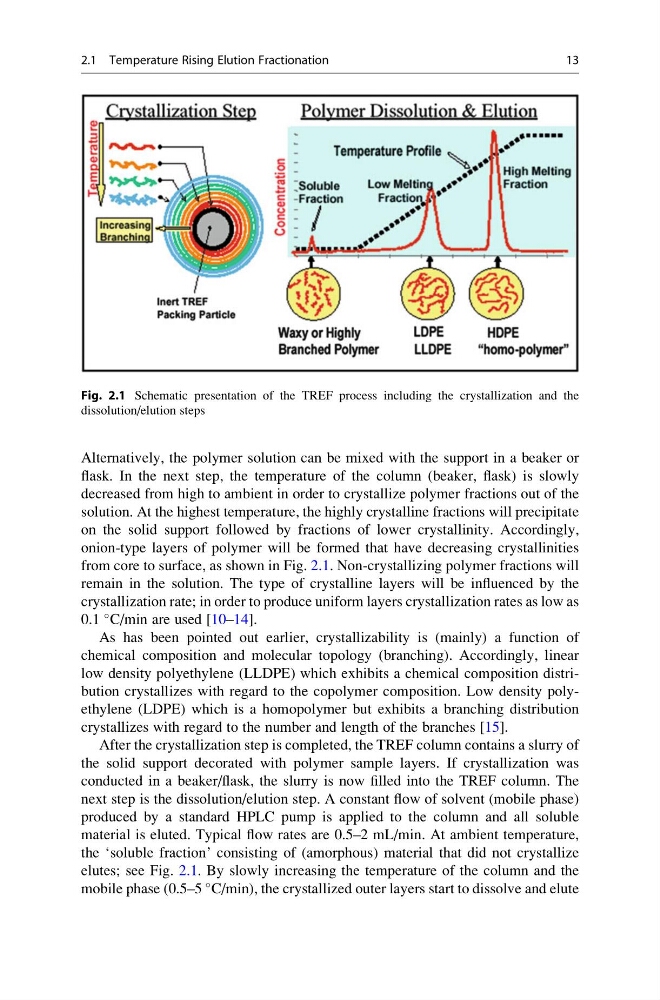
onion-type layers of polymer will be formed that have decreasing crystallinities
from core to surface, as shown in Fig. 2.1. Non-crystallizing polymer fractions will
remain in the solution. The type of crystalline layers will be influenced by the
crystallization rate; in order to produce uniform layers crystallization rates as low as
0.1
C/min are used [10–14].
As has been pointed out earlier, crystallizability is (mainly) a function of
chemical composition and molecular topology (branching). Accordingly, linear
low density polyethylene (LLDPE) which exhibits a chemical composition distribution crystallizes with regard to the copolymer composition. Low density polyethylene (LDPE) which is a homopolymer but exhibits a branching distribution
crystallizes with regard to the number and length of the branches [15].
After the crystallization step is completed, the TREF column contains a slurry of
the solid support decorated with polymer sample layers. If crystallization was
conducted in a beaker/flask, the slurry is now filled into the TREF column. The
next step is the dissolution/elution step. A constant flow of solvent (mobile phase)
produced by a standard HPLC pump is applied to the column and all soluble
material is eluted. Typical flow rates are 0.5–2 mL/min. At ambient temperature,
the ‘soluble fraction’ consisting of (amorphous) material that did not crystallize
elutes; see Fig. 2.1. By slowly increasing the temperature of the column and the
mobile phase (0.5–5
C/min), the crystallized outer layers start to dissolve and elute
Fig. 2.1 Schematic presentation of the TREF process including the crystallization and the
dissolution/elution steps
2.1 Temperature Rising Elution Fractionation
13
flask. In the next step, the temperature of the column (beaker, flask) is slowly
decreased from high to ambient in order to crystallize polymer fractions out of the
solution. At the highest temperature, the highly crystalline fractions will precipitate
on the solid support followed by fractions of lower crystallinity. Accordingly,
onion-type layers of polymer will be formed that have decreasing crystallinities
from core to surface, as shown in Fig. 2.1. Non-crystallizing polymer fractions will
remain in the solution. The type of crystalline layers will be influenced by the
crystallization rate; in order to produce uniform layers crystallization rates as low as
0.1
C/min are used [10–14].
As has been pointed out earlier, crystallizability is (mainly) a function of
chemical composition and molecular topology (branching). Accordingly, linear
low density polyethylene (LLDPE) which exhibits a chemical composition distribution crystallizes with regard to the copolymer composition. Low density polyethylene (LDPE) which is a homopolymer but exhibits a branching distribution
crystallizes with regard to the number and length of the branches [15].
After the crystallization step is completed, the TREF column contains a slurry of
the solid support decorated with polymer sample layers. If crystallization was
conducted in a beaker/flask, the slurry is now filled into the TREF column. The
next step is the dissolution/elution step. A constant flow of solvent (mobile phase)
produced by a standard HPLC pump is applied to the column and all soluble
material is eluted. Typical flow rates are 0.5–2 mL/min. At ambient temperature,
the ‘soluble fraction’ consisting of (amorphous) material that did not crystallize
elutes; see Fig. 2.1. By slowly increasing the temperature of the column and the
mobile phase (0.5–5
C/min), the crystallized outer layers start to dissolve and elute
Fig. 2.1 Schematic presentation of the TREF process including the crystallization and the
dissolution/elution steps
2.1 Temperature Rising Elution Fractionation
13