

in crystallization behaviours of different polymers are the basis of fractionation in
these techniques expressed by differences in crystallizability as a function of
temperature. A discussion of the various experimental approaches to obtain final
results will be given in the following chapters. Long analysis times and the limitation of the techniques to only the crystallizable part of the sample are the major
disadvantages of the techniques in this category. The amorphous part cannot be
fractionated and is obtained as a bulk fraction. Historically, TREF analysis required
around 100 h to be completed. New developments in the field have reduced TREF
analysis time to 3–4 h. CRYSTAF analysis can be accomplished in 100 min while
the latest development in crystallization-based techniques—CEF—allows analysis
to be completed in less than 30 min.
2.1
Temperature Rising Elution Fractionation
There are numerous excellent reviews on TREF that have been published over the
years. These reviews demonstrate very clearly that, to date, TREF is the most
important fractionation technique for semi-crystalline polyolefins and is a standard
method in the polyolefin industry. Most recent and comprehensive reviews have
been presented by Soares and Hamielec [6, 7], Monrabal [8, 9] and Pasch, Malik
and Macko [10].
The principles of polymer fractionation by solubility or crystallization such as
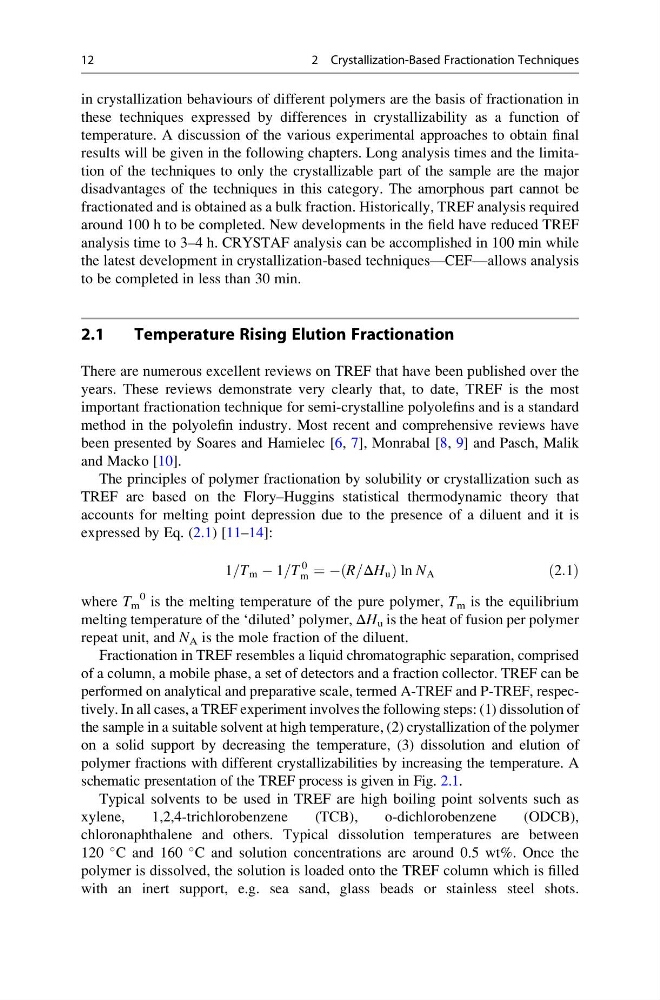
TREF are based on the Flory–Huggins statistical thermodynamic theory that
accounts for melting point depression due to the presence of a diluent and it is
expressed by Eq. (2.1) [11–14]:
1=T m À 1=T
0
m ¼ À R=ΔH u
ð
Þln N A
ð2:1Þ
where T m
0 is the melting temperature of the pure polymer, T m is the equilibrium
melting temperature of the ‘diluted’ polymer, ΔH u is the heat of fusion per polymer
repeat unit, and N A is the mole fraction of the diluent.
Fractionation in TREF resembles a liquid chromatographic separation, comprised
of a column, a mobile phase, a set of detectors and a fraction collector. TREF can be
performed on analytical and preparative scale, termed A-TREF and P-TREF, respectively. In all cases, a TREF experiment involves the following steps: (1) dissolution of
the sample in a suitable solvent at high temperature, (2) crystallization of the polymer
on a solid support by decreasing the temperature, (3) dissolution and elution of
polymer fractions with different crystallizabilities by increasing the temperature. A
schematic presentation of the TREF process is given in Fig. 2.1.
Typical solvents to be used in TREF are high boiling point solvents such as
xylene,
1,2,4-trichlorobenzene
(TCB),
o-dichlorobenzene
(ODCB),
chloronaphthalene and others. Typical dissolution temperatures are between
120
C and 160
C and solution concentrations are around 0.5 wt%. Once the
polymer is dissolved, the solution is loaded onto the TREF column which is filled
with an inert support, e.g. sea sand, glass beads or stainless steel shots.
12
2 Crystallization-Based Fractionation Techniques
these techniques expressed by differences in crystallizability as a function of
temperature. A discussion of the various experimental approaches to obtain final
results will be given in the following chapters. Long analysis times and the limitation of the techniques to only the crystallizable part of the sample are the major
disadvantages of the techniques in this category. The amorphous part cannot be
fractionated and is obtained as a bulk fraction. Historically, TREF analysis required
around 100 h to be completed. New developments in the field have reduced TREF
analysis time to 3–4 h. CRYSTAF analysis can be accomplished in 100 min while
the latest development in crystallization-based techniques—CEF—allows analysis
to be completed in less than 30 min.
2.1
Temperature Rising Elution Fractionation
There are numerous excellent reviews on TREF that have been published over the
years. These reviews demonstrate very clearly that, to date, TREF is the most
important fractionation technique for semi-crystalline polyolefins and is a standard
method in the polyolefin industry. Most recent and comprehensive reviews have
been presented by Soares and Hamielec [6, 7], Monrabal [8, 9] and Pasch, Malik
and Macko [10].
The principles of polymer fractionation by solubility or crystallization such as
TREF are based on the Flory–Huggins statistical thermodynamic theory that
accounts for melting point depression due to the presence of a diluent and it is
expressed by Eq. (2.1) [11–14]:
1=T m À 1=T
0
m ¼ À R=ΔH u
ð
Þln N A
ð2:1Þ
where T m
0 is the melting temperature of the pure polymer, T m is the equilibrium
melting temperature of the ‘diluted’ polymer, ΔH u is the heat of fusion per polymer
repeat unit, and N A is the mole fraction of the diluent.
Fractionation in TREF resembles a liquid chromatographic separation, comprised
of a column, a mobile phase, a set of detectors and a fraction collector. TREF can be
performed on analytical and preparative scale, termed A-TREF and P-TREF, respectively. In all cases, a TREF experiment involves the following steps: (1) dissolution of
the sample in a suitable solvent at high temperature, (2) crystallization of the polymer
on a solid support by decreasing the temperature, (3) dissolution and elution of
polymer fractions with different crystallizabilities by increasing the temperature. A
schematic presentation of the TREF process is given in Fig. 2.1.
Typical solvents to be used in TREF are high boiling point solvents such as
xylene,
1,2,4-trichlorobenzene
(TCB),
o-dichlorobenzene
(ODCB),
chloronaphthalene and others. Typical dissolution temperatures are between
120
C and 160
C and solution concentrations are around 0.5 wt%. Once the
polymer is dissolved, the solution is loaded onto the TREF column which is filled
with an inert support, e.g. sea sand, glass beads or stainless steel shots.
12
2 Crystallization-Based Fractionation Techniques