

1.2
Analytical Methods for Polyolefins
For the analysis of polyolefins, two types of molecular parameters are most
important: MMD and CCD. High temperature SEC is a relatively rapid method
for the determination of MMD. The detectors most commonly used for concentration detection are refractive index (RI) and infrared (IR) detectors. More advanced
detectors like an online viscometer (Visco) or a light scattering (LS) detector help to
determine chain dimensions and branching in terms of the hydrodynamic radius
(R h ) or the radius of gyration (R g ). With specific IR detectors, chain branching as a
function of MMD can be measured. As is known, SEC separates polymers
according to the hydrodynamic size of the molecules in solution [10–12]. The
size of polymer molecules in solution is influenced not only by the number of
repeat units in the polymer chain but also by the molecular architecture and the
chemical composition. Polymer molecules with identical hydrodynamic volumes
will co-elute in SEC, although they may have different chemical compositions and
different numbers of monomer units. Therefore, the knowledge of MMD obtained
by SEC analysis will not be sufficient to define the molecular heterogeneity of
complex polyolefins [13, 14].
Two methods are typically used to analyse the compositional heterogeneity of
polyolefins: TREF, developed in the late 1970s by Wild, and crystallization analysis fractionation (CRYSTAF), developed by Monrabal in the early 1990s. Both
methods fractionate the sample on the basis of crystallizability, which is a function
of both chemical composition and molecular architecture. They can be used to
fractionate semi-crystalline polyolefin copolymers and blends based on the crystallization of the macromolecules from a hot solution [15–19]. TREF and CRYSTAF
are based on slow crystallization and, therefore, require significant periods of time.
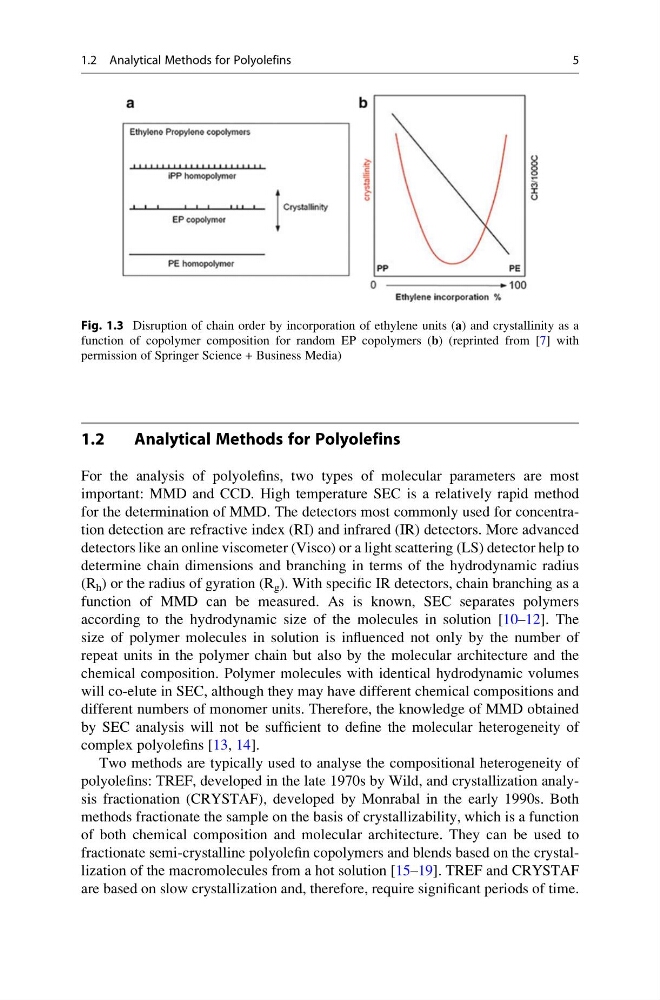
Fig. 1.3 Disruption of chain order by incorporation of ethylene units (a) and crystallinity as a
function of copolymer composition for random EP copolymers (b) (reprinted from [7] with
permission of Springer Science + Business Media)
1.2 Analytical Methods for Polyolefins
5
Analytical Methods for Polyolefins
For the analysis of polyolefins, two types of molecular parameters are most
important: MMD and CCD. High temperature SEC is a relatively rapid method
for the determination of MMD. The detectors most commonly used for concentration detection are refractive index (RI) and infrared (IR) detectors. More advanced
detectors like an online viscometer (Visco) or a light scattering (LS) detector help to
determine chain dimensions and branching in terms of the hydrodynamic radius
(R h ) or the radius of gyration (R g ). With specific IR detectors, chain branching as a
function of MMD can be measured. As is known, SEC separates polymers
according to the hydrodynamic size of the molecules in solution [10–12]. The
size of polymer molecules in solution is influenced not only by the number of
repeat units in the polymer chain but also by the molecular architecture and the
chemical composition. Polymer molecules with identical hydrodynamic volumes
will co-elute in SEC, although they may have different chemical compositions and
different numbers of monomer units. Therefore, the knowledge of MMD obtained
by SEC analysis will not be sufficient to define the molecular heterogeneity of
complex polyolefins [13, 14].
Two methods are typically used to analyse the compositional heterogeneity of
polyolefins: TREF, developed in the late 1970s by Wild, and crystallization analysis fractionation (CRYSTAF), developed by Monrabal in the early 1990s. Both
methods fractionate the sample on the basis of crystallizability, which is a function
of both chemical composition and molecular architecture. They can be used to
fractionate semi-crystalline polyolefin copolymers and blends based on the crystallization of the macromolecules from a hot solution [15–19]. TREF and CRYSTAF
are based on slow crystallization and, therefore, require significant periods of time.
Fig. 1.3 Disruption of chain order by incorporation of ethylene units (a) and crystallinity as a
function of copolymer composition for random EP copolymers (b) (reprinted from [7] with
permission of Springer Science + Business Media)
1.2 Analytical Methods for Polyolefins
5