

Degradation can be decelerated and minimized by stabilization, but it cannot be
fully stopped, as can be seen from the data shown in Figs. 4.13 and 4.14.
In a next step, HT-AF4-MALLS analyses of PE and PP samples with different
degrees of branching were conducted to investigate the relationship between
thermal degradation and the architecture of the polymer chain. The most important
outcome of this study was the abnormal late elution of highly branched polymers
with high molar mass molecules in SEC. Accordingly, it is not possible to determine the degree of branching by SEC-MALLS. As discussed previously, the late
elution and co-elution effects are not shown by HT-AF4. Therefore, the branched
samples were characterized by HT-AF4. The analyses of UHM linear PE and highly
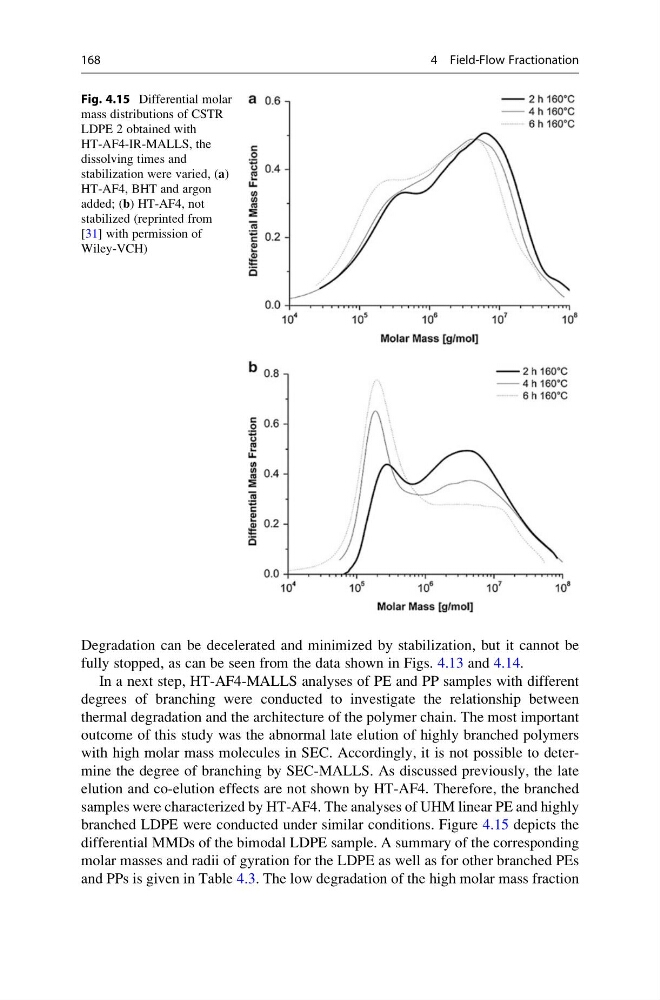
branched LDPE were conducted under similar conditions. Figure 4.15 depicts the
differential MMDs of the bimodal LDPE sample. A summary of the corresponding
molar masses and radii of gyration for the LDPE as well as for other branched PEs
and PPs is given in Table 4.3. The low degradation of the high molar mass fraction
Fig. 4.15 Differential molar
mass distributions of CSTR
LDPE 2 obtained with
HT-AF4-IR-MALLS, the
dissolving times and
stabilization were varied, (a)
HT-AF4, BHT and argon
added; (b) HT-AF4, not
stabilized (reprinted from
[31] with permission of
Wiley-VCH)
168
4 Field-Flow Fractionation
fully stopped, as can be seen from the data shown in Figs. 4.13 and 4.14.
In a next step, HT-AF4-MALLS analyses of PE and PP samples with different
degrees of branching were conducted to investigate the relationship between
thermal degradation and the architecture of the polymer chain. The most important
outcome of this study was the abnormal late elution of highly branched polymers
with high molar mass molecules in SEC. Accordingly, it is not possible to determine the degree of branching by SEC-MALLS. As discussed previously, the late
elution and co-elution effects are not shown by HT-AF4. Therefore, the branched
samples were characterized by HT-AF4. The analyses of UHM linear PE and highly
branched LDPE were conducted under similar conditions. Figure 4.15 depicts the
differential MMDs of the bimodal LDPE sample. A summary of the corresponding
molar masses and radii of gyration for the LDPE as well as for other branched PEs
and PPs is given in Table 4.3. The low degradation of the high molar mass fraction
Fig. 4.15 Differential molar
mass distributions of CSTR
LDPE 2 obtained with
HT-AF4-IR-MALLS, the
dissolving times and
stabilization were varied, (a)
HT-AF4, BHT and argon
added; (b) HT-AF4, not
stabilized (reprinted from
[31] with permission of
Wiley-VCH)
168
4 Field-Flow Fractionation