

is very difficult, or impossible, because shear-offset overlays the thermo-oxidative
degradation. For non-stabilized samples, differences between the molar masses
from SEC and AF4 are lower due to prior reduction of the molar mass by the
thermo-oxidative degradation. Shear degradation of the polymer sample is molar
mass dependent. Hence, samples already degraded by high temperatures during the
dissolution process will undergo considerably less shear degradation and the
resulting differences between the molar mass values from SEC and AF4 will not
be as great as would otherwise be obtained. The molar mass of the PP sample is
much lower than that of the UHM PE. It nonetheless sheared to a comparable or
even higher extent, which is an indication of the higher shear sensitivity of PP
compared to PE.
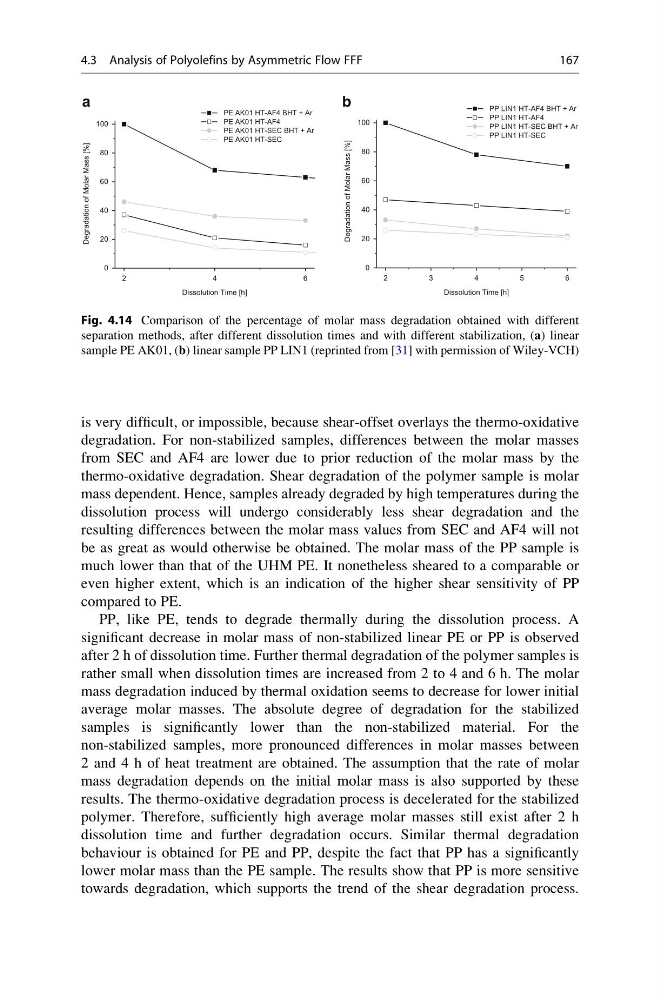
PP, like PE, tends to degrade thermally during the dissolution process. A
significant decrease in molar mass of non-stabilized linear PE or PP is observed
after 2 h of dissolution time. Further thermal degradation of the polymer samples is
rather small when dissolution times are increased from 2 to 4 and 6 h. The molar
mass degradation induced by thermal oxidation seems to decrease for lower initial
average molar masses. The absolute degree of degradation for the stabilized
samples is significantly lower than the non-stabilized material. For the
non-stabilized samples, more pronounced differences in molar masses between
2 and 4 h of heat treatment are obtained. The assumption that the rate of molar
mass degradation depends on the initial molar mass is also supported by these
results. The thermo-oxidative degradation process is decelerated for the stabilized
polymer. Therefore, sufficiently high average molar masses still exist after 2 h
dissolution time and further degradation occurs. Similar thermal degradation
behaviour is obtained for PE and PP, despite the fact that PP has a significantly
lower molar mass than the PE sample. The results show that PP is more sensitive
towards degradation, which supports the trend of the shear degradation process.
2
4
6
0
20
40
60
80
100
Degradation of Molar Mass [%]
Dissolution Time [h]
PE AK01 HT-AF4 BHT + Ar
PE AK01 HT-AF4
PE AK01 HT-SEC BHT + Ar
PE AK01 HT-SEC
2
3
4
5
6
0
20
40
60
80
100
Degradation of Molar Mass [%]
Dissolution Time [h]
PP LIN1 HT-AF4 BHT + Ar
PP LIN1 HT-AF4
PP LIN1 HT-SEC BHT + Ar
PP LIN1 HT-SEC
a
b
Fig. 4.14 Comparison of the percentage of molar mass degradation obtained with different
separation methods, after different dissolution times and with different stabilization, (a) linear
sample PE AK01, (b) linear sample PP LIN1 (reprinted from [31] with permission of Wiley-VCH)
4.3 Analysis of Polyolefins by Asymmetric Flow FFF
167
degradation. For non-stabilized samples, differences between the molar masses
from SEC and AF4 are lower due to prior reduction of the molar mass by the
thermo-oxidative degradation. Shear degradation of the polymer sample is molar
mass dependent. Hence, samples already degraded by high temperatures during the
dissolution process will undergo considerably less shear degradation and the
resulting differences between the molar mass values from SEC and AF4 will not
be as great as would otherwise be obtained. The molar mass of the PP sample is
much lower than that of the UHM PE. It nonetheless sheared to a comparable or
even higher extent, which is an indication of the higher shear sensitivity of PP
compared to PE.
PP, like PE, tends to degrade thermally during the dissolution process. A
significant decrease in molar mass of non-stabilized linear PE or PP is observed
after 2 h of dissolution time. Further thermal degradation of the polymer samples is
rather small when dissolution times are increased from 2 to 4 and 6 h. The molar
mass degradation induced by thermal oxidation seems to decrease for lower initial
average molar masses. The absolute degree of degradation for the stabilized
samples is significantly lower than the non-stabilized material. For the
non-stabilized samples, more pronounced differences in molar masses between
2 and 4 h of heat treatment are obtained. The assumption that the rate of molar
mass degradation depends on the initial molar mass is also supported by these
results. The thermo-oxidative degradation process is decelerated for the stabilized
polymer. Therefore, sufficiently high average molar masses still exist after 2 h
dissolution time and further degradation occurs. Similar thermal degradation
behaviour is obtained for PE and PP, despite the fact that PP has a significantly
lower molar mass than the PE sample. The results show that PP is more sensitive
towards degradation, which supports the trend of the shear degradation process.
2
4
6
0
20
40
60
80
100
Degradation of Molar Mass [%]
Dissolution Time [h]
PE AK01 HT-AF4 BHT + Ar
PE AK01 HT-AF4
PE AK01 HT-SEC BHT + Ar
PE AK01 HT-SEC
2
3
4
5
6
0
20
40
60
80
100
Degradation of Molar Mass [%]
Dissolution Time [h]
PP LIN1 HT-AF4 BHT + Ar
PP LIN1 HT-AF4
PP LIN1 HT-SEC BHT + Ar
PP LIN1 HT-SEC
a
b
Fig. 4.14 Comparison of the percentage of molar mass degradation obtained with different
separation methods, after different dissolution times and with different stabilization, (a) linear
sample PE AK01, (b) linear sample PP LIN1 (reprinted from [31] with permission of Wiley-VCH)
4.3 Analysis of Polyolefins by Asymmetric Flow FFF
167