

of LDPE samples as obtained by HT-SEC in different laboratories [14]. Therefore,
there is a strong motivation to study the late elution phenomenon and the shear
degradation dependence on different SEC parameters for different polyolefins.
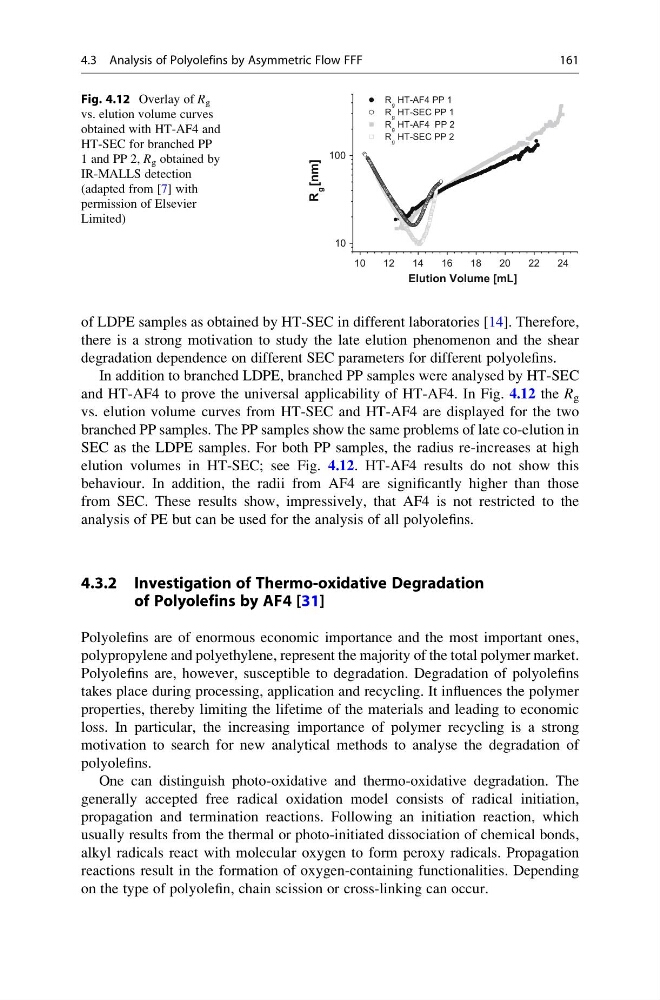
In addition to branched LDPE, branched PP samples were analysed by HT-SEC
and HT-AF4 to prove the universal applicability of HT-AF4. In Fig. 4.12 the R g
vs. elution volume curves from HT-SEC and HT-AF4 are displayed for the two
branched PP samples. The PP samples show the same problems of late co-elution in
SEC as the LDPE samples. For both PP samples, the radius re-increases at high
elution volumes in HT-SEC; see Fig. 4.12. HT-AF4 results do not show this
behaviour. In addition, the radii from AF4 are significantly higher than those
from SEC. These results show, impressively, that AF4 is not restricted to the
analysis of PE but can be used for the analysis of all polyolefins.
4.3.2 Investigation of Thermo-oxidative Degradation
of Polyolefins by AF4 [31]
Polyolefins are of enormous economic importance and the most important ones,
polypropylene and polyethylene, represent the majority of the total polymer market.
Polyolefins are, however, susceptible to degradation. Degradation of polyolefins
takes place during processing, application and recycling. It influences the polymer
properties, thereby limiting the lifetime of the materials and leading to economic
loss. In particular, the increasing importance of polymer recycling is a strong
motivation to search for new analytical methods to analyse the degradation of
polyolefins.
One can distinguish photo-oxidative and thermo-oxidative degradation. The
generally accepted free radical oxidation model consists of radical initiation,
propagation and termination reactions. Following an initiation reaction, which
usually results from the thermal or photo-initiated dissociation of chemical bonds,
alkyl radicals react with molecular oxygen to form peroxy radicals. Propagation
reactions result in the formation of oxygen-containing functionalities. Depending
on the type of polyolefin, chain scission or cross-linking can occur.
10
12
14
16
18
20
22
24
10
100
Elution Volume [mL]
R
g
[nm]
R g HT-AF4 PP 1
R g HT-SEC PP 1
R g HT-AF4 PP 2
R g HT-SEC PP 2
Fig. 4.12 Overlay of R g
vs. elution volume curves
obtained with HT-AF4 and
HT-SEC for branched PP
1 and PP 2, R g obtained by
IR-MALLS detection
(adapted from [7] with
permission of Elsevier
Limited)
4.3 Analysis of Polyolefins by Asymmetric Flow FFF
161
there is a strong motivation to study the late elution phenomenon and the shear
degradation dependence on different SEC parameters for different polyolefins.
In addition to branched LDPE, branched PP samples were analysed by HT-SEC
and HT-AF4 to prove the universal applicability of HT-AF4. In Fig. 4.12 the R g
vs. elution volume curves from HT-SEC and HT-AF4 are displayed for the two
branched PP samples. The PP samples show the same problems of late co-elution in
SEC as the LDPE samples. For both PP samples, the radius re-increases at high
elution volumes in HT-SEC; see Fig. 4.12. HT-AF4 results do not show this
behaviour. In addition, the radii from AF4 are significantly higher than those
from SEC. These results show, impressively, that AF4 is not restricted to the
analysis of PE but can be used for the analysis of all polyolefins.
4.3.2 Investigation of Thermo-oxidative Degradation
of Polyolefins by AF4 [31]
Polyolefins are of enormous economic importance and the most important ones,
polypropylene and polyethylene, represent the majority of the total polymer market.
Polyolefins are, however, susceptible to degradation. Degradation of polyolefins
takes place during processing, application and recycling. It influences the polymer
properties, thereby limiting the lifetime of the materials and leading to economic
loss. In particular, the increasing importance of polymer recycling is a strong
motivation to search for new analytical methods to analyse the degradation of
polyolefins.
One can distinguish photo-oxidative and thermo-oxidative degradation. The
generally accepted free radical oxidation model consists of radical initiation,
propagation and termination reactions. Following an initiation reaction, which
usually results from the thermal or photo-initiated dissociation of chemical bonds,
alkyl radicals react with molecular oxygen to form peroxy radicals. Propagation
reactions result in the formation of oxygen-containing functionalities. Depending
on the type of polyolefin, chain scission or cross-linking can occur.
10
12
14
16
18
20
22
24
10
100
Elution Volume [mL]
R
g
[nm]
R g HT-AF4 PP 1
R g HT-SEC PP 1
R g HT-AF4 PP 2
R g HT-SEC PP 2
Fig. 4.12 Overlay of R g
vs. elution volume curves
obtained with HT-AF4 and
HT-SEC for branched PP
1 and PP 2, R g obtained by
IR-MALLS detection
(adapted from [7] with
permission of Elsevier
Limited)
4.3 Analysis of Polyolefins by Asymmetric Flow FFF
161