

c x
ð Þ ¼ c 0 e
Àx
l
ð Þ ¼ c 0 e
Àx
λw
ð Þ
ð4:6Þ
The diffusion coefficient D and the field induced by the force U can be related to the
frictional drag f and is given by
D ¼
kT
f
ð4:7Þ
and
U ¼
F
f
,
ð4:8Þ
respectively, where k, T and F are the Boltzmann constant, temperature and applied
force, respectively. By substituting these two relationships in the λ term, the
retention parameter can be expressed as
λ ¼
l
w
¼
kT
Fw
ð4:9Þ
This is the basic equation for the retention parameter and the force F. The force will
vary depending on the FFF technique used. Retention in FFF is based on the flow
velocity v(x), the concentration of solute molecules and the field induced force, and
can be described solely based on the dimensionless retention parameter λ.
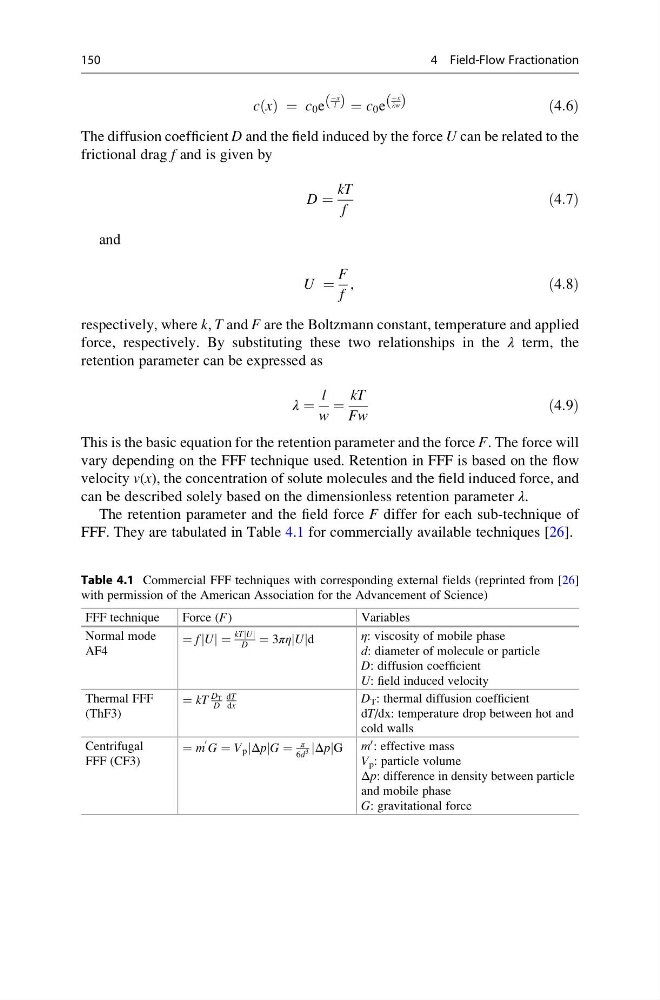
The retention parameter and the field force F differ for each sub-technique of
FFF. They are tabulated in Table 4.1 for commercially available techniques [26].
Table 4.1 Commercial FFF techniques with corresponding external fields (reprinted from [26]
with permission of the American Association for the Advancement of Science)
FFF technique
Force (F)
Variables
Normal mode
AF4
¼ f U
j j ¼
kT U
j j
D ¼ 3πη U
j jd
η: viscosity of mobile phase
d: diameter of molecule or particle
D: diffusion coefficient
U: field induced velocity
Thermal FFF
(ThF3)
¼ kT
DT
D
dT
dx
D T : thermal diffusion coefficient
dT/dx: temperature drop between hot and
cold walls
Centrifugal
FFF (CF3)
¼ m
0 G ¼ V p Δp
j jG ¼
π
6d
3 Δp
j jG m
0 : effective mass
V p : particle volume
Δp: difference in density between particle
and mobile phase
G: gravitational force
150
4 Field-Flow Fractionation
ð Þ ¼ c 0 e
Àx
l
ð Þ ¼ c 0 e
Àx
λw
ð Þ
ð4:6Þ
The diffusion coefficient D and the field induced by the force U can be related to the
frictional drag f and is given by
D ¼
kT
f
ð4:7Þ
and
U ¼
F
f
,
ð4:8Þ
respectively, where k, T and F are the Boltzmann constant, temperature and applied
force, respectively. By substituting these two relationships in the λ term, the
retention parameter can be expressed as
λ ¼
l
w
¼
kT
Fw
ð4:9Þ
This is the basic equation for the retention parameter and the force F. The force will
vary depending on the FFF technique used. Retention in FFF is based on the flow
velocity v(x), the concentration of solute molecules and the field induced force, and
can be described solely based on the dimensionless retention parameter λ.
The retention parameter and the field force F differ for each sub-technique of
FFF. They are tabulated in Table 4.1 for commercially available techniques [26].
Table 4.1 Commercial FFF techniques with corresponding external fields (reprinted from [26]
with permission of the American Association for the Advancement of Science)
FFF technique
Force (F)
Variables
Normal mode
AF4
¼ f U
j j ¼
kT U
j j
D ¼ 3πη U
j jd
η: viscosity of mobile phase
d: diameter of molecule or particle
D: diffusion coefficient
U: field induced velocity
Thermal FFF
(ThF3)
¼ kT
DT
D
dT
dx
D T : thermal diffusion coefficient
dT/dx: temperature drop between hot and
cold walls
Centrifugal
FFF (CF3)
¼ m
0 G ¼ V p Δp
j jG ¼
π
6d
3 Δp
j jG m
0 : effective mass
V p : particle volume
Δp: difference in density between particle
and mobile phase
G: gravitational force
150
4 Field-Flow Fractionation