

applications [15–18]. Applications in organic mobile phases include branched
polymers, high-temperature analysis of polyolefins, gel-containing polymers and
rubber emulsions, to name a few [6, 7, 19–22]. The different FFF sub-techniques
have their merits and limitations; nevertheless, for most of the analytical problems
that complex polymers present, a suitable FFF method can be found.
A few advantages of FFF over SEC are summarized as follows:
1. Shear degradation of polymer is strongly minimized due to the absence of any
stationary phase [15, 23].
2. Unwanted adsorption and secondary separation effects are avoided by the very
low surface area of the accumulation wall in FFF [15, 24].
3. An open channel is used, therefore filtration is no longer necessary [6, 7].
4. Two orders higher exclusion limit is achieved compared to SEC [15].
5. Analysis of complex mixtures of suspended particles, gels and soluble polymers
is possible in one measurement [15].
6. Working conditions in FFF are conducive for the analysis of sensitive molecules
that degrade easily [23].
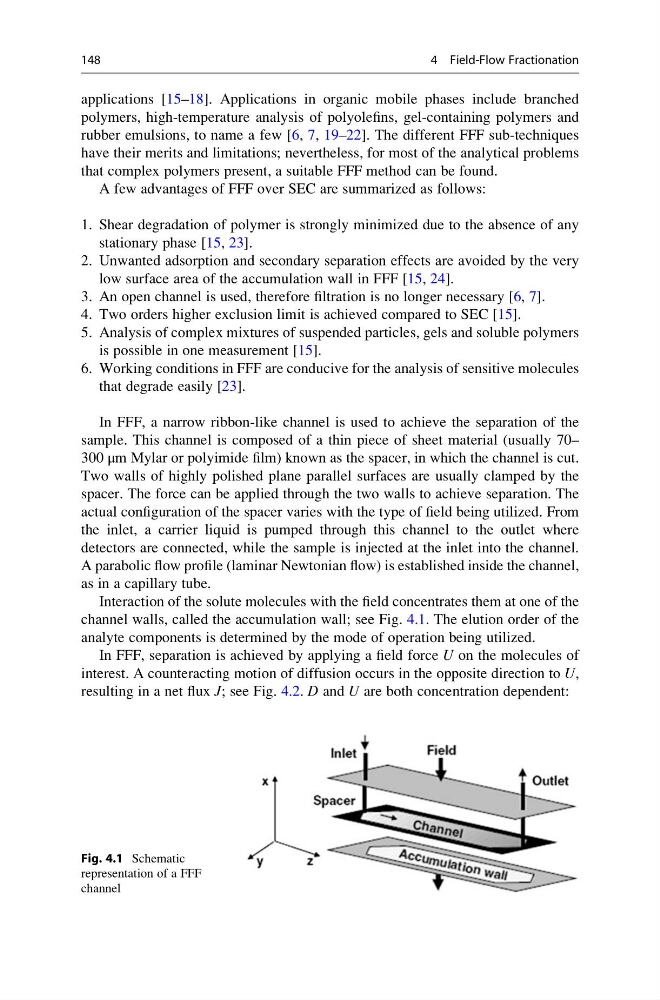
In FFF, a narrow ribbon-like channel is used to achieve the separation of the
sample. This channel is composed of a thin piece of sheet material (usually 70–
300 μm Mylar or polyimide film) known as the spacer, in which the channel is cut.
Two walls of highly polished plane parallel surfaces are usually clamped by the
spacer. The force can be applied through the two walls to achieve separation. The
actual configuration of the spacer varies with the type of field being utilized. From
the inlet, a carrier liquid is pumped through this channel to the outlet where
detectors are connected, while the sample is injected at the inlet into the channel.
A parabolic flow profile (laminar Newtonian flow) is established inside the channel,
as in a capillary tube.
Interaction of the solute molecules with the field concentrates them at one of the
channel walls, called the accumulation wall; see Fig. 4.1. The elution order of the
analyte components is determined by the mode of operation being utilized.
In FFF, separation is achieved by applying a field force U on the molecules of
interest. A counteracting motion of diffusion occurs in the opposite direction to U,
resulting in a net flux J; see Fig. 4.2. D and U are both concentration dependent:
Fig. 4.1 Schematic
representation of a FFF
channel
148
4 Field-Flow Fractionation
polymers, high-temperature analysis of polyolefins, gel-containing polymers and
rubber emulsions, to name a few [6, 7, 19–22]. The different FFF sub-techniques
have their merits and limitations; nevertheless, for most of the analytical problems
that complex polymers present, a suitable FFF method can be found.
A few advantages of FFF over SEC are summarized as follows:
1. Shear degradation of polymer is strongly minimized due to the absence of any
stationary phase [15, 23].
2. Unwanted adsorption and secondary separation effects are avoided by the very
low surface area of the accumulation wall in FFF [15, 24].
3. An open channel is used, therefore filtration is no longer necessary [6, 7].
4. Two orders higher exclusion limit is achieved compared to SEC [15].
5. Analysis of complex mixtures of suspended particles, gels and soluble polymers
is possible in one measurement [15].
6. Working conditions in FFF are conducive for the analysis of sensitive molecules
that degrade easily [23].
In FFF, a narrow ribbon-like channel is used to achieve the separation of the
sample. This channel is composed of a thin piece of sheet material (usually 70–
300 μm Mylar or polyimide film) known as the spacer, in which the channel is cut.
Two walls of highly polished plane parallel surfaces are usually clamped by the
spacer. The force can be applied through the two walls to achieve separation. The
actual configuration of the spacer varies with the type of field being utilized. From
the inlet, a carrier liquid is pumped through this channel to the outlet where
detectors are connected, while the sample is injected at the inlet into the channel.
A parabolic flow profile (laminar Newtonian flow) is established inside the channel,
as in a capillary tube.
Interaction of the solute molecules with the field concentrates them at one of the
channel walls, called the accumulation wall; see Fig. 4.1. The elution order of the
analyte components is determined by the mode of operation being utilized.
In FFF, separation is achieved by applying a field force U on the molecules of
interest. A counteracting motion of diffusion occurs in the opposite direction to U,
resulting in a net flux J; see Fig. 4.2. D and U are both concentration dependent:
Fig. 4.1 Schematic
representation of a FFF
channel
148
4 Field-Flow Fractionation