

TCB with a flow rate of 2.75 mL/min. HT-SEC: TCB with a flow rate of 1 mL/
min.
• Detectors. ELSD PL-ELS 1000 (Polymer Laboratories, Church Stretton,
England). The following parameters were set on the ELSD: air flow rate 1.5 L/
min, nebulizer temperature 160
C, evaporator temperature 270
C.
• Column temperature. 160
C.
• Sample concentration. 2.5 mg/mL. All samples were dissolved in 1-decanol.
• Injection volume. 50 μL (first dimension).
3.4.3.4 Preparatory Investigations
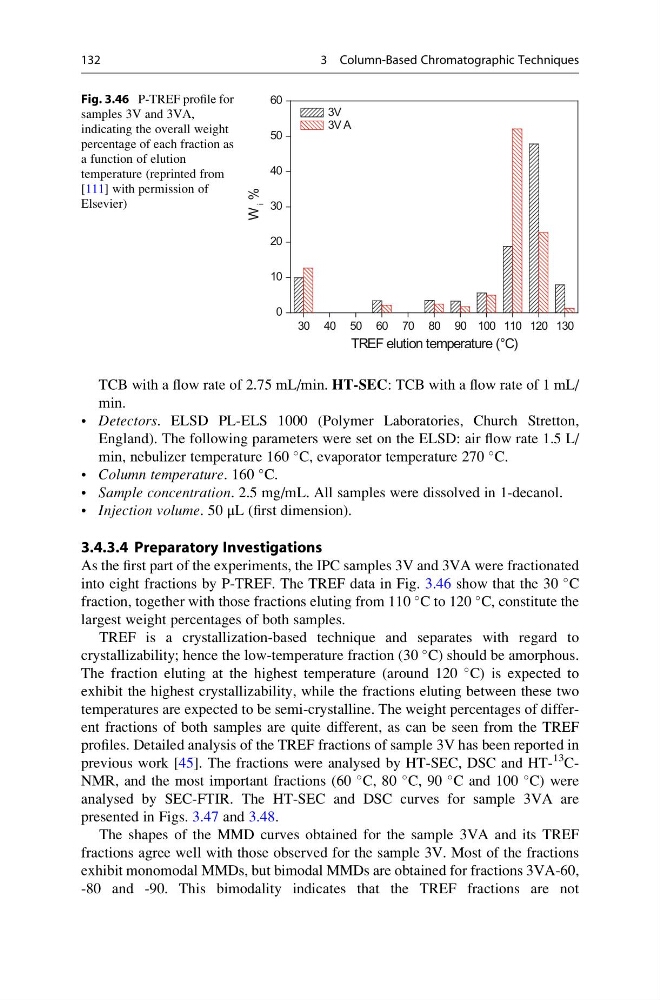
As the first part of the experiments, the IPC samples 3V and 3VA were fractionated
into eight fractions by P-TREF. The TREF data in Fig. 3.46 show that the 30
C
fraction, together with those fractions eluting from 110
C to 120
C, constitute the
largest weight percentages of both samples.
TREF is a crystallization-based technique and separates with regard to
crystallizability; hence the low-temperature fraction (30
C) should be amorphous.
The fraction eluting at the highest temperature (around 120
C) is expected to
exhibit the highest crystallizability, while the fractions eluting between these two
temperatures are expected to be semi-crystalline. The weight percentages of different fractions of both samples are quite different, as can be seen from the TREF
profiles. Detailed analysis of the TREF fractions of sample 3V has been reported in
previous work [45]. The fractions were analysed by HT-SEC, DSC and HT13 CNMR, and the most important fractions (60
C, 80
C, 90
C and 100
C) were
analysed by SEC-FTIR. The HT-SEC and DSC curves for sample 3VA are
presented in Figs. 3.47 and 3.48.
The shapes of the MMD curves obtained for the sample 3VA and its TREF
fractions agree well with those observed for the sample 3V. Most of the fractions
exhibit monomodal MMDs, but bimodal MMDs are obtained for fractions 3VA-60,
-80 and -90. This bimodality indicates that the TREF fractions are not
30 40 50 60 70 80 90 100 110 120 130
0
10
20
30
40
50
60
W
i
%
TREF elution temperature (°C)
3V
3V A
Fig. 3.46 P-TREF profile for
samples 3V and 3VA,
indicating the overall weight
percentage of each fraction as
a function of elution
temperature (reprinted from
[111] with permission of
Elsevier)
132
3 Column-Based Chromatographic Techniques
min.
• Detectors. ELSD PL-ELS 1000 (Polymer Laboratories, Church Stretton,
England). The following parameters were set on the ELSD: air flow rate 1.5 L/
min, nebulizer temperature 160
C, evaporator temperature 270
C.
• Column temperature. 160
C.
• Sample concentration. 2.5 mg/mL. All samples were dissolved in 1-decanol.
• Injection volume. 50 μL (first dimension).
3.4.3.4 Preparatory Investigations
As the first part of the experiments, the IPC samples 3V and 3VA were fractionated
into eight fractions by P-TREF. The TREF data in Fig. 3.46 show that the 30
C
fraction, together with those fractions eluting from 110
C to 120
C, constitute the
largest weight percentages of both samples.
TREF is a crystallization-based technique and separates with regard to
crystallizability; hence the low-temperature fraction (30
C) should be amorphous.
The fraction eluting at the highest temperature (around 120
C) is expected to
exhibit the highest crystallizability, while the fractions eluting between these two
temperatures are expected to be semi-crystalline. The weight percentages of different fractions of both samples are quite different, as can be seen from the TREF
profiles. Detailed analysis of the TREF fractions of sample 3V has been reported in
previous work [45]. The fractions were analysed by HT-SEC, DSC and HT13 CNMR, and the most important fractions (60
C, 80
C, 90
C and 100
C) were
analysed by SEC-FTIR. The HT-SEC and DSC curves for sample 3VA are
presented in Figs. 3.47 and 3.48.
The shapes of the MMD curves obtained for the sample 3VA and its TREF
fractions agree well with those observed for the sample 3V. Most of the fractions
exhibit monomodal MMDs, but bimodal MMDs are obtained for fractions 3VA-60,
-80 and -90. This bimodality indicates that the TREF fractions are not
30 40 50 60 70 80 90 100 110 120 130
0
10
20
30
40
50
60
W
i
%
TREF elution temperature (°C)
3V
3V A
Fig. 3.46 P-TREF profile for
samples 3V and 3VA,
indicating the overall weight
percentage of each fraction as
a function of elution
temperature (reprinted from
[111] with permission of
Elsevier)
132
3 Column-Based Chromatographic Techniques