

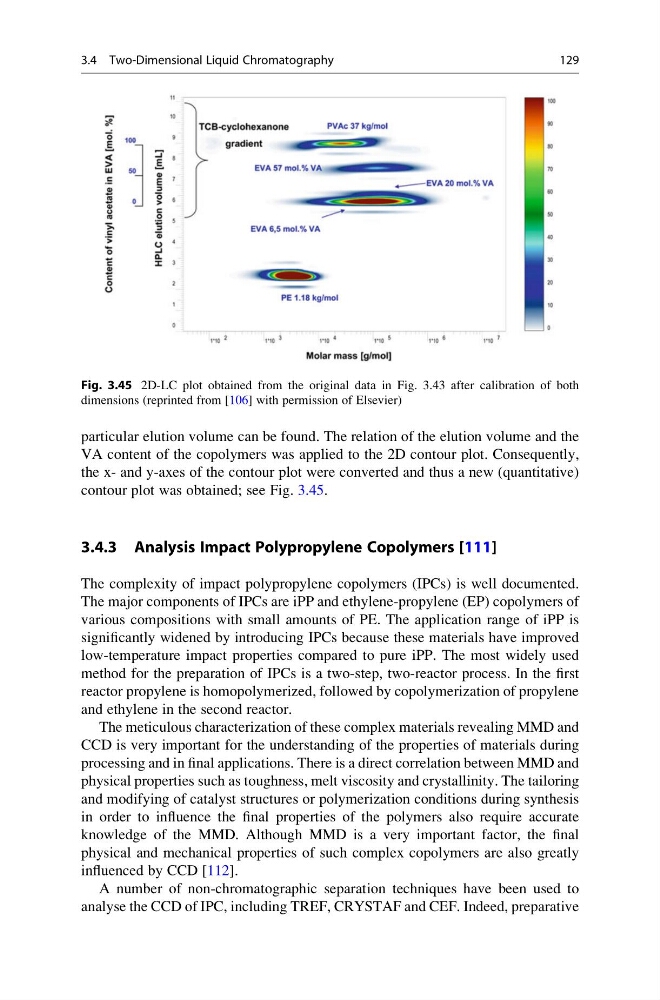
particular elution volume can be found. The relation of the elution volume and the
VA content of the copolymers was applied to the 2D contour plot. Consequently,
the x- and y-axes of the contour plot were converted and thus a new (quantitative)
contour plot was obtained; see Fig. 3.45.
3.4.3 Analysis Impact Polypropylene Copolymers [111]
The complexity of impact polypropylene copolymers (IPCs) is well documented.
The major components of IPCs are iPP and ethylene-propylene (EP) copolymers of
various compositions with small amounts of PE. The application range of iPP is
significantly widened by introducing IPCs because these materials have improved
low-temperature impact properties compared to pure iPP. The most widely used
method for the preparation of IPCs is a two-step, two-reactor process. In the first
reactor propylene is homopolymerized, followed by copolymerization of propylene
and ethylene in the second reactor.
The meticulous characterization of these complex materials revealing MMD and
CCD is very important for the understanding of the properties of materials during
processing and in final applications. There is a direct correlation between MMD and
physical properties such as toughness, melt viscosity and crystallinity. The tailoring
and modifying of catalyst structures or polymerization conditions during synthesis
in order to influence the final properties of the polymers also require accurate
knowledge of the MMD. Although MMD is a very important factor, the final
physical and mechanical properties of such complex copolymers are also greatly
influenced by CCD [112].
A number of non-chromatographic separation techniques have been used to
analyse the CCD of IPC, including TREF, CRYSTAF and CEF. Indeed, preparative
Fig. 3.45 2D-LC plot obtained from the original data in Fig. 3.43 after calibration of both
dimensions (reprinted from [106] with permission of Elsevier)
3.4 Two-Dimensional Liquid Chromatography
129
VA content of the copolymers was applied to the 2D contour plot. Consequently,
the x- and y-axes of the contour plot were converted and thus a new (quantitative)
contour plot was obtained; see Fig. 3.45.
3.4.3 Analysis Impact Polypropylene Copolymers [111]
The complexity of impact polypropylene copolymers (IPCs) is well documented.
The major components of IPCs are iPP and ethylene-propylene (EP) copolymers of
various compositions with small amounts of PE. The application range of iPP is
significantly widened by introducing IPCs because these materials have improved
low-temperature impact properties compared to pure iPP. The most widely used
method for the preparation of IPCs is a two-step, two-reactor process. In the first
reactor propylene is homopolymerized, followed by copolymerization of propylene
and ethylene in the second reactor.
The meticulous characterization of these complex materials revealing MMD and
CCD is very important for the understanding of the properties of materials during
processing and in final applications. There is a direct correlation between MMD and
physical properties such as toughness, melt viscosity and crystallinity. The tailoring
and modifying of catalyst structures or polymerization conditions during synthesis
in order to influence the final properties of the polymers also require accurate
knowledge of the MMD. Although MMD is a very important factor, the final
physical and mechanical properties of such complex copolymers are also greatly
influenced by CCD [112].
A number of non-chromatographic separation techniques have been used to
analyse the CCD of IPC, including TREF, CRYSTAF and CEF. Indeed, preparative
Fig. 3.45 2D-LC plot obtained from the original data in Fig. 3.43 after calibration of both
dimensions (reprinted from [106] with permission of Elsevier)
3.4 Two-Dimensional Liquid Chromatography
129