

of the mobile phase required to elute the unretained component. The dwell volume
is the volume of the liquid between the injector and the point where the gradient is
formed. The method proposed by Bashir et al. was modified to determine the void
and dwell volume in HPLC [110]. According to the previous knowledge of the
current system, there is a linear correlation between the elution volume and the
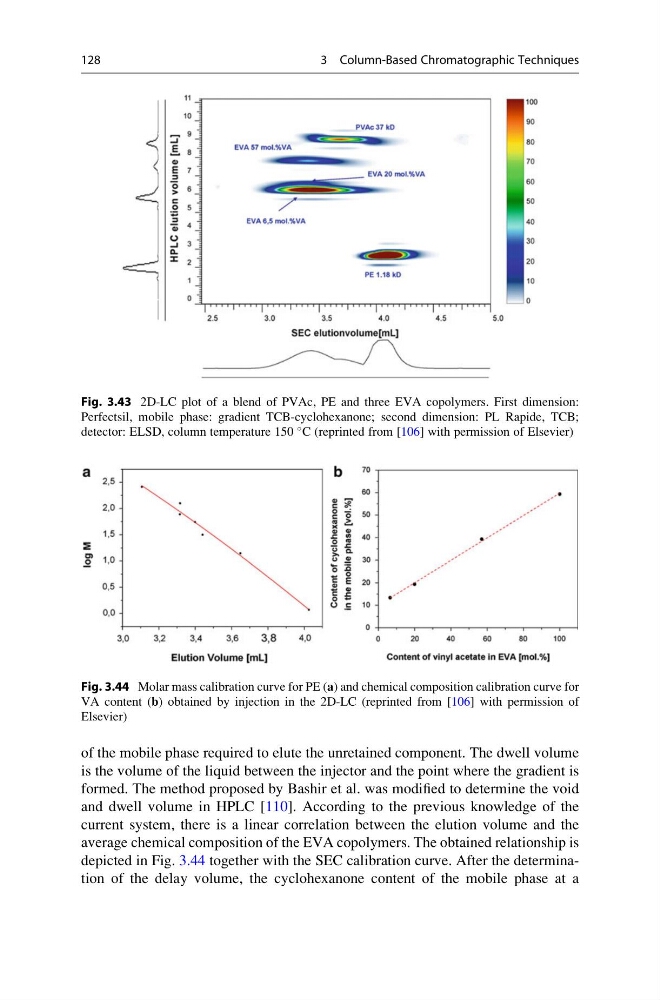
average chemical composition of the EVA copolymers. The obtained relationship is
depicted in Fig. 3.44 together with the SEC calibration curve. After the determination of the delay volume, the cyclohexanone content of the mobile phase at a
Fig. 3.43 2D-LC plot of a blend of PVAc, PE and three EVA copolymers. First dimension:
Perfectsil, mobile phase: gradient TCB-cyclohexanone; second dimension: PL Rapide, TCB;
detector: ELSD, column temperature 150
C (reprinted from [106] with permission of Elsevier)
Fig. 3.44 Molar mass calibration curve for PE (a) and chemical composition calibration curve for
VA content (b) obtained by injection in the 2D-LC (reprinted from [106] with permission of
Elsevier)
128
3 Column-Based Chromatographic Techniques
is the volume of the liquid between the injector and the point where the gradient is
formed. The method proposed by Bashir et al. was modified to determine the void
and dwell volume in HPLC [110]. According to the previous knowledge of the
current system, there is a linear correlation between the elution volume and the
average chemical composition of the EVA copolymers. The obtained relationship is
depicted in Fig. 3.44 together with the SEC calibration curve. After the determination of the delay volume, the cyclohexanone content of the mobile phase at a
Fig. 3.43 2D-LC plot of a blend of PVAc, PE and three EVA copolymers. First dimension:
Perfectsil, mobile phase: gradient TCB-cyclohexanone; second dimension: PL Rapide, TCB;
detector: ELSD, column temperature 150
C (reprinted from [106] with permission of Elsevier)
Fig. 3.44 Molar mass calibration curve for PE (a) and chemical composition calibration curve for
VA content (b) obtained by injection in the 2D-LC (reprinted from [106] with permission of
Elsevier)
128
3 Column-Based Chromatographic Techniques