

Standards Service GmbH, Mainz, Germany) was used for data collection and
processing.
• Column temperature. 140
C.
• Sample concentration. 1–1.2 mg/mL. All samples were dissolved in TCB or
decalin.
• Injection volume. 50 μL.
3.2.1.4 Preparatory Investigations
Suitable stationary and mobile phases have to be found to identify chromatographic
conditions for the separation of EMA copolymers. The EMA copolymers are
composed of polar acrylate units and nonpolar ethylene units. When using a polar
(normal phase) stationary phase, acrylate units will interact with the stationary
phase whereas ethylene units will not contribute to retention. Therefore, as the
acrylate content increases, the elution volume of copolymer will increase. Based on
these assumptions, a bare silica column was selected as the stationary phase. TCB,
decalin, cyclohexanone and dibenzylether were identified as solvents for both
homo- and copolymers.
A chromatographic method that has been originally developed to fractionate
EVA copolymers in a decalin-cyclohexanone gradient [80] was first tested. Some
separation of the EMA copolymers was obtained using this system. As can be seen
in Fig. 3.17, EMA 1 (23.5 wt% MA) and EMA 2 (27 wt%) elute in the order of
increasing MA content. It is interesting to note that EMA 10 (24 wt%) and EMA
11 (25 wt%) show quite broad elution peaks. The sharp peak, which is observed for
these samples at 11.8 mL, can be explained by weakly adsorbing copolymer
fractions with a low acrylate content, which can be desorbed by a small amount
of the desorption promoting solvent, e.g. cyclohexanone.
To improve the separation of EMA copolymers, a step gradient of decalincyclohexanone was applied. A number of stationary phases were tested; Perfectsil
300 gave the best performance.
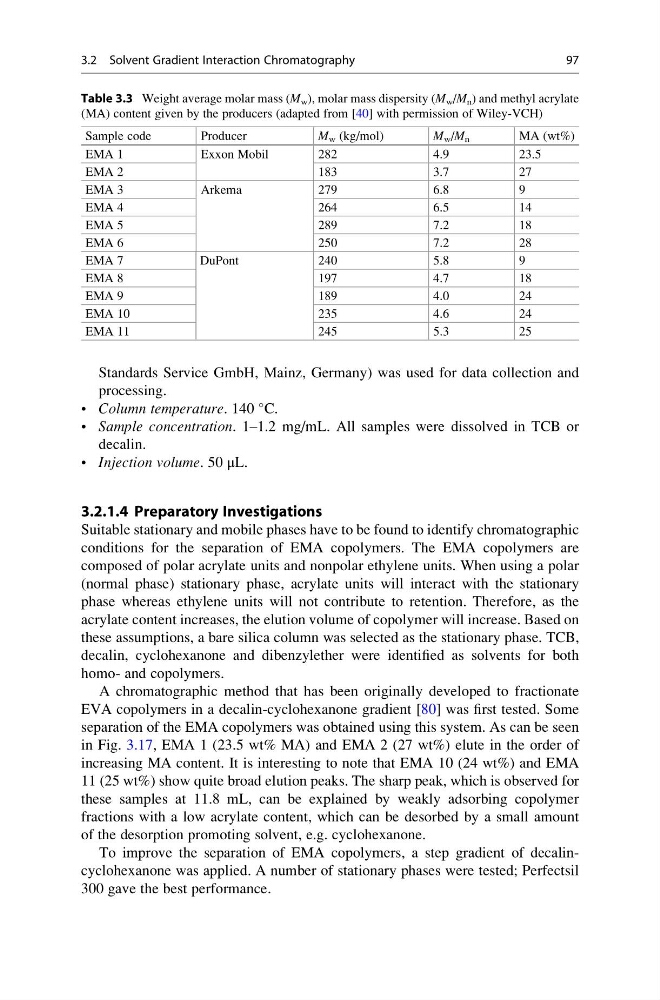
Table 3.3 Weight average molar mass (M w ), molar mass dispersity (M w /M n ) and methyl acrylate
(MA) content given by the producers (adapted from [40] with permission of Wiley-VCH)
Sample code
Producer
M w (kg/mol)
M w /M n
MA (wt%)
EMA 1
Exxon Mobil
282
4.9
23.5
EMA 2
183
3.7
27
EMA 3
Arkema
279
6.8
9
EMA 4
264
6.5
14
EMA 5
289
7.2
18
EMA 6
250
7.2
28
EMA 7
DuPont
240
5.8
9
EMA 8
197
4.7
18
EMA 9
189
4.0
24
EMA 10
235
4.6
24
EMA 11
245
5.3
25
3.2 Solvent Gradient Interaction Chromatography
97
processing.
• Column temperature. 140
C.
• Sample concentration. 1–1.2 mg/mL. All samples were dissolved in TCB or
decalin.
• Injection volume. 50 μL.
3.2.1.4 Preparatory Investigations
Suitable stationary and mobile phases have to be found to identify chromatographic
conditions for the separation of EMA copolymers. The EMA copolymers are
composed of polar acrylate units and nonpolar ethylene units. When using a polar
(normal phase) stationary phase, acrylate units will interact with the stationary
phase whereas ethylene units will not contribute to retention. Therefore, as the
acrylate content increases, the elution volume of copolymer will increase. Based on
these assumptions, a bare silica column was selected as the stationary phase. TCB,
decalin, cyclohexanone and dibenzylether were identified as solvents for both
homo- and copolymers.
A chromatographic method that has been originally developed to fractionate
EVA copolymers in a decalin-cyclohexanone gradient [80] was first tested. Some
separation of the EMA copolymers was obtained using this system. As can be seen
in Fig. 3.17, EMA 1 (23.5 wt% MA) and EMA 2 (27 wt%) elute in the order of
increasing MA content. It is interesting to note that EMA 10 (24 wt%) and EMA
11 (25 wt%) show quite broad elution peaks. The sharp peak, which is observed for
these samples at 11.8 mL, can be explained by weakly adsorbing copolymer
fractions with a low acrylate content, which can be desorbed by a small amount
of the desorption promoting solvent, e.g. cyclohexanone.
To improve the separation of EMA copolymers, a step gradient of decalincyclohexanone was applied. A number of stationary phases were tested; Perfectsil
300 gave the best performance.
Table 3.3 Weight average molar mass (M w ), molar mass dispersity (M w /M n ) and methyl acrylate
(MA) content given by the producers (adapted from [40] with permission of Wiley-VCH)
Sample code
Producer
M w (kg/mol)
M w /M n
MA (wt%)
EMA 1
Exxon Mobil
282
4.9
23.5
EMA 2
183
3.7
27
EMA 3
Arkema
279
6.8
9
EMA 4
264
6.5
14
EMA 5
289
7.2
18
EMA 6
250
7.2
28
EMA 7
DuPont
240
5.8
9
EMA 8
197
4.7
18
EMA 9
189
4.0
24
EMA 10
235
4.6
24
EMA 11
245
5.3
25
3.2 Solvent Gradient Interaction Chromatography
97