

1. Retrieve the nucleotide sequence of the gene of interest (GOI)
and focus on the site of tag insertion. The UCSC genome
browser is a convenient source for this step (genome.ucsc.edu).
2. Screen the genomic regions of interest using an online CRISPR
design tool such as CRISPOR (http://crispor.tefor.net/) to
identify and rank the guide sequences (Table 1). We recommend testing several sgRNAs with cut sites less than 20 bp away
from the insertion site to find an optimal sgRNA. Guide RNAs
for the human genome can also be visualized directly in the
UCSC genome browser with pre-calculated data from CRISPOR (select “Full” display mode of the “CRISPR targets” in
the “Genes and Gene Predictions” list of features).
3. Order the sense and antisense oligonucleotides for cloning the
sgRNA sequences into an sgRNA expression plasmid such as
MLM3636. Note that the oligonucleotides contain overhangs
for ligation into the pair of BsmBI sites with the sense and
antisense sequences matching the genomic target. The oligonucleotide sequences can be accessed by clicking on the “PCR/
cloning primers” button in CRISPOR. If you have used the
UCSC genome browser for sgRNA selection, you can directly
transfer the sgRNA sequence to CRISPOR by a hyperlink
feature or simply by copy-pasting to the CRISPOR input page.
Puro
GFP
Chr.2
Last exon
sgRNA
Last exon
exon
XPB
-
STOP
Chr.2
5’ HA
P2A
3’ HA
STOP
Puro
GFP
P2A
STOP
exon
XPB
~700 nt
~700 nt
~1500nt
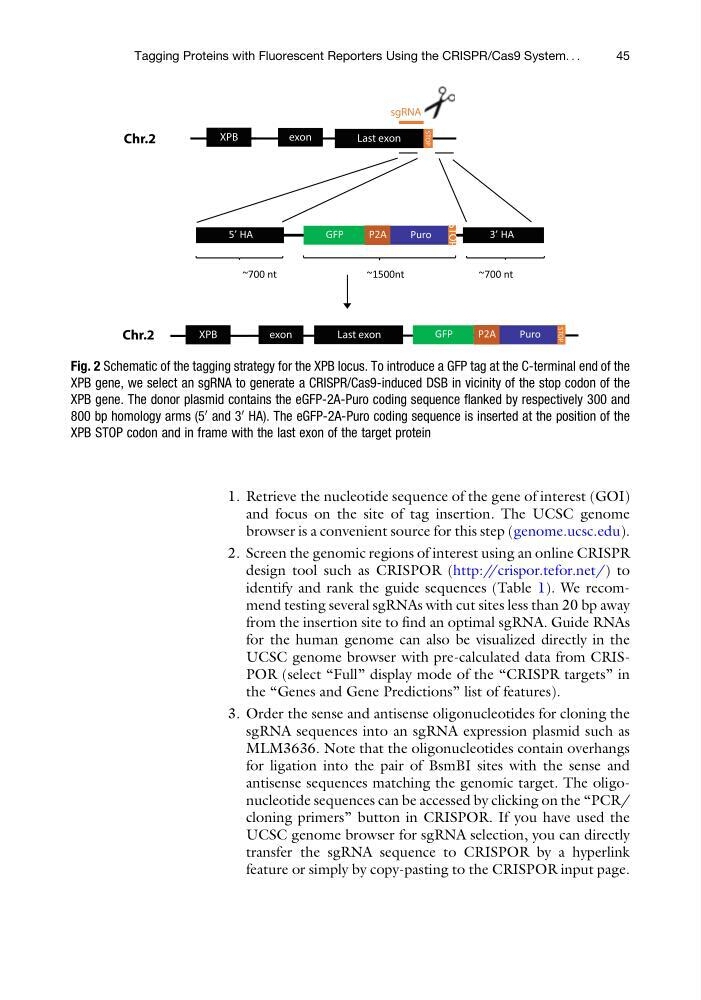
Fig. 2 Schematic of the tagging strategy for the XPB locus. To introduce a GFP tag at the C-terminal end of the
XPB gene, we select an sgRNA to generate a CRISPR/Cas9-induced DSB in vicinity of the stop codon of the
XPB gene. The donor plasmid contains the eGFP-2A-Puro coding sequence flanked by respectively 300 and
800 bp homology arms (5
0
and 3
0
HA). The eGFP-2A-Puro coding sequence is inserted at the position of the
XPB STOP codon and in frame with the last exon of the target protein
Tagging Proteins with Fluorescent Reporters Using the CRISPR/Cas9 System. . .
45
and focus on the site of tag insertion. The UCSC genome
browser is a convenient source for this step (genome.ucsc.edu).
2. Screen the genomic regions of interest using an online CRISPR
design tool such as CRISPOR (http://crispor.tefor.net/) to
identify and rank the guide sequences (Table 1). We recommend testing several sgRNAs with cut sites less than 20 bp away
from the insertion site to find an optimal sgRNA. Guide RNAs
for the human genome can also be visualized directly in the
UCSC genome browser with pre-calculated data from CRISPOR (select “Full” display mode of the “CRISPR targets” in
the “Genes and Gene Predictions” list of features).
3. Order the sense and antisense oligonucleotides for cloning the
sgRNA sequences into an sgRNA expression plasmid such as
MLM3636. Note that the oligonucleotides contain overhangs
for ligation into the pair of BsmBI sites with the sense and
antisense sequences matching the genomic target. The oligonucleotide sequences can be accessed by clicking on the “PCR/
cloning primers” button in CRISPOR. If you have used the
UCSC genome browser for sgRNA selection, you can directly
transfer the sgRNA sequence to CRISPOR by a hyperlink
feature or simply by copy-pasting to the CRISPOR input page.
Puro
GFP
Chr.2
Last exon
sgRNA
Last exon
exon
XPB
-
STOP
Chr.2
5’ HA
P2A
3’ HA
STOP
Puro
GFP
P2A
STOP
exon
XPB
~700 nt
~700 nt
~1500nt
Fig. 2 Schematic of the tagging strategy for the XPB locus. To introduce a GFP tag at the C-terminal end of the
XPB gene, we select an sgRNA to generate a CRISPR/Cas9-induced DSB in vicinity of the stop codon of the
XPB gene. The donor plasmid contains the eGFP-2A-Puro coding sequence flanked by respectively 300 and
800 bp homology arms (5
0
and 3
0
HA). The eGFP-2A-Puro coding sequence is inserted at the position of the
XPB STOP codon and in frame with the last exon of the target protein
Tagging Proteins with Fluorescent Reporters Using the CRISPR/Cas9 System. . .
45