

3 Methods
Targeted gene knock-in is achieved through the following steps.
First, the Cas9 endonuclease is directed by a guide RNA to a
specific target site in the genome to generate a double-stranded
break (DSB). The DSB is then repaired with a donor template
through a homology-directed repair (HDR) pathway [12]. Below,
we first describe the design of the single-guide RNAs and donor
plasmid template to edit the genome (Subheadings 3.1–3.3) and
the clonal isolation of CRISPR/Cas9-modified cells (Subheading
3.4). Selected clones are finally characterized at the genomic and
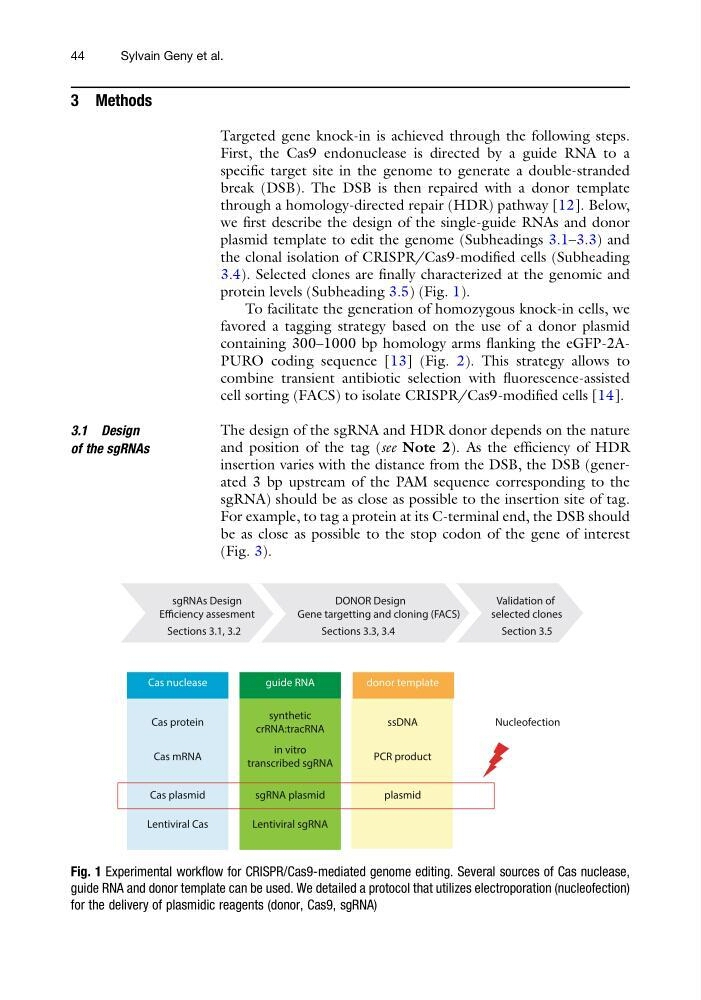
protein levels (Subheading 3.5) (Fig. 1).
To facilitate the generation of homozygous knock-in cells, we
favored a tagging strategy based on the use of a donor plasmid
containing 300–1000 bp homology arms flanking the eGFP-2APURO coding sequence [13] (Fig. 2). This strategy allows to
combine transient antibiotic selection with fluorescence-assisted
cell sorting (FACS) to isolate CRISPR/Cas9-modified cells [14].
3.1 Design
of the sgRNAs
The design of the sgRNA and HDR donor depends on the nature
and position of the tag (see Note 2). As the efficiency of HDR
insertion varies with the distance from the DSB, the DSB (generated 3 bp upstream of the PAM sequence corresponding to the
sgRNA) should be as close as possible to the insertion site of tag.
For example, to tag a protein at its C-terminal end, the DSB should
be as close as possible to the stop codon of the gene of interest
(Fig. 3).
sgRNAs Design
Efficiency assesment
Validation of
selected clones
Sections 3.1, 3.2
Section 3.5
DONOR Design
Gene targetting and cloning (FACS)
Sections 3.3, 3.4
Cas nuclease
guide RNA
donor template
Cas plasmid
Lentiviral Cas
Cas protein
Cas mRNA
ssDNA
PCR product
plasmid
synthetic
crRNA:tracRNA
Lentiviral sgRNA
sgRNA plasmid
in vitro
transcribed sgRNA
Nucleofection
Fig. 1 Experimental workflow for CRISPR/Cas9-mediated genome editing. Several sources of Cas nuclease,
guide RNA and donor template can be used. We detailed a protocol that utilizes electroporation (nucleofection)
for the delivery of plasmidic reagents (donor, Cas9, sgRNA)
44
Sylvain Geny et al.
Targeted gene knock-in is achieved through the following steps.
First, the Cas9 endonuclease is directed by a guide RNA to a
specific target site in the genome to generate a double-stranded
break (DSB). The DSB is then repaired with a donor template
through a homology-directed repair (HDR) pathway [12]. Below,
we first describe the design of the single-guide RNAs and donor
plasmid template to edit the genome (Subheadings 3.1–3.3) and
the clonal isolation of CRISPR/Cas9-modified cells (Subheading
3.4). Selected clones are finally characterized at the genomic and
protein levels (Subheading 3.5) (Fig. 1).
To facilitate the generation of homozygous knock-in cells, we
favored a tagging strategy based on the use of a donor plasmid
containing 300–1000 bp homology arms flanking the eGFP-2APURO coding sequence [13] (Fig. 2). This strategy allows to
combine transient antibiotic selection with fluorescence-assisted
cell sorting (FACS) to isolate CRISPR/Cas9-modified cells [14].
3.1 Design
of the sgRNAs
The design of the sgRNA and HDR donor depends on the nature
and position of the tag (see Note 2). As the efficiency of HDR
insertion varies with the distance from the DSB, the DSB (generated 3 bp upstream of the PAM sequence corresponding to the
sgRNA) should be as close as possible to the insertion site of tag.
For example, to tag a protein at its C-terminal end, the DSB should
be as close as possible to the stop codon of the gene of interest
(Fig. 3).
sgRNAs Design
Efficiency assesment
Validation of
selected clones
Sections 3.1, 3.2
Section 3.5
DONOR Design
Gene targetting and cloning (FACS)
Sections 3.3, 3.4
Cas nuclease
guide RNA
donor template
Cas plasmid
Lentiviral Cas
Cas protein
Cas mRNA
ssDNA
PCR product
plasmid
synthetic
crRNA:tracRNA
Lentiviral sgRNA
sgRNA plasmid
in vitro
transcribed sgRNA
Nucleofection
Fig. 1 Experimental workflow for CRISPR/Cas9-mediated genome editing. Several sources of Cas nuclease,
guide RNA and donor template can be used. We detailed a protocol that utilizes electroporation (nucleofection)
for the delivery of plasmidic reagents (donor, Cas9, sgRNA)
44
Sylvain Geny et al.