

protein 1 (4E-BP1/eIF4E) [1–4]. The phosphorylation of these
effectors is to regulate cell growth, aging and adiposity [5], memory [6], immunity [7], and muscle hypertrophy [8]. The human
mTOR protein exists as a multi-protein complex with Rheb, raptor,
mLST8, PRAS40, and DEPTOR proteins termed mTOR Complex
1 (mTORC1). This complex is the main rapamycin target via the
FKBP12 protein. Furthermore, rapamycin differentially inhibits
S6Ks and 4E-BP1 toward mRNA translation [9]. It has also been
observed that the concentration of rapamycin required for an effect
varies significantly between cell lines with a range of nM-mM
reported [10]. Majority of our understanding of the mTOR signaling pathway and protein interaction has come from classical cell
disruption pull-down assays. Hence, information where within the
cell these assemblies are localized that lead to subsequent downstream targets phosphorylation in real time is lost. Cell immunofluorescence staining following cell fixation also has several drawbacks
and limitations such as mislocalization of proteins after fixation,
poor antibody sensitivity and specificity in some cases, as well as
antibodies not reaching their target of interest.
Fo ¨rster or fluorescence resonance energy transfer (FRET) is an
excellent and powerful technique to determine relevant distances in
biological processes under physiological conditions [11]. It relies
on the non-radiative energy transfer from an excited fluorescent
donor molecule to an acceptor molecule with non-excited fluorescence in its close vicinity through a dipole–dipole interaction and
may be used to investigate physical interactions between two or
more small or macro-molecules. Thus molecular scale distances
(1–10 nm) can be measured using energy transfer processes. The
very short distances required for this process to occur (<10 nm)
mean that the molecules, in this case two or more macromolecules
such as proteins, need to be physically close to one another for
FRET to occur. The key general requirements are that the donor
emission spectrum must overlap sufficiently with the acceptor
absorption spectrum while the donor and acceptor dipoles display
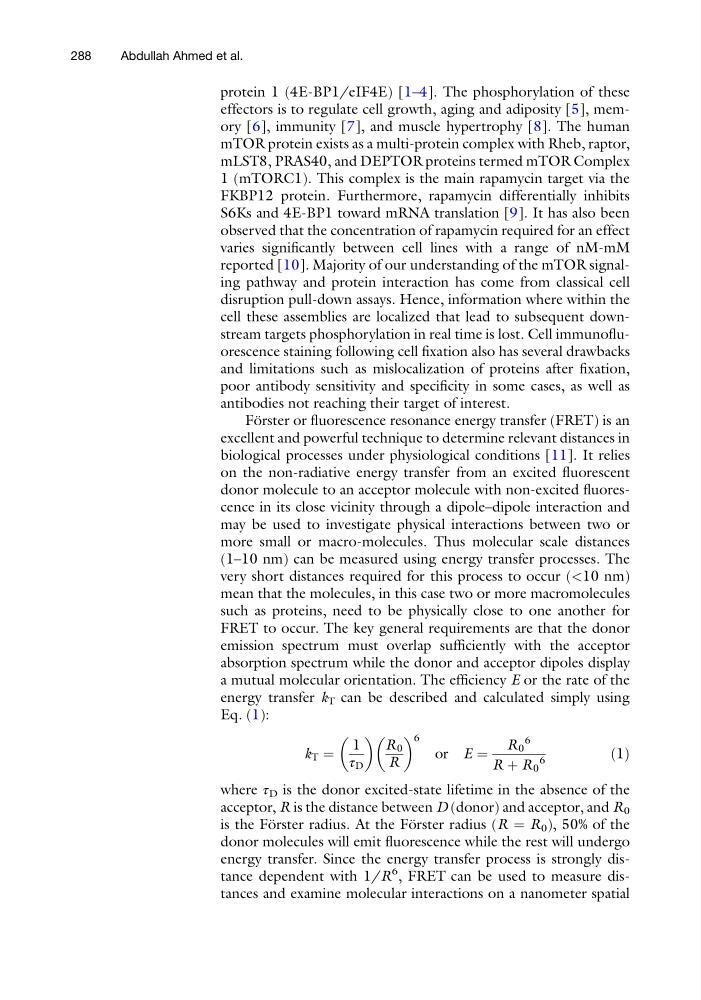
a mutual molecular orientation. The efficiency E or the rate of the
energy transfer k T can be described and calculated simply using
Eq. (1):
k T ¼
1
τ D
R 0
R
6
or E ¼
R 0
6
R þ R 0
6
ð1Þ
where τ D is the donor excited-state lifetime in the absence of the
acceptor, R is the distance between D (donor) and acceptor, and R 0
is the Fo ¨rster radius. At the Fo ¨rster radius (R ¼ R 0 ), 50% of the
donor molecules will emit fluorescence while the rest will undergo
energy transfer. Since the energy transfer process is strongly distance dependent with 1/R
6 , FRET can be used to measure distances and examine molecular interactions on a nanometer spatial
288
Abdullah Ahmed et al.
effectors is to regulate cell growth, aging and adiposity [5], memory [6], immunity [7], and muscle hypertrophy [8]. The human
mTOR protein exists as a multi-protein complex with Rheb, raptor,
mLST8, PRAS40, and DEPTOR proteins termed mTOR Complex
1 (mTORC1). This complex is the main rapamycin target via the
FKBP12 protein. Furthermore, rapamycin differentially inhibits
S6Ks and 4E-BP1 toward mRNA translation [9]. It has also been
observed that the concentration of rapamycin required for an effect
varies significantly between cell lines with a range of nM-mM
reported [10]. Majority of our understanding of the mTOR signaling pathway and protein interaction has come from classical cell
disruption pull-down assays. Hence, information where within the
cell these assemblies are localized that lead to subsequent downstream targets phosphorylation in real time is lost. Cell immunofluorescence staining following cell fixation also has several drawbacks
and limitations such as mislocalization of proteins after fixation,
poor antibody sensitivity and specificity in some cases, as well as
antibodies not reaching their target of interest.
Fo ¨rster or fluorescence resonance energy transfer (FRET) is an
excellent and powerful technique to determine relevant distances in
biological processes under physiological conditions [11]. It relies
on the non-radiative energy transfer from an excited fluorescent
donor molecule to an acceptor molecule with non-excited fluorescence in its close vicinity through a dipole–dipole interaction and
may be used to investigate physical interactions between two or
more small or macro-molecules. Thus molecular scale distances
(1–10 nm) can be measured using energy transfer processes. The
very short distances required for this process to occur (<10 nm)
mean that the molecules, in this case two or more macromolecules
such as proteins, need to be physically close to one another for
FRET to occur. The key general requirements are that the donor
emission spectrum must overlap sufficiently with the acceptor
absorption spectrum while the donor and acceptor dipoles display
a mutual molecular orientation. The efficiency E or the rate of the
energy transfer k T can be described and calculated simply using
Eq. (1):
k T ¼
1
τ D
R 0
R
6
or E ¼
R 0
6
R þ R 0
6
ð1Þ
where τ D is the donor excited-state lifetime in the absence of the
acceptor, R is the distance between D (donor) and acceptor, and R 0
is the Fo ¨rster radius. At the Fo ¨rster radius (R ¼ R 0 ), 50% of the
donor molecules will emit fluorescence while the rest will undergo
energy transfer. Since the energy transfer process is strongly distance dependent with 1/R
6 , FRET can be used to measure distances and examine molecular interactions on a nanometer spatial
288
Abdullah Ahmed et al.