

For multi-color imaging, chromatic aberrations of the objective
can cause a shift between images, captured with different wavelengths. To correct for this, first, the aberrations should be calibrated by imaging a multi-color fiducial marker (e.g., beads) with
the spectral channels to be used for the experiments. The shift
detected from the fiducials should be subtracted from the singlemolecule coordinates [30].
If the on-time of fluorophores is higher than the frame exposure time, their images will appear on several consecutive frames.
These localizations can be combined by searching localizations
within a circle of a given radius (usually around 50 nm) around
every localization in following frames. Using this option, it is
possible to increase the number of photons per localization and
therefore the localization precision. An inconvenience is that localizations of different fluorophores can be combined by error if they
appear on consecutive frame (this is less likely when the densities of
switched-on fluorophores is low). In some cases, it can be also
useful to remove localizations that appear on too many consecutive
frames, eliminating non-blinking regions that can produce artifacts.
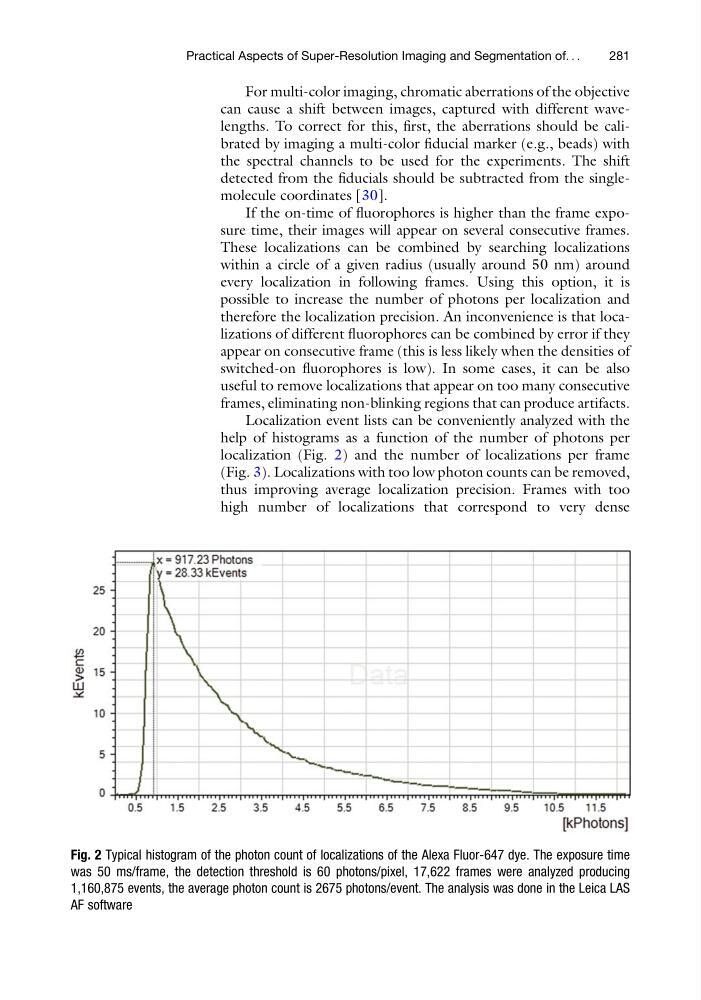
Localization event lists can be conveniently analyzed with the
help of histograms as a function of the number of photons per
localization (Fig. 2) and the number of localizations per frame
(Fig. 3). Localizations with too low photon counts can be removed,
thus improving average localization precision. Frames with too
high number of localizations that correspond to very dense
Fig. 2 Typical histogram of the photon count of localizations of the Alexa Fluor-647 dye. The exposure time
was 50 ms/frame, the detection threshold is 60 photons/pixel, 17,622 frames were analyzed producing
1,160,875 events, the average photon count is 2675 photons/event. The analysis was done in the Leica LAS
AF software
Practical Aspects of Super-Resolution Imaging and Segmentation of. . .
281
can cause a shift between images, captured with different wavelengths. To correct for this, first, the aberrations should be calibrated by imaging a multi-color fiducial marker (e.g., beads) with
the spectral channels to be used for the experiments. The shift
detected from the fiducials should be subtracted from the singlemolecule coordinates [30].
If the on-time of fluorophores is higher than the frame exposure time, their images will appear on several consecutive frames.
These localizations can be combined by searching localizations
within a circle of a given radius (usually around 50 nm) around
every localization in following frames. Using this option, it is
possible to increase the number of photons per localization and
therefore the localization precision. An inconvenience is that localizations of different fluorophores can be combined by error if they
appear on consecutive frame (this is less likely when the densities of
switched-on fluorophores is low). In some cases, it can be also
useful to remove localizations that appear on too many consecutive
frames, eliminating non-blinking regions that can produce artifacts.
Localization event lists can be conveniently analyzed with the
help of histograms as a function of the number of photons per
localization (Fig. 2) and the number of localizations per frame
(Fig. 3). Localizations with too low photon counts can be removed,
thus improving average localization precision. Frames with too
high number of localizations that correspond to very dense
Fig. 2 Typical histogram of the photon count of localizations of the Alexa Fluor-647 dye. The exposure time
was 50 ms/frame, the detection threshold is 60 photons/pixel, 17,622 frames were analyzed producing
1,160,875 events, the average photon count is 2675 photons/event. The analysis was done in the Leica LAS
AF software
Practical Aspects of Super-Resolution Imaging and Segmentation of. . .
281