

the data can also efficiently be used in mirror (or so-called butterfly)
plots or in bar graphs. The disadvantage of this data display is that
the proportions of the peptides versus the protein sequence are lost.
Probably one of the most attractive ways of data presentation is thus
mapping the observed changes onto an existing high-resolution
structure or protein model. In this case, differences between two
protein states are calculated (preferably for the number of deuterons not for percentages), and the structure is colored according to
the observed changes. Visualization tools are usually included in
the HDX specific software (DynamX, HDExaminer, etc.,); however, our web-based MSTools suite makes many visualization tools
available for vendor-independent use [38].
Moreover, for structure coloring, PyMol with its scripting
capabilities is unparalleled. In this workflow, the b-factors of pdb
format’s fields in an existing protein structure are hijacked and
replaced with the numbers from an HDX experiment. To load the
data into PyMol, it is necessary to cut each peptide virtually into
individual amino acids and use this as an input for coloring.
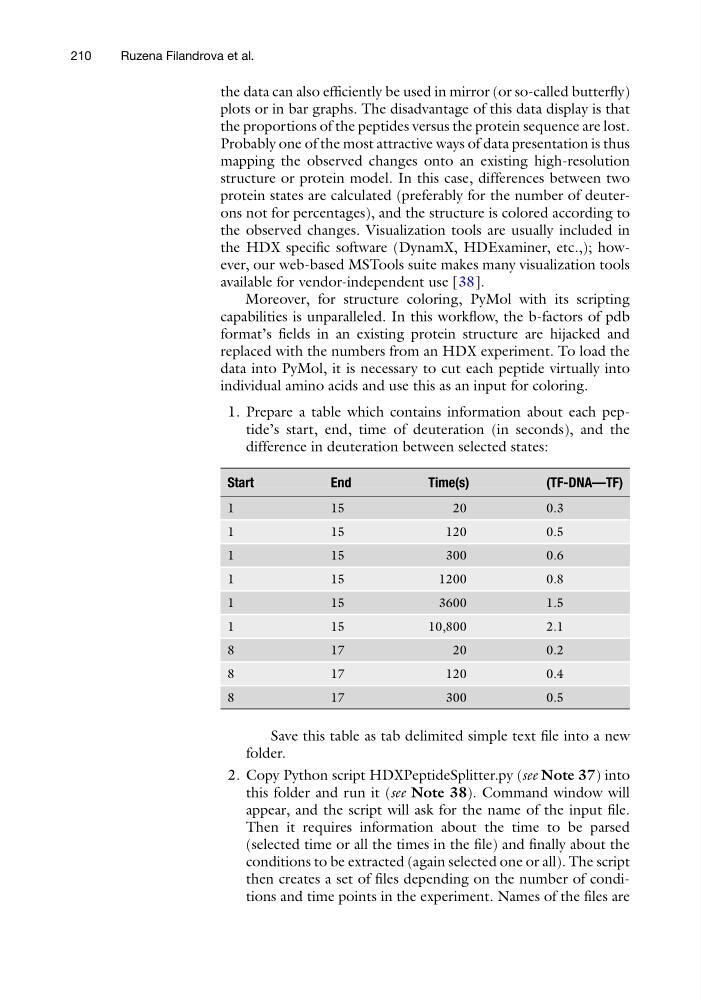
1. Prepare a table which contains information about each peptide’s start, end, time of deuteration (in seconds), and the
difference in deuteration between selected states:
Start
End
Time(s)
(TF-DNA—TF)
1
15
20
0.3
1
15
120
0.5
1
15
300
0.6
1
15
1200
0.8
1
15
3600
1.5
1
15
10,800
2.1
8
17
20
0.2
8
17
120
0.4
8
17
300
0.5
Save this table as tab delimited simple text file into a new
folder.
2. Copy Python script HDXPeptideSplitter.py (see Note 37) into
this folder and run it (see Note 38). Command window will
appear, and the script will ask for the name of the input file.
Then it requires information about the time to be parsed
(selected time or all the times in the file) and finally about the
conditions to be extracted (again selected one or all). The script
then creates a set of files depending on the number of conditions and time points in the experiment. Names of the files are
210
Ruzena Filandrova et al.
plots or in bar graphs. The disadvantage of this data display is that
the proportions of the peptides versus the protein sequence are lost.
Probably one of the most attractive ways of data presentation is thus
mapping the observed changes onto an existing high-resolution
structure or protein model. In this case, differences between two
protein states are calculated (preferably for the number of deuterons not for percentages), and the structure is colored according to
the observed changes. Visualization tools are usually included in
the HDX specific software (DynamX, HDExaminer, etc.,); however, our web-based MSTools suite makes many visualization tools
available for vendor-independent use [38].
Moreover, for structure coloring, PyMol with its scripting
capabilities is unparalleled. In this workflow, the b-factors of pdb
format’s fields in an existing protein structure are hijacked and
replaced with the numbers from an HDX experiment. To load the
data into PyMol, it is necessary to cut each peptide virtually into
individual amino acids and use this as an input for coloring.
1. Prepare a table which contains information about each peptide’s start, end, time of deuteration (in seconds), and the
difference in deuteration between selected states:
Start
End
Time(s)
(TF-DNA—TF)
1
15
20
0.3
1
15
120
0.5
1
15
300
0.6
1
15
1200
0.8
1
15
3600
1.5
1
15
10,800
2.1
8
17
20
0.2
8
17
120
0.4
8
17
300
0.5
Save this table as tab delimited simple text file into a new
folder.
2. Copy Python script HDXPeptideSplitter.py (see Note 37) into
this folder and run it (see Note 38). Command window will
appear, and the script will ask for the name of the input file.
Then it requires information about the time to be parsed
(selected time or all the times in the file) and finally about the
conditions to be extracted (again selected one or all). The script
then creates a set of files depending on the number of conditions and time points in the experiment. Names of the files are
210
Ruzena Filandrova et al.