

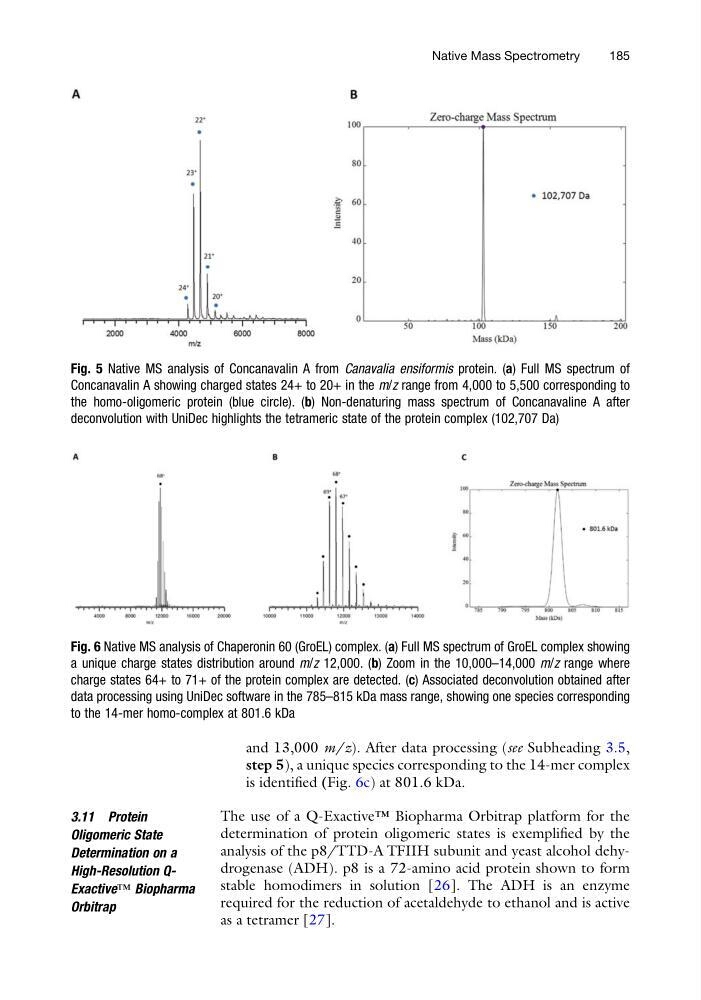
and 13,000 m/z). After data processing (see Subheading 3.5,
step 5), a unique species corresponding to the 14-mer complex
is identified (Fig. 6c) at 801.6 kDa.
3.11 Protein
Oligomeric State
Determination on a
High-Resolution QExactive™ Biopharma
Orbitrap
The use of a Q-Exactive™ Biopharma Orbitrap platform for the
determination of protein oligomeric states is exemplified by the
analysis of the p8/TTD-A TFIIH subunit and yeast alcohol dehydrogenase (ADH). p8 is a 72-amino acid protein shown to form
stable homodimers in solution [26]. The ADH is an enzyme
required for the reduction of acetaldehyde to ethanol and is active
as a tetramer [27].
Fig. 5 Native MS analysis of Concanavalin A from Canavalia ensiformis protein. (a) Full MS spectrum of
Concanavalin A showing charged states 24+ to 20+ in the m/z range from 4,000 to 5,500 corresponding to
the homo-oligomeric protein (blue circle). (b) Non-denaturing mass spectrum of Concanavaline A after
deconvolution with UniDec highlights the tetrameric state of the protein complex (102,707 Da)
Fig. 6 Native MS analysis of Chaperonin 60 (GroEL) complex. (a) Full MS spectrum of GroEL complex showing
a unique charge states distribution around m/z 12,000. (b) Zoom in the 10,000–14,000 m/z range where
charge states 64+ to 71+ of the protein complex are detected. (c) Associated deconvolution obtained after
data processing using UniDec software in the 785–815 kDa mass range, showing one species corresponding
to the 14-mer homo-complex at 801.6 kDa
Native Mass Spectrometry
185
step 5), a unique species corresponding to the 14-mer complex
is identified (Fig. 6c) at 801.6 kDa.
3.11 Protein
Oligomeric State
Determination on a
High-Resolution QExactive™ Biopharma
Orbitrap
The use of a Q-Exactive™ Biopharma Orbitrap platform for the
determination of protein oligomeric states is exemplified by the
analysis of the p8/TTD-A TFIIH subunit and yeast alcohol dehydrogenase (ADH). p8 is a 72-amino acid protein shown to form
stable homodimers in solution [26]. The ADH is an enzyme
required for the reduction of acetaldehyde to ethanol and is active
as a tetramer [27].
Fig. 5 Native MS analysis of Concanavalin A from Canavalia ensiformis protein. (a) Full MS spectrum of
Concanavalin A showing charged states 24+ to 20+ in the m/z range from 4,000 to 5,500 corresponding to
the homo-oligomeric protein (blue circle). (b) Non-denaturing mass spectrum of Concanavaline A after
deconvolution with UniDec highlights the tetrameric state of the protein complex (102,707 Da)
Fig. 6 Native MS analysis of Chaperonin 60 (GroEL) complex. (a) Full MS spectrum of GroEL complex showing
a unique charge states distribution around m/z 12,000. (b) Zoom in the 10,000–14,000 m/z range where
charge states 64+ to 71+ of the protein complex are detected. (c) Associated deconvolution obtained after
data processing using UniDec software in the 785–815 kDa mass range, showing one species corresponding
to the 14-mer homo-complex at 801.6 kDa
Native Mass Spectrometry
185