

3.6 Native MS
Analysis of the CDKActivating Kinase
Complex on a Q-TOF
Synapt G2
The use of a Q-TOF Synapt G2 platform is illustrated by the
characterization of the CDK-activating kinase complex (CAK), a
sub-complex of the transcription/DNA repair factor TFIIH
[21, 22]. CAK is composed of a cyclin-dependent kinase (Cdk7),
its associated cyclin (Cyclin H), and a third polypeptide known as
MAT1, which stabilizes the Cdk7/cyclin H pair and bridges the
kinase module of TFIIH to the core-complex composed of seven
additional subunits. Recombinant CAK was produced in insect cells
using the baculovirus expression system as described [23].
1. Desalt 20 μL of recombinant CAK at 20 μM in 200 mM
ammonium acetate supplemented with 0.02% n-dodecyl β-Dmaltoside (see Note 10), as explained in Subheading 3.1.
2. Connect the TriVersa NanomateTM as explained in Subheading 3.3.
3. In MassLynx MS Tune window manually set the following
parameters:
Operate the instrument in positive and sensitivity modes
with an m/z range from 1,000 to 10,000 (see Note 11).
Nanoflow+ panel: Sampling Cone: 175 V (see Note 12).
Extraction cone: 5 V. Source Temperature: 90
C.
Instrument: Increase the backing pressure up to 6 mbar (see
Note 6). Trap Collision Energy is turned on (75 V) and
Transfer Collision Energy is turned off (2 V by default) (see
Note 13). Trap gas flow (argon) is set to 4.5 mL/min.
Save these parameters as an .ipr file.
4. Press “acquire” to start a 2-min TOF-MS acquisition in the
1,000–10,000 m/z range.
5. Analyze data.
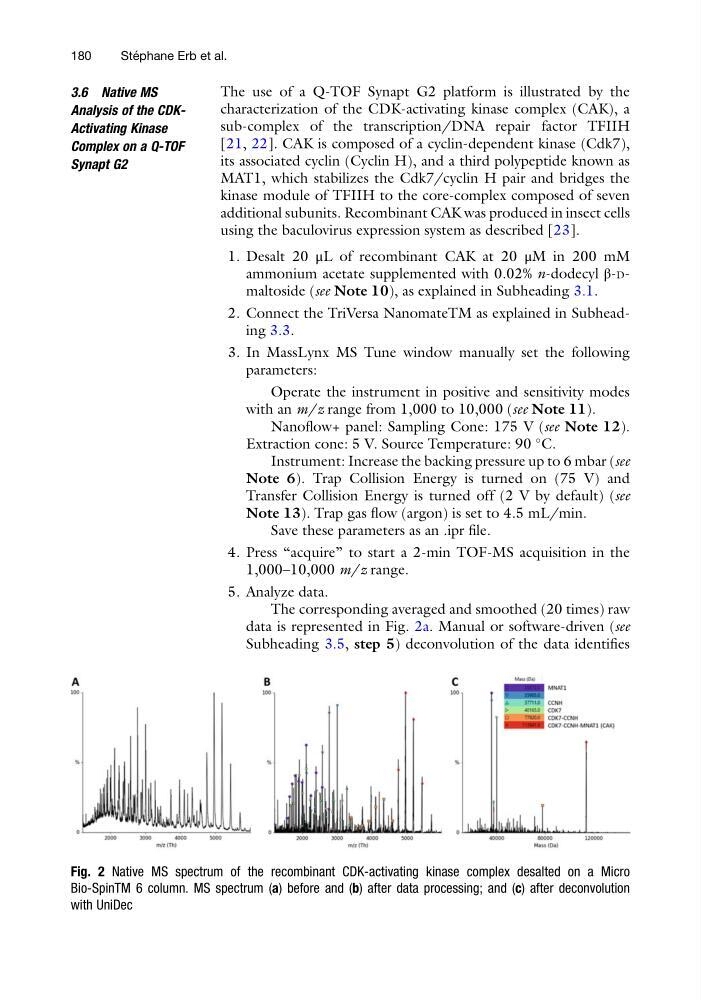
The corresponding averaged and smoothed (20 times) raw
data is represented in Fig. 2a. Manual or software-driven (see
Subheading 3.5, step 5) deconvolution of the data identifies
Fig. 2 Native MS spectrum of the recombinant CDK-activating kinase complex desalted on a Micro
Bio-SpinTM 6 column. MS spectrum (a) before and (b) after data processing; and (c) after deconvolution
with UniDec
180
Ste ´ phane Erb et al.
Analysis of the CDKActivating Kinase
Complex on a Q-TOF
Synapt G2
The use of a Q-TOF Synapt G2 platform is illustrated by the
characterization of the CDK-activating kinase complex (CAK), a
sub-complex of the transcription/DNA repair factor TFIIH
[21, 22]. CAK is composed of a cyclin-dependent kinase (Cdk7),
its associated cyclin (Cyclin H), and a third polypeptide known as
MAT1, which stabilizes the Cdk7/cyclin H pair and bridges the
kinase module of TFIIH to the core-complex composed of seven
additional subunits. Recombinant CAK was produced in insect cells
using the baculovirus expression system as described [23].
1. Desalt 20 μL of recombinant CAK at 20 μM in 200 mM
ammonium acetate supplemented with 0.02% n-dodecyl β-Dmaltoside (see Note 10), as explained in Subheading 3.1.
2. Connect the TriVersa NanomateTM as explained in Subheading 3.3.
3. In MassLynx MS Tune window manually set the following
parameters:
Operate the instrument in positive and sensitivity modes
with an m/z range from 1,000 to 10,000 (see Note 11).
Nanoflow+ panel: Sampling Cone: 175 V (see Note 12).
Extraction cone: 5 V. Source Temperature: 90
C.
Instrument: Increase the backing pressure up to 6 mbar (see
Note 6). Trap Collision Energy is turned on (75 V) and
Transfer Collision Energy is turned off (2 V by default) (see
Note 13). Trap gas flow (argon) is set to 4.5 mL/min.
Save these parameters as an .ipr file.
4. Press “acquire” to start a 2-min TOF-MS acquisition in the
1,000–10,000 m/z range.
5. Analyze data.
The corresponding averaged and smoothed (20 times) raw
data is represented in Fig. 2a. Manual or software-driven (see
Subheading 3.5, step 5) deconvolution of the data identifies
Fig. 2 Native MS spectrum of the recombinant CDK-activating kinase complex desalted on a Micro
Bio-SpinTM 6 column. MS spectrum (a) before and (b) after data processing; and (c) after deconvolution
with UniDec
180
Ste ´ phane Erb et al.