

be easily quantified by integration of the peaks. After size
exclusion chromatography, the sample is homogeneous, with
only one species in solution at 4.3 S, corresponding to the
globular compact monomer. Note that to ascertain the fact
that this peak corresponds to a non-interacting species, we
should have measured the samples at different concentrations.
Here we obtain this conclusion because the main species in the
heterogeneous samples have the same s-value.
2. The non-interacting species analysis: in SEDFIT, choose the
non-interacting discrete species model. In the parameter window, enter estimate values for the total concentration, the
molar mass, and s-value of the species and mark the
corresponding check boxes. Press the run command then the
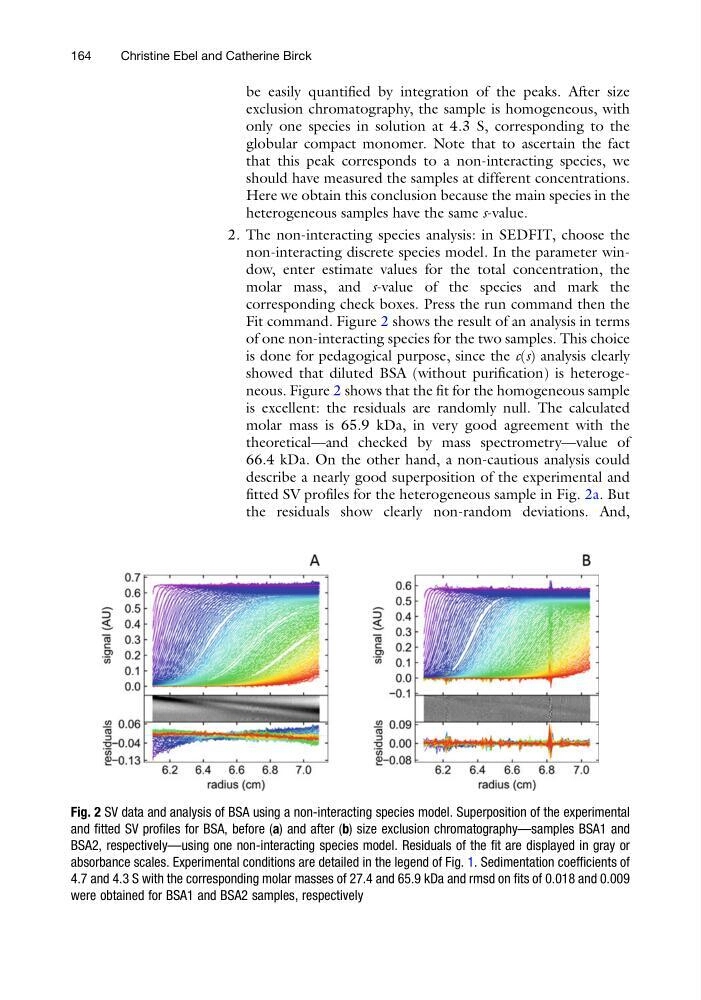
Fit command. Figure 2 shows the result of an analysis in terms
of one non-interacting species for the two samples. This choice
is done for pedagogical purpose, since the c(s) analysis clearly
showed that diluted BSA (without purification) is heterogeneous. Figure 2 shows that the fit for the homogeneous sample
is excellent: the residuals are randomly null. The calculated
molar mass is 65.9 kDa, in very good agreement with the
theoretical—and checked by mass spectrometry—value of
66.4 kDa. On the other hand, a non-cautious analysis could
describe a nearly good superposition of the experimental and
fitted SV profiles for the heterogeneous sample in Fig. 2a. But
the residuals show clearly non-random deviations. And,
Fig. 2 SV data and analysis of BSA using a non-interacting species model. Superposition of the experimental
and fitted SV profiles for BSA, before (a) and after (b) size exclusion chromatography—samples BSA1 and
BSA2, respectively—using one non-interacting species model. Residuals of the fit are displayed in gray or
absorbance scales. Experimental conditions are detailed in the legend of Fig. 1. Sedimentation coefficients of
4.7 and 4.3 S with the corresponding molar masses of 27.4 and 65.9 kDa and rmsd on fits of 0.018 and 0.009
were obtained for BSA1 and BSA2 samples, respectively
164
Christine Ebel and Catherine Birck
exclusion chromatography, the sample is homogeneous, with
only one species in solution at 4.3 S, corresponding to the
globular compact monomer. Note that to ascertain the fact
that this peak corresponds to a non-interacting species, we
should have measured the samples at different concentrations.
Here we obtain this conclusion because the main species in the
heterogeneous samples have the same s-value.
2. The non-interacting species analysis: in SEDFIT, choose the
non-interacting discrete species model. In the parameter window, enter estimate values for the total concentration, the
molar mass, and s-value of the species and mark the
corresponding check boxes. Press the run command then the
Fit command. Figure 2 shows the result of an analysis in terms
of one non-interacting species for the two samples. This choice
is done for pedagogical purpose, since the c(s) analysis clearly
showed that diluted BSA (without purification) is heterogeneous. Figure 2 shows that the fit for the homogeneous sample
is excellent: the residuals are randomly null. The calculated
molar mass is 65.9 kDa, in very good agreement with the
theoretical—and checked by mass spectrometry—value of
66.4 kDa. On the other hand, a non-cautious analysis could
describe a nearly good superposition of the experimental and
fitted SV profiles for the heterogeneous sample in Fig. 2a. But
the residuals show clearly non-random deviations. And,
Fig. 2 SV data and analysis of BSA using a non-interacting species model. Superposition of the experimental
and fitted SV profiles for BSA, before (a) and after (b) size exclusion chromatography—samples BSA1 and
BSA2, respectively—using one non-interacting species model. Residuals of the fit are displayed in gray or
absorbance scales. Experimental conditions are detailed in the legend of Fig. 1. Sedimentation coefficients of
4.7 and 4.3 S with the corresponding molar masses of 27.4 and 65.9 kDa and rmsd on fits of 0.018 and 0.009
were obtained for BSA1 and BSA2 samples, respectively
164
Christine Ebel and Catherine Birck