

1.1 Sedimentation
Velocity Equations
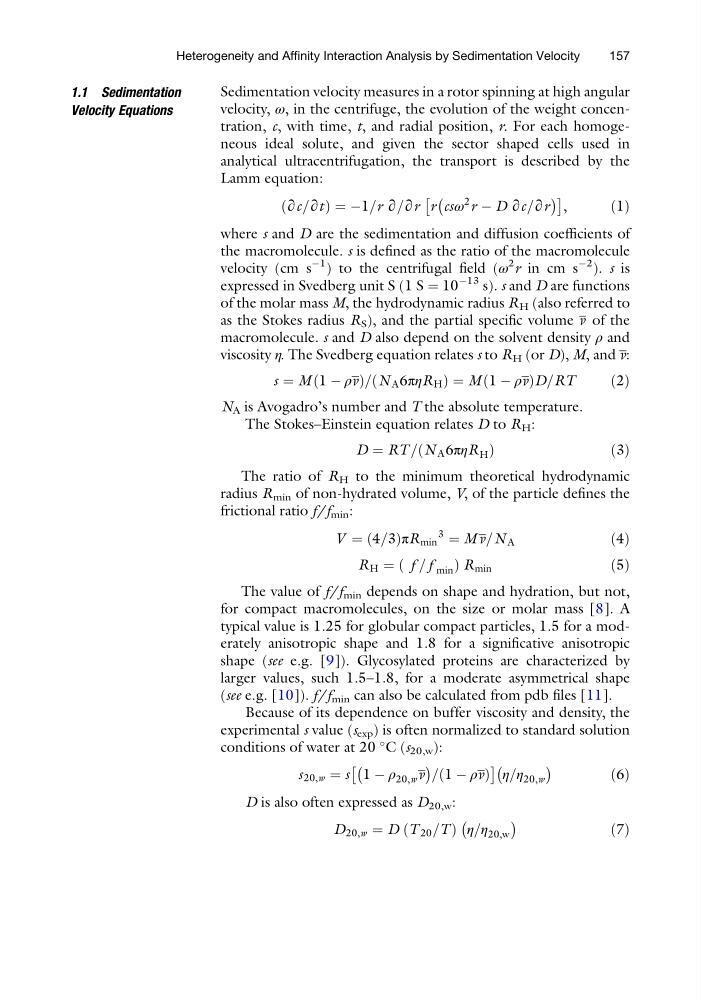
Sedimentation velocity measures in a rotor spinning at high angular
velocity, ω, in the centrifuge, the evolution of the weight concentration, c, with time, t, and radial position, r. For each homogeneous ideal solute, and given the sector shaped cells used in
analytical ultracentrifugation, the transport is described by the
Lamm equation:
∂c=∂t
ð
Þ¼À1=r ∂=∂r r csω
2
r À D ∂c=∂r
À
Á
Â
Ã
,
ð1Þ
where s and D are the sedimentation and diffusion coefficients of
the macromolecule. s is defined as the ratio of the macromolecule
velocity (cm s
À1 ) to the centrifugal field (ω
2
r in cm s
À2 ). s is
expressed in Svedberg unit S (1 S ¼ 10
À13 s). s and D are functions
of the molar mass M, the hydrodynamic radius R H (also referred to
as the Stokes radius R S ), and the partial specific volume v of the
macromolecule. s and D also depend on the solvent density ρ and
viscosity η. The Svedberg equation relates s to R H (or D), M, and v:
s ¼ M 1 À ρv
ð
Þ= N A 6πηR H
ð
Þ¼M 1 À ρv
ð
ÞD=RT
ð2Þ
N A is Avogadro’s number and T the absolute temperature.
The Stokes–Einstein equation relates D to R H :
D ¼ RT = N A 6πηR H
ð
Þ
ð 3Þ
The ratio of R H to the minimum theoretical hydrodynamic
radius R min of non-hydrated volume, V, of the particle defines the
frictional ratio f/f min :
V ¼ 4=3
ð
ÞπR min
3
¼ M v=N A
ð4Þ
R H ¼ f = f min
ð
ÞR min
ð5Þ
The value of f/f min depends on shape and hydration, but not,
for compact macromolecules, on the size or molar mass [8]. A
typical value is 1.25 for globular compact particles, 1.5 for a moderately anisotropic shape and 1.8 for a significative anisotropic
shape (see e.g. [9]). Glycosylated proteins are characterized by
larger values, such 1.5–1.8, for a moderate asymmetrical shape
(see e.g. [10]). f/f min can also be calculated from pdb files [11].
Because of its dependence on buffer viscosity and density, the
experimental s value (s exp ) is often normalized to standard solution
conditions of water at 20
C (s 20,w ):
s 20,w ¼ s 1 À ρ 20,w v
À
Á = 1 À ρv
ð
Þ
Â
à η=η 20,w
À
Á
ð6Þ
D is also often expressed as D 20,w :
D 20,w ¼ D T 20 =T
ð
Þ η=η 20,w
À
Á
ð7Þ
Heterogeneity and Affinity Interaction Analysis by Sedimentation Velocity
157
Velocity Equations
Sedimentation velocity measures in a rotor spinning at high angular
velocity, ω, in the centrifuge, the evolution of the weight concentration, c, with time, t, and radial position, r. For each homogeneous ideal solute, and given the sector shaped cells used in
analytical ultracentrifugation, the transport is described by the
Lamm equation:
∂c=∂t
ð
Þ¼À1=r ∂=∂r r csω
2
r À D ∂c=∂r
À
Á
Â
Ã
,
ð1Þ
where s and D are the sedimentation and diffusion coefficients of
the macromolecule. s is defined as the ratio of the macromolecule
velocity (cm s
À1 ) to the centrifugal field (ω
2
r in cm s
À2 ). s is
expressed in Svedberg unit S (1 S ¼ 10
À13 s). s and D are functions
of the molar mass M, the hydrodynamic radius R H (also referred to
as the Stokes radius R S ), and the partial specific volume v of the
macromolecule. s and D also depend on the solvent density ρ and
viscosity η. The Svedberg equation relates s to R H (or D), M, and v:
s ¼ M 1 À ρv
ð
Þ= N A 6πηR H
ð
Þ¼M 1 À ρv
ð
ÞD=RT
ð2Þ
N A is Avogadro’s number and T the absolute temperature.
The Stokes–Einstein equation relates D to R H :
D ¼ RT = N A 6πηR H
ð
Þ
ð 3Þ
The ratio of R H to the minimum theoretical hydrodynamic
radius R min of non-hydrated volume, V, of the particle defines the
frictional ratio f/f min :
V ¼ 4=3
ð
ÞπR min
3
¼ M v=N A
ð4Þ
R H ¼ f = f min
ð
ÞR min
ð5Þ
The value of f/f min depends on shape and hydration, but not,
for compact macromolecules, on the size or molar mass [8]. A
typical value is 1.25 for globular compact particles, 1.5 for a moderately anisotropic shape and 1.8 for a significative anisotropic
shape (see e.g. [9]). Glycosylated proteins are characterized by
larger values, such 1.5–1.8, for a moderate asymmetrical shape
(see e.g. [10]). f/f min can also be calculated from pdb files [11].
Because of its dependence on buffer viscosity and density, the
experimental s value (s exp ) is often normalized to standard solution
conditions of water at 20
C (s 20,w ):
s 20,w ¼ s 1 À ρ 20,w v
À
Á = 1 À ρv
ð
Þ
Â
à η=η 20,w
À
Á
ð6Þ
D is also often expressed as D 20,w :
D 20,w ¼ D T 20 =T
ð
Þ η=η 20,w
À
Á
ð7Þ
Heterogeneity and Affinity Interaction Analysis by Sedimentation Velocity
157