

3 Pulse Oximetry for the Measurement of Oxygen Saturation …
67
Time t
Time t
t1
t 1
t 2
t 2
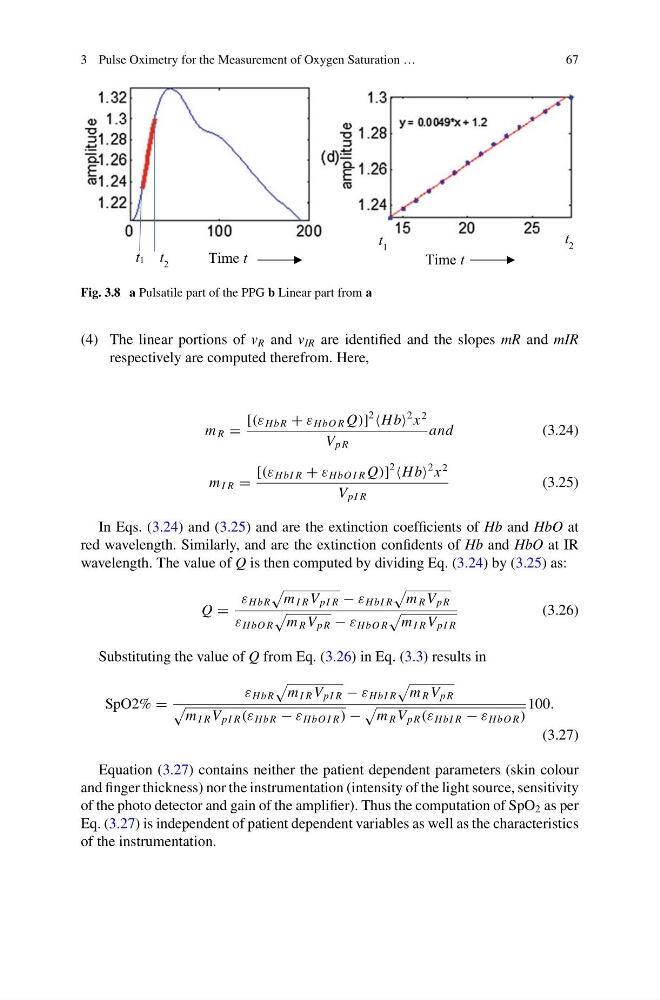
Fig. 3.8 a Pulsatile part of the PPG b Linear part from a
(4) The linear portions of v R and v IR are identified and the slopes mR and mIR
respectively are computed therefrom. Here,
m R =
[(ε HbR + ε HbO R Q)]
2
Hb
2 x
2
V pR
and
(3.24)
m I R =
[(ε HbI R + ε HbO I R Q)]
2
Hb
2 x
2
V pI R
(3.25)
In Eqs. (3.24) and (3.25) and are the extinction coefficients of Hb and HbO at
red wavelength. Similarly, and are the extinction confidents of Hb and HbO at IR
wavelength. The value of Q is then computed by dividing Eq. (3.24) by (3.25) as:
Q =
ε HbR
m I R V pI R − ε HbI R
m R V pR
ε HbO R
m R V pR − ε HbO R
m I R V pI R
(3.26)
Substituting the value of Q from Eq. (3.26) in Eq. (3.3) results in
SpO2% =
ε HbR
m I R V pI R − ε HbI R
m R V pR
m I R V pI R (ε HbR − ε HbO I R ) −
m R V pR (ε HbI R − ε HbO R )
100.
(3.27)
Equation (3.27) contains neither the patient dependent parameters (skin colour
and finger thickness) nor the instrumentation (intensity of the light source, sensitivity
of the photo detector and gain of the amplifier). Thus the computation of SpO 2 as per
Eq. (3.27) is independent of patient dependent variables as well as the characteristics
of the instrumentation.
67
Time t
Time t
t1
t 1
t 2
t 2
Fig. 3.8 a Pulsatile part of the PPG b Linear part from a
(4) The linear portions of v R and v IR are identified and the slopes mR and mIR
respectively are computed therefrom. Here,
m R =
[(ε HbR + ε HbO R Q)]
2
Hb
2 x
2
V pR
and
(3.24)
m I R =
[(ε HbI R + ε HbO I R Q)]
2
Hb
2 x
2
V pI R
(3.25)
In Eqs. (3.24) and (3.25) and are the extinction coefficients of Hb and HbO at
red wavelength. Similarly, and are the extinction confidents of Hb and HbO at IR
wavelength. The value of Q is then computed by dividing Eq. (3.24) by (3.25) as:
Q =
ε HbR
m I R V pI R − ε HbI R
m R V pR
ε HbO R
m R V pR − ε HbO R
m I R V pI R
(3.26)
Substituting the value of Q from Eq. (3.26) in Eq. (3.3) results in
SpO2% =
ε HbR
m I R V pI R − ε HbI R
m R V pR
m I R V pI R (ε HbR − ε HbO I R ) −
m R V pR (ε HbI R − ε HbO R )
100.
(3.27)
Equation (3.27) contains neither the patient dependent parameters (skin colour
and finger thickness) nor the instrumentation (intensity of the light source, sensitivity
of the photo detector and gain of the amplifier). Thus the computation of SpO 2 as per
Eq. (3.27) is independent of patient dependent variables as well as the characteristics
of the instrumentation.