

48
M. Mukunda Rao
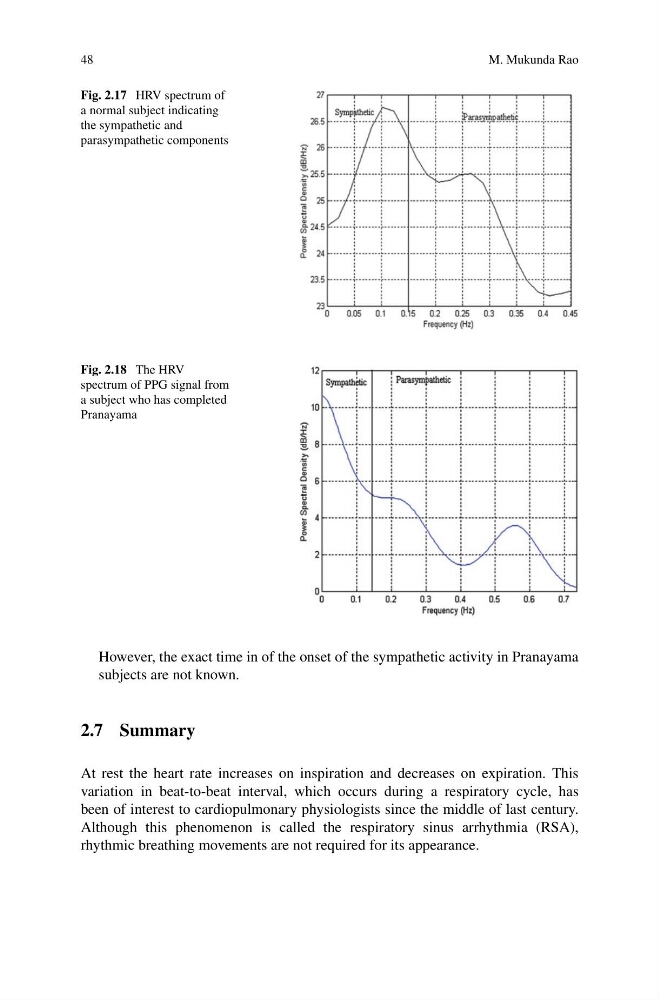
Fig. 2.17 HRV spectrum of
a normal subject indicating
the sympathetic and
parasympathetic components
Fig. 2.18 The HRV
spectrum of PPG signal from
a subject who has completed
Pranayama
However, the exact time in of the onset of the sympathetic activity in Pranayama
subjects are not known.
2.7 Summary
At rest the heart rate increases on inspiration and decreases on expiration. This
variation in beat-to-beat interval, which occurs during a respiratory cycle, has
been of interest to cardiopulmonary physiologists since the middle of last century.
Although this phenomenon is called the respiratory sinus arrhythmia (RSA),
rhythmic breathing movements are not required for its appearance.
M. Mukunda Rao
Fig. 2.17 HRV spectrum of
a normal subject indicating
the sympathetic and
parasympathetic components
Fig. 2.18 The HRV
spectrum of PPG signal from
a subject who has completed
Pranayama
However, the exact time in of the onset of the sympathetic activity in Pranayama
subjects are not known.
2.7 Summary
At rest the heart rate increases on inspiration and decreases on expiration. This
variation in beat-to-beat interval, which occurs during a respiratory cycle, has
been of interest to cardiopulmonary physiologists since the middle of last century.
Although this phenomenon is called the respiratory sinus arrhythmia (RSA),
rhythmic breathing movements are not required for its appearance.